A life in context
The person behind the prize
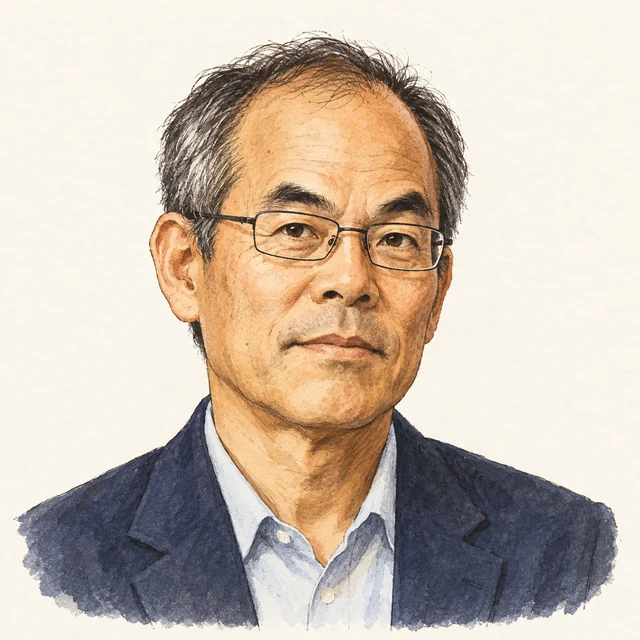
Nakamura studied electrical engineering at the University of Tokushima and joined Nichia, a company in the same region. There he pursued gallium nitride for blue-light devices, developing equipment and processing methods suited to a difficult material. He received his doctorate in 1994 and later moved to the University of California, Santa Barbara. His award-winning work illustrates how industrial experimentation and basic materials research can reinforce each other.
The contribution
Working independently of Akasaki and Amano’s group, he developed crystal-growth methods and heat treatment that made p-type gallium nitride practical. Further work on gallium-nitride-based alloys and device structures produced bright, efficient blue LEDs. Blue emission then became a crucial ingredient in white LED lighting.
The idea in plain language
An LED converts electrical energy into light inside a semiconductor. Electrons and positively charged vacancies, called holes, meet in an active region; some of their energy is released as photons. The material determines the photon energies and therefore the colour. Red and green LEDs existed long before efficient blue ones. Blue photons require a larger energy gap, and the suitable materials were much harder to turn into reliable devices.
Read the full award story ↗