A life in context
The person behind the prize
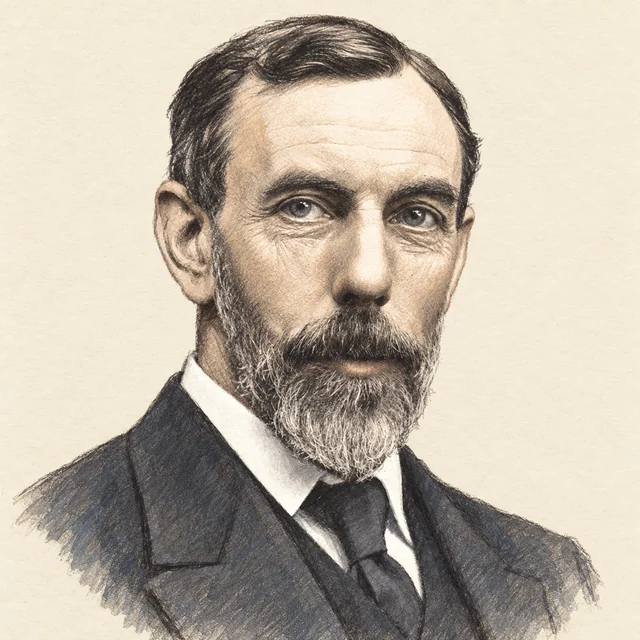
William Ramsay grew up and studied in Glasgow before continuing his chemical education in Germany. He completed a doctorate at Tübingen in 1872 under Rudolf Fittig, initially working on organic compounds. Returning to Scotland, he held laboratory and teaching posts before becoming professor of chemistry at Bristol in 1880. In 1887 he moved to University College London. His experimental interests included the properties of liquids and the accurate comparison of substances. Lord Rayleigh’s puzzling difference between the densities of nitrogen from air and nitrogen from chemical compounds opened a new direction. Ramsay’s chemical investigations complemented Rayleigh’s physical measurements; together they identified argon in 1894. A familiar mixture, air, still contained an unrecognised element. In 1895 Ramsay identified helium in terrestrial material. Helium had already been observed in the solar spectrum in 1868, so this was not its first detection anywhere. Further work suggested a family of unusually unreactive gases. In 1898 Ramsay and Morris W. Travers discovered krypton, neon and xenon, filling out a new group in the periodic system. Travers’s contribution should remain visible alongside that of the laboratory’s more famous leader. Ramsay was knighted in 1902, and in 1903 collaborated with Frederick Soddy on helium produced from radioactive material. He received the full 1904 Chemistry Prize for discovering inert gaseous elements in air and establishing their place in the periodic system. Rayleigh received a separate Physics Prize that year. The historical word inert describes their strikingly low reactivity under many ordinary conditions; it does not mean no noble-gas compound can ever exist. Later chemistry revised that absolute interpretation. Ramsay died at High Wycombe in 1916. His work enlarged the periodic table and showed how measurement, chemical separation, spectroscopy and collaborative laboratory skills could expose a whole family hidden in apparently familiar matter.
The contribution
Ramsay received the full Chemistry Prize for discoveries of noble gases in air and their place in the periodic system. Argon research with Rayleigh and later discoveries with Travers revealed a new family of elements.
The idea in plain language
Argon emerged from the mismatch between nitrogen samples investigated by Rayleigh and Ramsay. Its low chemical reactivity made it difficult to fit into familiar patterns based on combining capacity. Ramsay’s identification of terrestrial helium in 1895 connected a gas on Earth with an element already observed in the solar spectrum.
Read the full award story ↗

