01 · The discovery
The idea, in everyday language
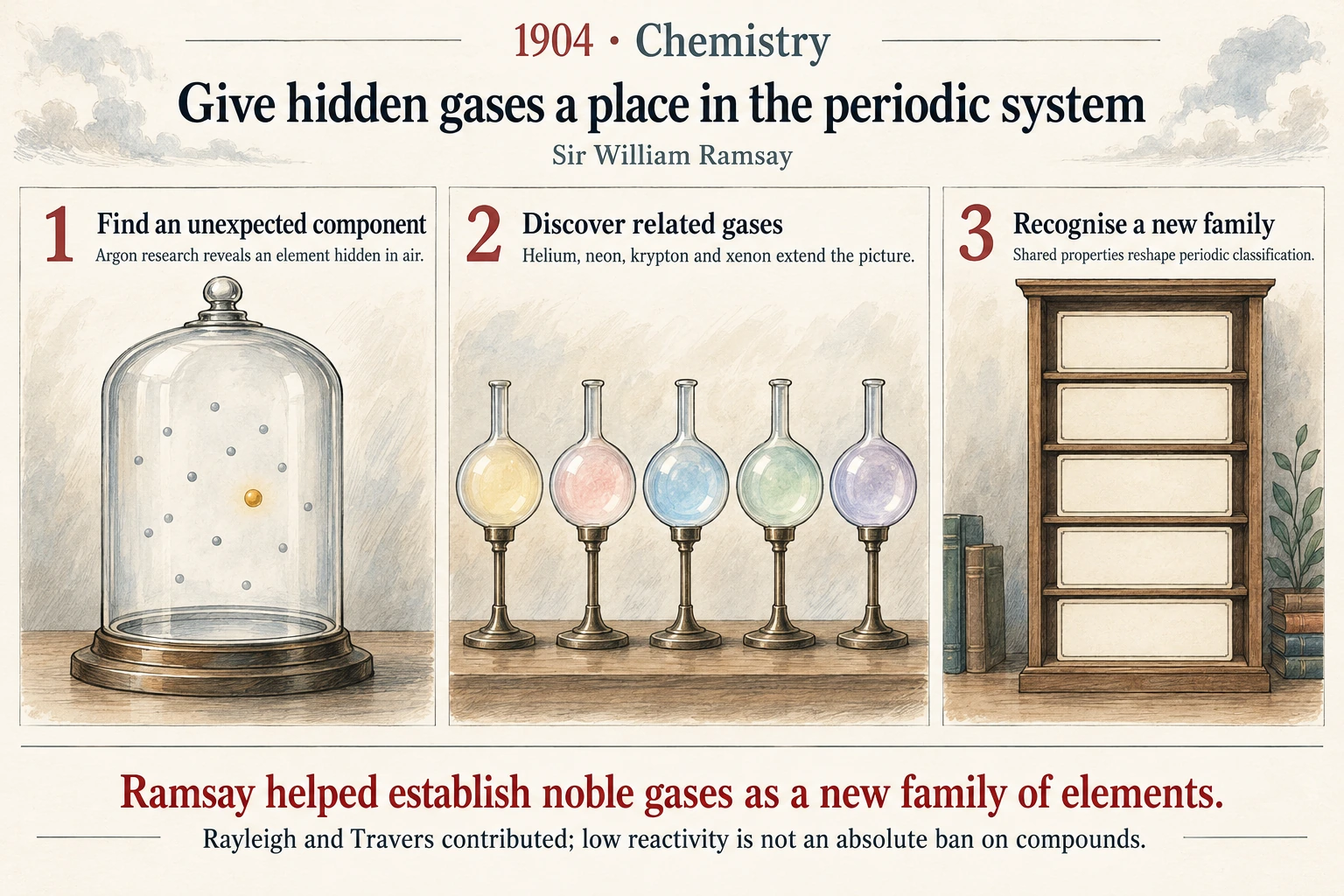
Argon emerged from the mismatch between nitrogen samples investigated by Rayleigh and Ramsay. Its low chemical reactivity made it difficult to fit into familiar patterns based on combining capacity. Ramsay’s identification of terrestrial helium in 1895 connected a gas on Earth with an element already observed in the solar spectrum.
The possibility of a new family guided further investigation. In 1898 Ramsay and Morris Travers found krypton, neon and xenon. Comparing physical properties and characteristic spectra helped distinguish the gases. The contribution was both discovery and classification: the periodic system had to accommodate a group whose behaviour differed from the more reactive elements around it.
Why it matters
The discoveries expanded the known elements and sharpened the periodic organisation of matter. Low reactivity also made noble gases useful in settings where unwanted chemical reactions needed to be limited; those uses developed through further work.