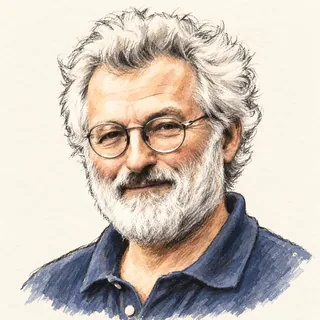
A life in context
The person behind the prize
Brenner studied medicine and science at the University of the Witwatersrand, then pursued doctoral research at Oxford. His career in Cambridge included major work in molecular genetics. He wanted an animal simple enough to study in detail, yet complex enough to have a nervous system and developing organs. That search led to the transparent roundworm Caenorhabditis elegans, which became a shared experimental system for researchers around the world.
The contribution
Brenner established methods for breeding C. elegans, inducing mutations and connecting genetic changes with observable traits. His 1974 work helped turn the worm into a tractable model for studying how genes influence development and behaviour. Because its cells could be followed under a microscope, genetic experiments could be linked with detailed observations of cell division, specialisation and death. This platform enabled Sulston’s lineage studies and Horvitz’s analysis of cell-death genes.
The idea in plain language
Building an animal involves more than making new cells. Cells divide, become specialised and, in some cases, are deliberately eliminated through a regulated biological process. Brenner established the small roundworm C. elegans as a model in which researchers could alter genes and observe the consequences. Its transparency made individual cells visible under a microscope.
Read the full award story ↗