A life in context
The person behind the prize
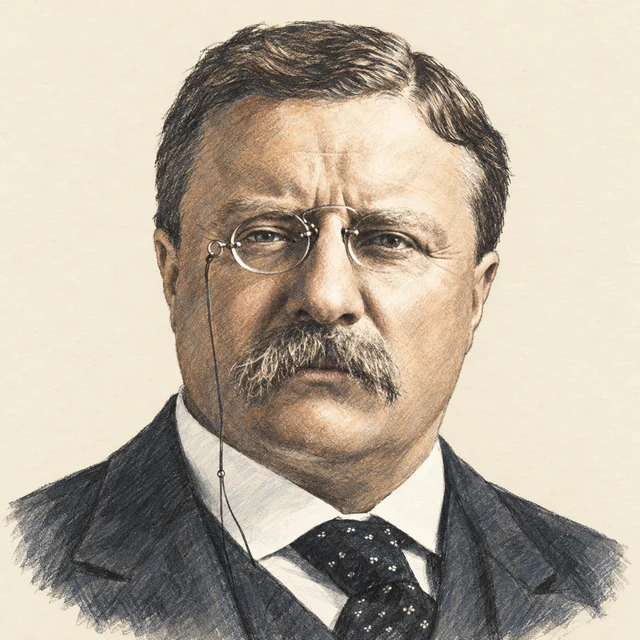
Theodore Roosevelt was born in New York City and entered Harvard in 1876. He combined interests in natural history and writing with an energetic political career, first in the New York State Assembly. After the deaths of his mother and first wife in 1884 he spent periods ranching in the Dakota Territory. He married Edith Kermit Carow in 1886. Public appointments included the Civil Service Commission, the New York police and the Navy Department. During the 1898 war with Spain he served with the Rough Riders in Cuba and returned to become governor of New York. Elected vice president in 1900, he succeeded William McKinley as president on 14 September 1901 after McKinley’s assassination. He won election in his own right in 1904 and remained president until 1909. In foreign affairs he favoured an active, powerful United States. That background matters when considering his peace work: mediation did not mean opposition to military power or imperial expansion in general. In 1905 Roosevelt helped bring Russia and Japan to negotiations that ended their war. The Treaty of Portsmouth was signed on 5 September by the countries’ own representatives: Sergei Witte and Roman Rosen for Russia, Komura Jutarō and Takahira Kogorō for Japan. Roosevelt encouraged compromise, including over indemnities and Sakhalin, while pursuing American strategic and economic interests. The settlement ended a destructive conflict but also recognised Japanese predominance in Korea and rearranged imperial interests in Manchuria. The full 1906 Peace Prize honoured his mediation; Herbert H. D. Peirce accepted in his absence. Roosevelt later travelled to Norway in 1910. He returned to electoral politics as the Progressive Party’s presidential candidate in 1912 and publicly supported American preparedness and participation in the First World War. He died at Oyster Bay in 1919. His prize offers a concrete example of successful crisis mediation within a wider career whose uses of military power and imperial assumptions remain contested.
The contribution
Roosevelt received the full Peace Prize for mediating an end to the Russo-Japanese War. His support for the Portsmouth negotiations complemented the work of Russian and Japanese representatives.
The idea in plain language
By 1905 the Russo-Japanese War had imposed heavy costs on both sides. Roosevelt encouraged negotiations and worked to bridge demands that threatened agreement. Compromise over questions including indemnities and Sakhalin helped make a settlement possible.
Read the full award story ↗

