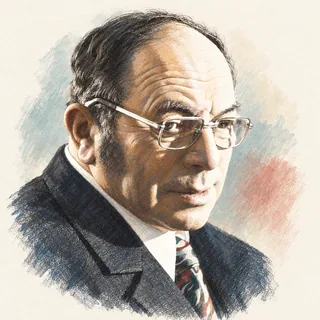
A life in context
The person behind the prize
Koopmans began with mathematics at Utrecht, moved into theoretical physics with Hans Kramers and then turned to mathematical economics under Jan Tinbergen. His doctorate was awarded by Leiden in 1936. After work in Rotterdam and Geneva, he moved to the United States in 1940. Wartime shipping work led to a 1942 analysis of routing and shadow costs measured in ship-days. He later cautioned that he did not know whether the ideas were systematically used. Joining the Cowles Commission in 1944, he worked on econometrics and developed activity analysis through discussions with George Dantzig and Albert Tucker. He moved with colleagues to Yale in 1955 and studied efficient allocation over time, including growth and later energy questions. His intellectual route joined mathematical precision with practical economic concerns.
The contribution
Koopmans developed activity analysis, linking production possibilities, efficient allocation and supporting valuations. He received half the Economic Sciences memorial prize for resource-allocation theory.
The idea in plain language
An allocation problem starts with a specified objective and a set of possible activities. Each activity uses inputs and produces outputs; limited resources restrict which combinations are feasible. Kantorovich’s work, prompted by a plywood-production problem, gave mathematical form to such decisions. Linear programming can compare feasible combinations systematically rather than relying on a vague instruction to use resources well. The mathematical optimum is relative to the model’s objective and assumptions.
Read the full award story ↗