01 · The discovery
The idea, in everyday language
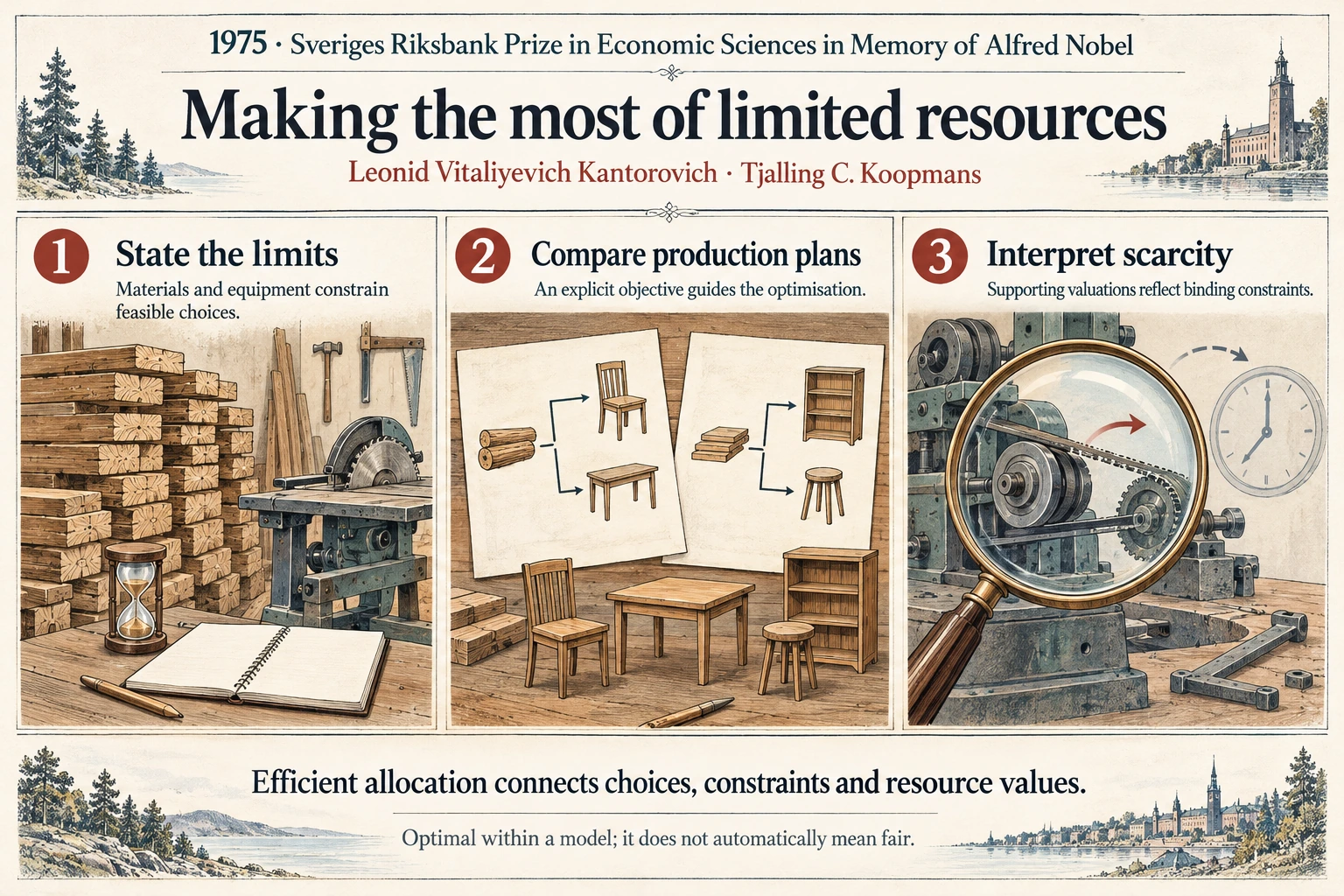
An allocation problem starts with a specified objective and a set of possible activities. Each activity uses inputs and produces outputs; limited resources restrict which combinations are feasible. Kantorovich’s work, prompted by a plywood-production problem, gave mathematical form to such decisions. Linear programming can compare feasible combinations systematically rather than relying on a vague instruction to use resources well. The mathematical optimum is relative to the model’s objective and assumptions.
Koopmans developed activity analysis and connected efficient production with supporting calculation prices. Shadow valuations describe how relaxing a binding resource constraint would affect the model’s objective near the optimum. They are not automatically the prices observed in a market, nor a measure of every social value. Independent developments by Dantzig and other researchers strengthened the field. The laureates worked in different economic settings, and each received one half of the full Sveriges Riksbank Prize in Economic Sciences in Memory of Alfred Nobel.
Why it matters
The theory gave researchers and planners tools for comparing production possibilities, transport choices and allocation over time. It connected mathematical optimisation with an economic interpretation of scarcity. Its uses extend across institutional settings, while actual decisions still require evidence and judgement.