01 · The discovery
The idea, in everyday language
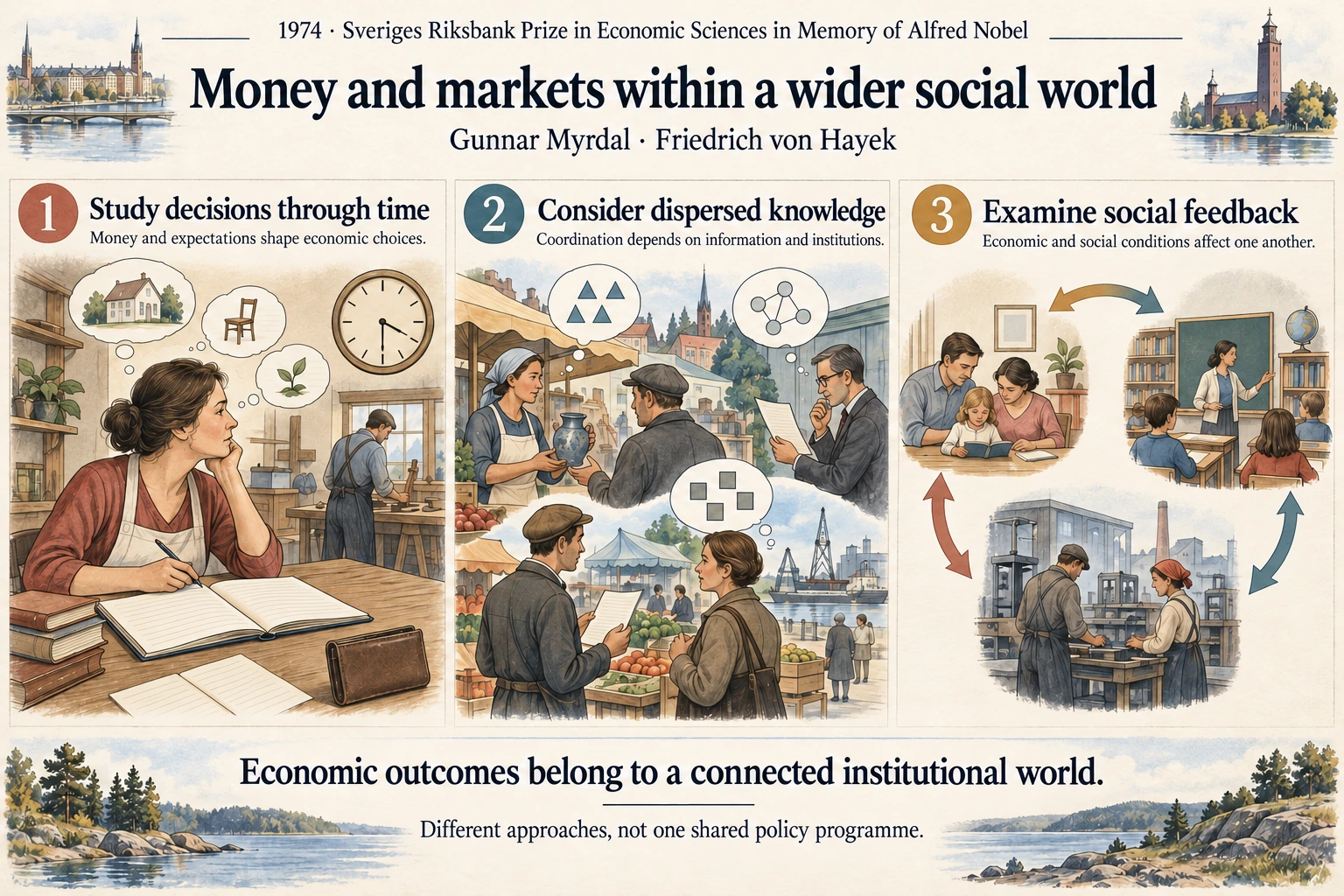
Both economists contributed to accounts of money and economic fluctuations. Myrdal examined expectations and the relationship between plans and outcomes; Hayek studied how money, credit, capital and production interact over time. Their approaches asked how decisions in one part of an economy affect choices elsewhere. Later, Hayek emphasised that useful knowledge is dispersed among people and that prices can help coordinate decisions under particular institutional arrangements.
Myrdal broadened his analysis to the mutual influence of economic outcomes, social conditions and institutions. Education, health, political power and discrimination could shape opportunities, while income and opportunity could in turn affect those conditions. His studies of racial inequality and development therefore could not treat the economy as an isolated mechanism. Hayek’s work on knowledge and social order approached institutional questions from a different direction. The common recognition concerned monetary research and interdependence, not a joint theory proving one political position correct.
Why it matters
The work encouraged economists to examine expectations, coordination and social institutions alongside money and fluctuations. It connected economic questions with other social sciences and exposed limits of analyses that assume all relevant knowledge or conditions are already given.