A life in context
The person behind the prize
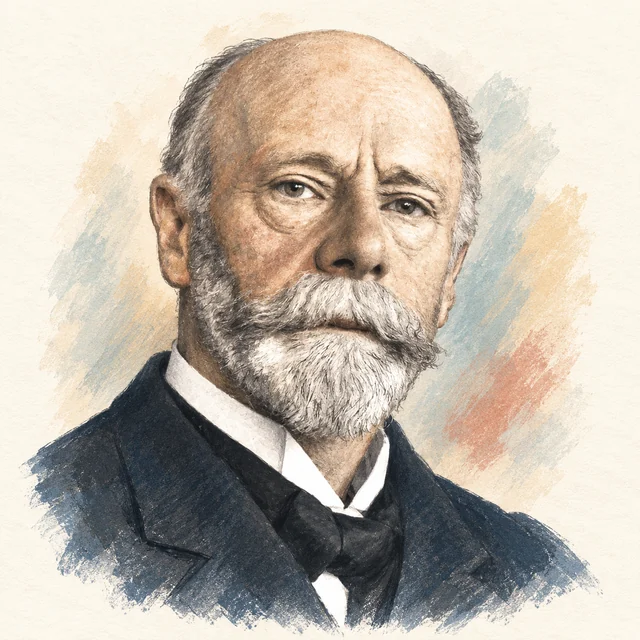
Einthoven was born in Semarang on Java. After his father’s death, his family moved to the Netherlands in 1870. He began medical studies at Utrecht in 1878 and completed a doctorate on stereoscopic vision in 1885. Appointed to the physiology chair at Leiden that year, he took up the post in 1886 and spent the rest of his career there. His interests included vision, breathing and the measurement of small physiological signals. Earlier investigators had already recorded electrical changes accompanying the heartbeat, but their instruments struggled to follow rapid variations faithfully. Einthoven first studied corrections for capillary-electrometer records, then developed the string galvanometer, described in 1903. A very light conducting string in a magnetic field made small, rapid electrical changes easier to register optically. He also developed ways to interpret recordings and compare them under standard conditions. His full 1924 Medicine Prize recognised the mechanism of the electrocardiogram. This concerned electrical activity measured at the body surface, rather than a picture or sound recording of the heart. He died in Leiden in 1927.
The contribution
Einthoven received the full Medicine Prize for discovering the mechanism of the electrocardiogram. His sensitive string galvanometer and physiological interpretation helped turn electrical traces into a dependable way to study the heart’s activity.
The idea in plain language
The heartbeat is accompanied by electrical changes that can be measured at the body surface. Earlier researchers had recorded them, but slow or distorted instrument responses made the traces hard to interpret. Einthoven studied these limitations and developed a more responsive instrument.
Read the full award story ↗