A life in context
The person behind the prize
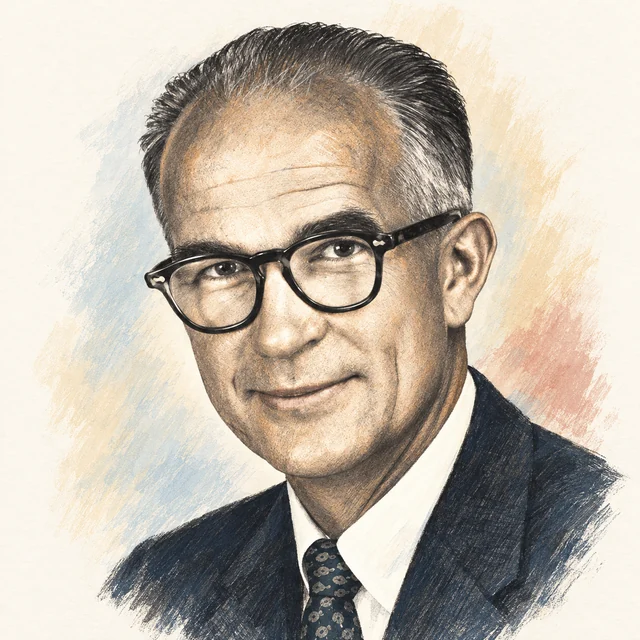
Shockley was born in London and grew up in California after his family returned to the United States in 1913. He earned a Caltech bachelor’s degree in 1932 and completed an MIT doctorate under John Slater in 1936, studying the energy-band structure of sodium chloride. He joined Bell Laboratories that year. Research on solids and wartime operational research preceded the postwar semiconductor programme he led. Bardeen and Brattain produced the point-contact transistor in 1947; Shockley developed the junction approach and further semiconductor theory. At the 1956 award he directed the Semiconductor Laboratory of Beckman Instruments in Mountain View, rather than remaining at Bell Labs. Each of the three recipients received one third for semiconductor research and the transistor effect. His Stanford professorship began in 1963. His later promotion of racist eugenic claims was criticised by geneticists as pseudoscience; it is separate from the semiconductor achievement recognised by this prize.
The contribution
Shockley led semiconductor research and developed the junction-transistor approach and its theoretical foundations. He received one third of the Physics Prize.
The idea in plain language
Telephones and radios needed amplification, but vacuum-tube amplifiers required heated filaments and relatively bulky components. Semiconductor materials offered another possibility, yet understanding and controlling their surfaces and charge carriers presented difficult experimental and theoretical problems.
Read the full award story ↗