A life in context
The person behind the prize
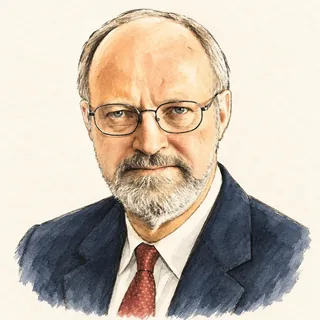
Chauvin was a French chemist born in Belgium who carried out his research at the Institut Français du Pétrole. His work connected industrial reactions with questions about their molecular mechanisms. Olefin metathesis had already been observed and used before its workings were understood; explaining what the catalyst actually did could make the search for better catalysts less dependent on trial and error.
The contribution
Chauvin and his student Jean-Louis Hérisson proposed a mechanism published in 1971: a metal–carbon double bond reacts with an alkene to form a temporary four-membered ring, which can break apart in a new arrangement. This exchange regenerates a reactive metal-containing partner that can continue the cycle. The explanation guided the development of well-defined catalysts by Schrock, Grubbs and others.
The idea in plain language
Building an organic molecule often means finding an efficient way to connect its carbon framework. In olefin metathesis, groups on carbon–carbon double bonds exchange partners. The reaction can join fragments, close rings or help form polymers, depending on the starting molecules. The atoms are rearranged rather than created or destroyed.
Read the full award story ↗