c.curionodeThe Nobel Archive

2005 · Chemistry

Rearranging carbon partners

Metathesis uses metal catalysts to exchange parts of molecules across carbon–carbon double bonds.

metathesiscatalysisorganic synthesiscarbon bonds
2005Chemistry

Visual guide

The prize, pictured

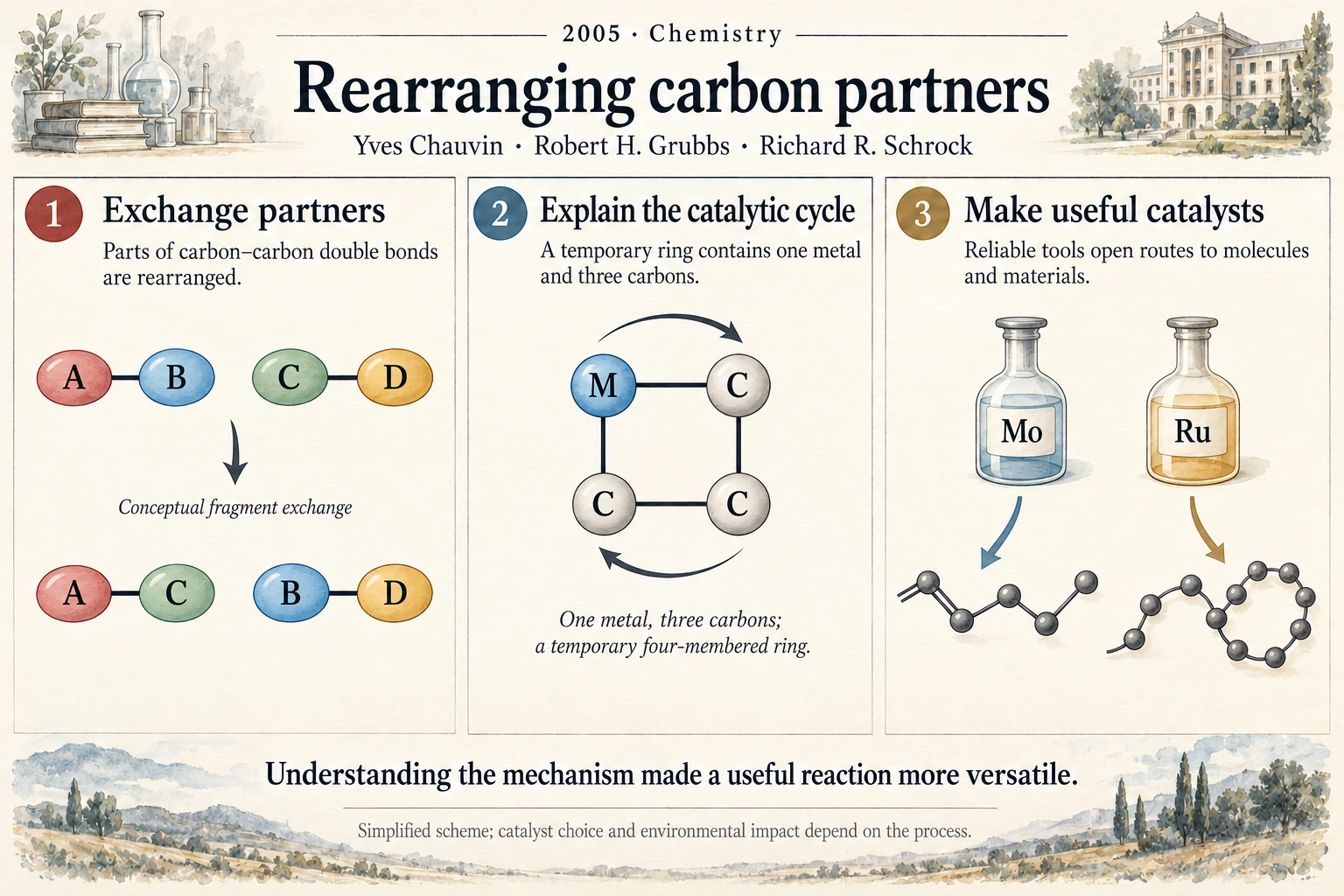
Infographic explaining Rearranging carbon partners
Original AI-generated infographic. A conceptual overview; the explanations and sources below provide context.
Read the poster text

Understanding the mechanism made a useful reaction more versatile.

  1. Exchange partners

    Parts of carbon–carbon double bonds are rearranged.

  2. Explain the catalytic cycle

    A temporary ring contains one metal and three carbons.

  3. Make useful catalysts

    Reliable tools open routes to molecules and materials.

Simplified scheme; catalyst choice and environmental impact depend on the process.

01 · The discovery

The idea, in everyday language

Building an organic molecule often means finding an efficient way to connect its carbon framework. In olefin metathesis, groups on carbon–carbon double bonds exchange partners. The reaction can join fragments, close rings or help form polymers, depending on the starting molecules. The atoms are rearranged rather than created or destroyed.

Chauvin and Hérisson explained a cycle in which a metal–carbon double bond and an alkene form a temporary ring containing one metal and three carbon atoms. Breaking that ring in the other direction gives a new alkene and a new metal partner. Schrock developed highly active, well-defined molybdenum catalysts; Grubbs developed ruthenium catalysts with useful stability and tolerance of other chemical groups.

Why it matters

Reliable catalysts made metathesis a widely useful tool for making complex molecules and materials. In suitable syntheses it can replace several steps and reduce waste. The important advance joined a mechanistic explanation with catalysts that chemists could understand, choose and improve, opening routes that had been difficult with older methods.
02 · The people

Who brought the idea to life?

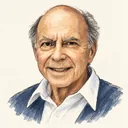
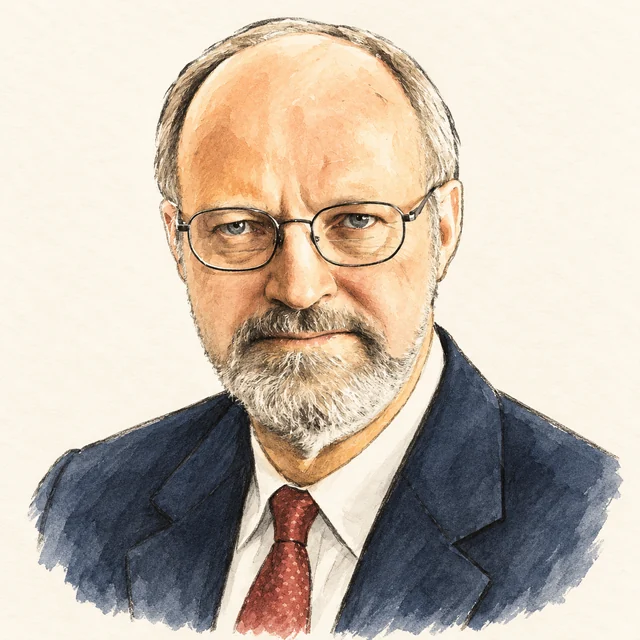
Illustrated portrait of Yves Chauvin

Yves Chauvin

Prize share · 1/3

Chauvin and his student Jean-Louis Hérisson proposed a mechanism published in 1971: a metal–carbon double bond reacts with an alkene to form a temporary four-membered ring, which can break apart in a new arrangement. This exchange regenerates a reactive metal-containing partner that can continue the cycle. The explanation guided the development of well-defined catalysts by Schrock, Grubbs and others.

Read the biography ↗
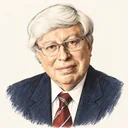
Illustrated portrait of Robert H. Grubbs

Robert H. Grubbs

Prize share · 1/3

In 1992 Grubbs and coworkers reported a ruthenium-based metathesis catalyst with useful stability and tolerance of other functional groups. Later versions broadened its value in synthesis, including ring formation and polymer chemistry. These catalysts complemented the highly reactive molybdenum systems developed by Schrock; robustness and reactivity are different properties, so neither family is best for every reaction.

Read the biography ↗
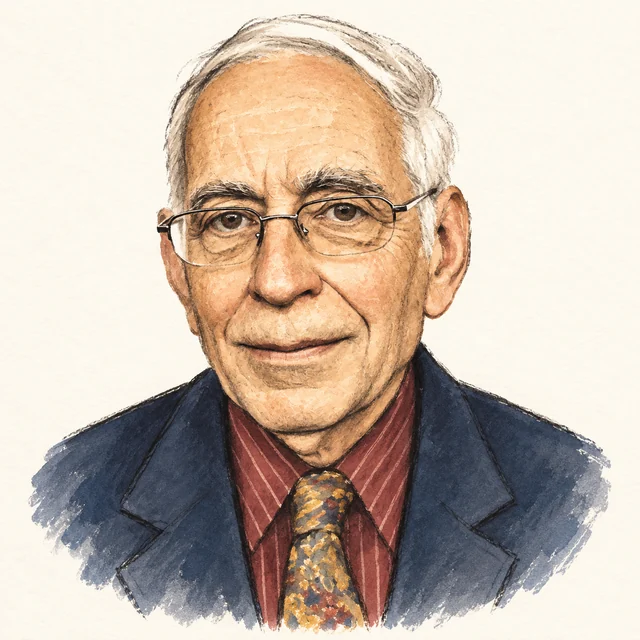
Illustrated portrait of Richard R. Schrock

Richard R. Schrock

Prize share · 1/3

Schrock developed well-defined metal alkylidene compounds and in 1990 reported highly active molybdenum catalysts for olefin metathesis with his colleagues. Their known structures made it possible to understand and adjust their behaviour. These powerful catalysts require appropriate handling because they can be sensitive to oxygen and moisture; their value comes from controlled chemistry, not universal resistance to every environment.

Read the biography ↗

03 · Years in the making

The path here

  1. 1971

    Hérisson and Chauvin published the mechanism involving a metal-containing four-membered ring.

  2. 1990

    Schrock’s group reported highly active, well-defined molybdenum catalysts.

  3. 1992

    Grubbs’s group reported a useful ruthenium catalyst, followed by further improvements.

04 · Read further

From the original sources

Original explanations by Curionode, based on the official records below. Biographical details and affiliations refer to the award year.

  1. Official announcement nobelprize.org
  2. Popular science background nobelprize.org
  3. Original metathesis mechanism: publication record onlinelibrary.wiley.com

More in Chemistry

Browse this subject ↗