c.curionodeThe Nobel Archive

2007 · Chemistry

Watching chemistry at a solid surface

Ertl made it possible to reconstruct surface reactions one carefully tested step at a time.

surface chemistrycatalysisreaction mechanisms
2007Chemistry

Visual guide

The prize, pictured

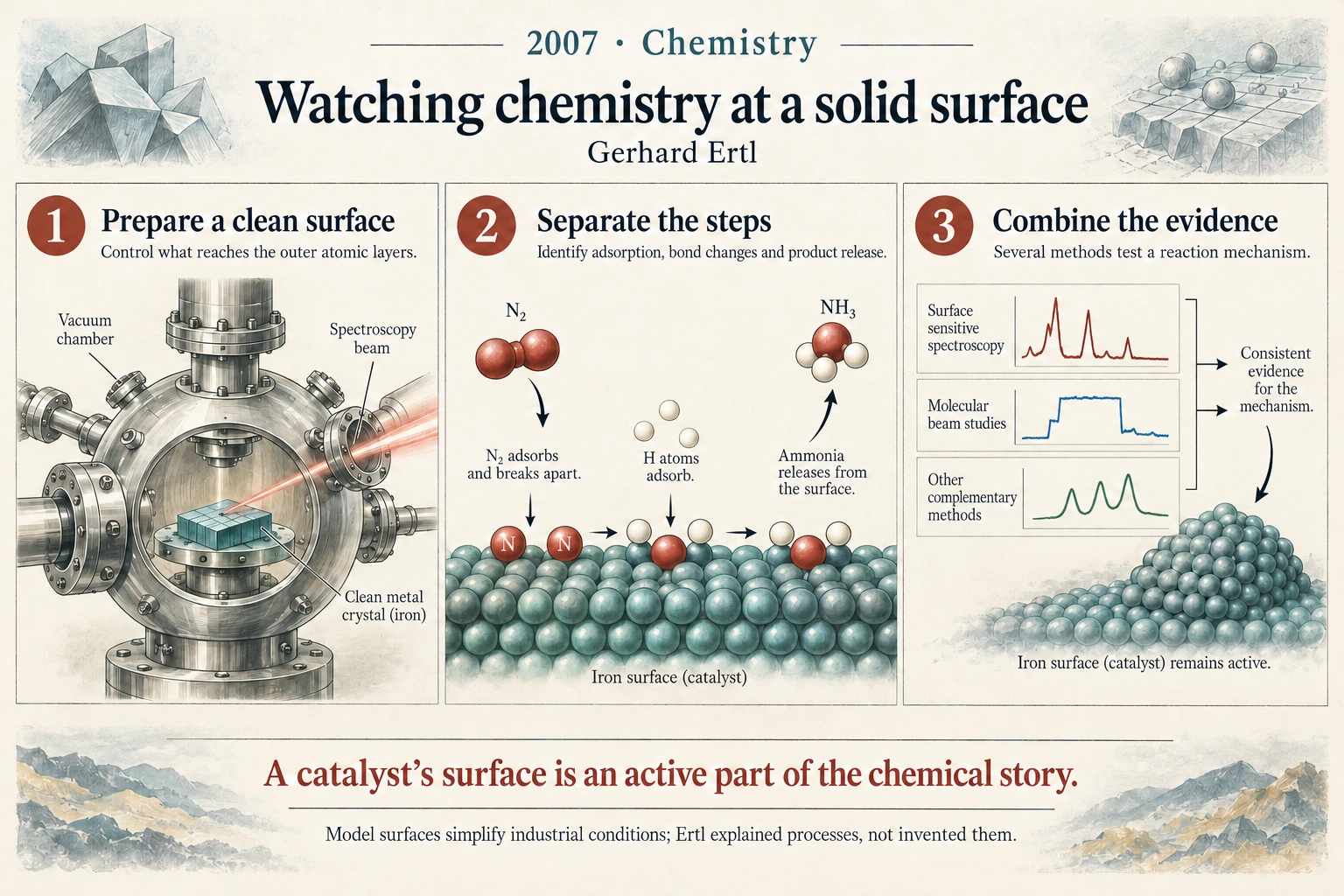
Infographic explaining Watching chemistry at a solid surface
Original AI-generated infographic. A conceptual overview; the explanations and sources below provide context.
Read the poster text

A catalyst’s surface is an active part of the chemical story.

  1. Prepare a clean surface

    Control what reaches the outer atomic layers.

  2. Separate the steps

    Identify adsorption, bond changes and product release.

  3. Combine the evidence

    Several methods test a reaction mechanism.

Model surfaces simplify industrial conditions; Ertl explained processes, not invented them.

01 · The discovery

The idea, in everyday language

A solid catalyst can help reacting molecules meet, attach, split and rearrange before the products leave. The important action may occupy only the outermost atomic layers, making it hard to distinguish a genuine reaction intermediate from contamination. Ertl combined very clean surfaces, controlled exposure to gases, spectroscopy and other measurements to establish what was present and how the reaction proceeded.

One major example was ammonia formation on iron. Nitrogen molecules must split into atoms, which then combine with hydrogen through intermediate stages before ammonia leaves the surface. By studying the reaction in both directions and comparing complementary measurements, Ertl mapped steps that would be difficult to isolate in a working industrial reactor. His studies of carbon monoxide oxidation on platinum also revealed patterns and oscillations on a reacting surface.

Why it matters

The contribution was both detailed knowledge of important reactions and a reliable experimental method that other researchers could use. Understanding adsorption, bond breaking, intermediates and product release helps connect atomic-scale behaviour with catalyst design. Surface chemistry matters in fertiliser production, exhaust treatment and many other technologies.

02 · The people

Who brought the idea to life?

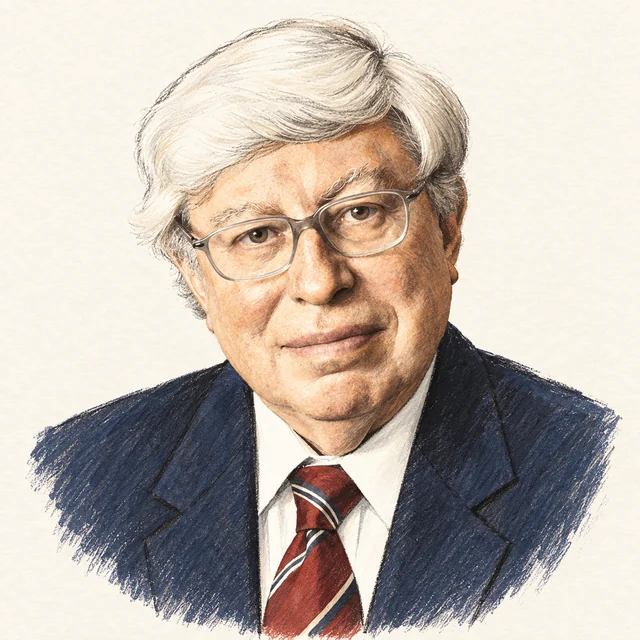
Illustrated portrait of Gerhard Ertl

Gerhard Ertl

Prize share · 1/1

Ertl established methods for working out the individual steps of reactions on solid surfaces. His studies explained how nitrogen and hydrogen form ammonia on iron, and explored carbon monoxide oxidation on platinum, including complicated changes in reaction patterns over time. He did not invent the Haber–Bosch process; he helped reveal how its catalytic surface works at the atomic scale.

Read the biography ↗

03 · Years in the making

The path here

  1. 1960s

    New vacuum and surface-measurement techniques enabled precise model experiments.

  2. 1970s

    Ertl investigated the steps of ammonia synthesis on iron surfaces.

  3. 2007

    The Chemistry prize recognised his studies of chemical processes on solid surfaces.

04 · Read further

From the original sources

Original explanations by Curionode, based on the official records below. Biographical details and affiliations refer to the award year.

  1. Official announcement nobelprize.org
  2. Popular science background nobelprize.org

More in Chemistry

Browse this subject ↗