01 · The discovery
The idea, in everyday language
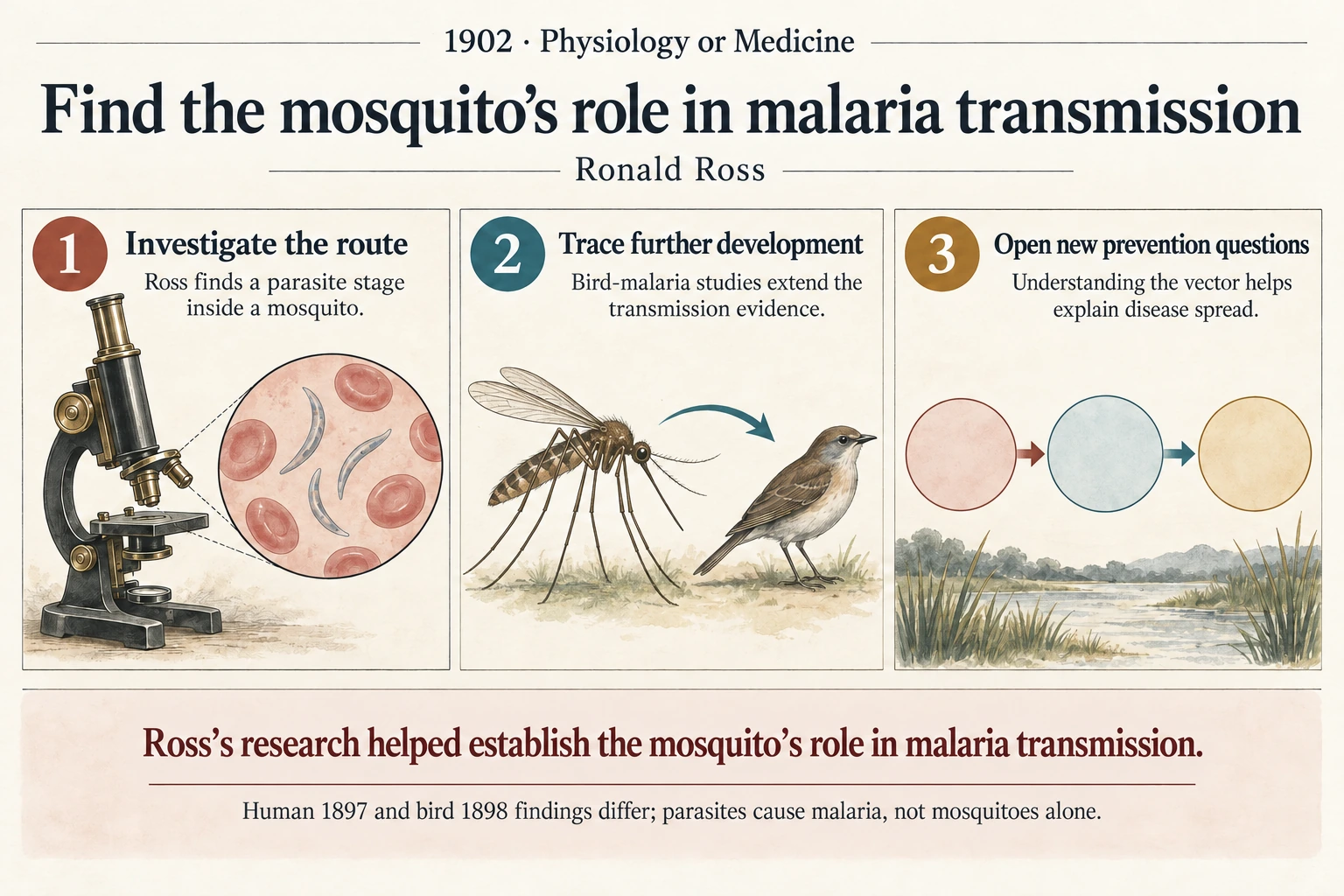
Following Manson’s encouragement, Ross investigated the mosquito hypothesis. In 1897 he observed a stage of the human malaria parasite in a mosquito’s stomach wall. That finding linked the infected host with development in the insect, beyond an association between mosquitoes and fever.
In 1898 he pursued bird malaria and traced further development through the mosquito, showing how later transmission could occur. Grassi, Bignami and Bastianelli established further details for human malaria. The 1902 award recognised Ross’s foundational work within this wider sequence of contributions, including assistants and patients in a colonial medical setting.
Why it matters
Understanding the vector’s role opened practical questions about prevention and helped make transmission a subject of experimental study and mathematical modelling. Ross’s later epidemiological work examined how changing conditions could affect the spread of disease.