c.curionodeThe Nobel Archive

1906 · Physiology or Medicine

Reveal nerve cells and ask how they connect

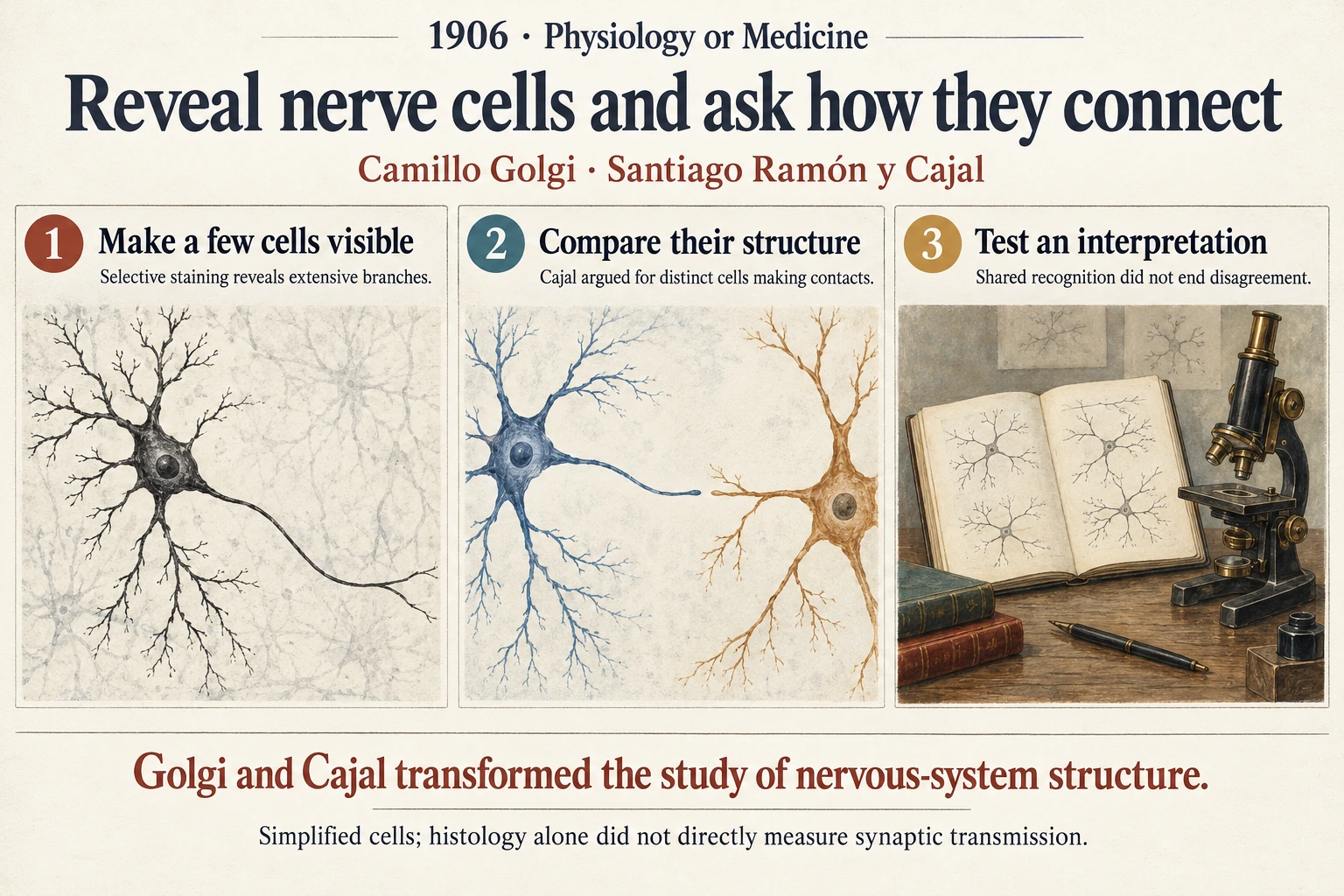
Dense nervous tissue was difficult to untangle. Golgi’s selective staining and Cajal’s systematic observations made individual cells and their branching organisation visible, while the two scientists disagreed over what the network meant.

Nerve-cell stainingNeuron doctrineNeuroanatomy
1906Physiology or Medicine

Visual guide

The prize, pictured

Infographic explaining Reveal nerve cells and ask how they connect
Original AI-generated infographic. A conceptual overview; the explanations and sources below provide context.
Read the poster text

Golgi and Cajal transformed the study of nervous-system structure.

  1. Make a few cells visible

    Selective staining reveals extensive branches.

  2. Compare their structure

    Cajal argued for distinct cells making contacts.

  3. Test an interpretation

    Shared recognition did not end disagreement.

Simplified cells; histology alone did not directly measure synaptic transmission.

01 · The discovery

The idea, in everyday language

Golgi’s black reaction stains a small selection of nerve cells darkly, exposing cell bodies and long, fine processes against a relatively clear background. Instead of colouring everything, selective visibility lets an observer follow the shape of a few cells through complicated tissue.

Cajal adapted the method and examined many preparations, including developing nervous tissue. He argued for distinct nerve cells that communicate through contacts. Golgi favoured a continuous reticular interpretation. The equal 1906 prize shares recognised work on nervous-system structure despite this theoretical disagreement.

Why it matters

The work established a powerful visual foundation for neuroscience. Cell shape, branching patterns and organised contacts became questions that could be compared across regions and species, helping researchers connect microscopic anatomy with function.
02 · The people

Who brought the idea to life?

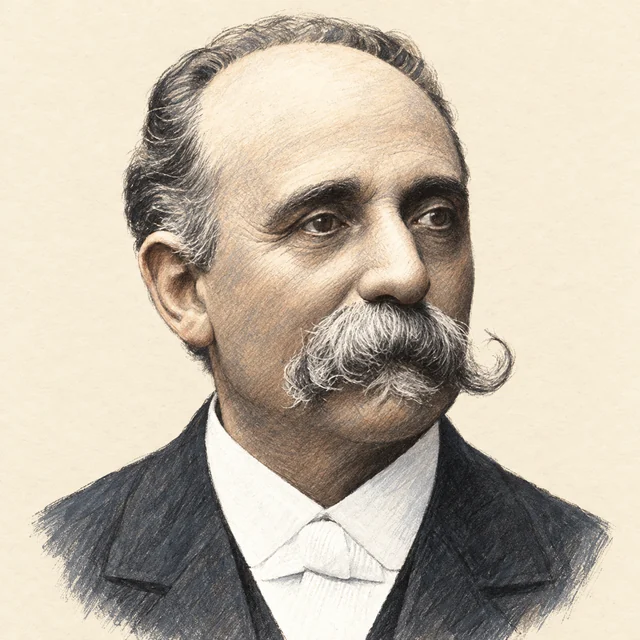
Illustrated portrait of Camillo Golgi

Camillo Golgi

Prize share · 1/2

Golgi received half the Medicine Prize for work on the structure of the nervous system. His black reaction made a small number of nerve cells and their extensive branches visible in tissue.

Read the biography ↗
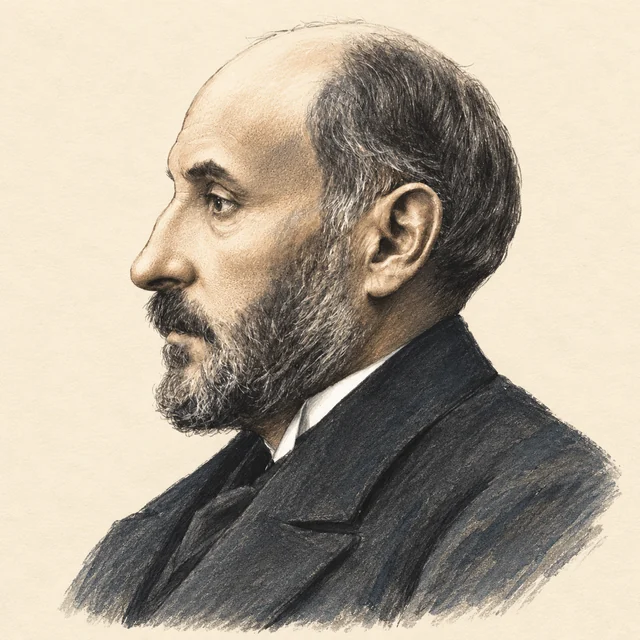
Illustrated portrait of Santiago Ramón y Cajal

Santiago Ramón y Cajal

Prize share · 1/2

Cajal received half the Medicine Prize for work on nervous-system structure. Using and adapting Golgi’s method, he established detailed evidence for distinct nerve cells and their organised contacts.

Read the biography ↗

03 · Years in the making

The path here

  1. 1865

    Golgi graduates in medicine at Pavia.

  2. 1872–1873

    Golgi develops the black reaction.

  3. 1887

    Cajal learns and adapts Golgi’s method.

  4. 1888

    Cajal begins publishing a research journal.

  5. 1889

    Kölliker’s response helps bring international attention to Cajal’s preparations.

  6. 1894

    Cajal gives the Croonian Lecture in London.

  7. 1906

    Golgi and Cajal each receive half the Medicine Prize.

04 · Read further

From the original sources

Original explanations by Curionode, based on the official records below. Biographical details and affiliations refer to the award year.

  1. Official award summary nobelprize.org
  2. Award ceremony speech nobelprize.org
  3. University of Pavia Museum: Golgi’s staining method and career museoperlastoria.unipv.it
  4. CSIC National Museum: Cajal, neuroscience and his school mncn.csic.es

More in Physiology or Medicine

Browse this subject ↗