01 · The discovery
The idea, in everyday language
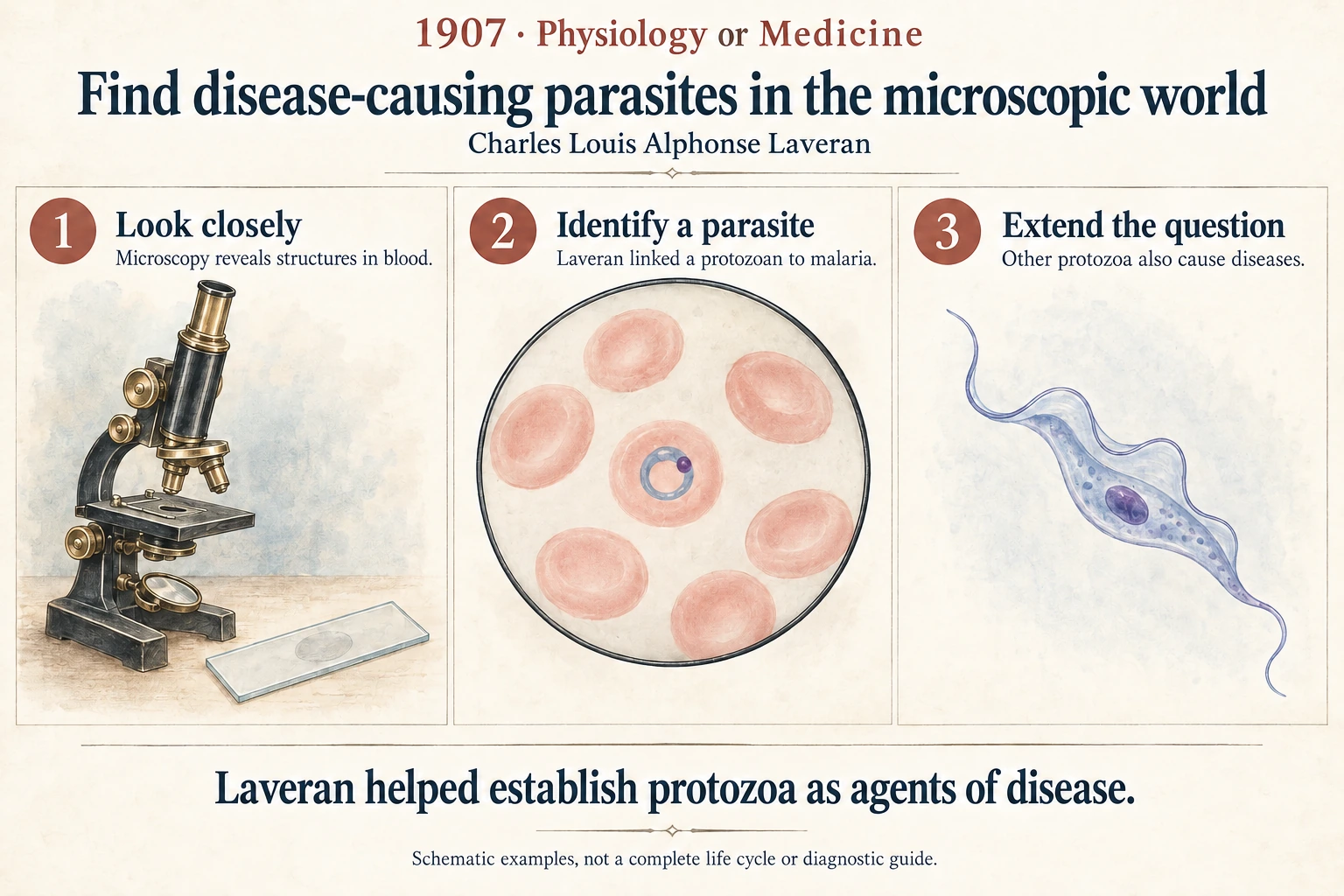
At Constantine in 1880 Laveran examined patients’ blood and observed pigmented bodies and moving structures associated with malaria. These observations, repeated and defended against scepticism, helped establish that an animal-like microscopic parasite could cause an important human disease. In modern terms malaria is caused by Plasmodium parasites, not bacteria or viruses.
His later work extended to other protozoa, including research on trypanosomes with Félix Mesnil. The 1907 prize recognised this broader contribution. Identifying the parasite must be distinguished from establishing the full life cycle and mosquito transmission, which involved other investigators, including the work recognised by Ronald Ross’s 1902 prize.
Why it matters
The work widened the search for infectious causes beyond bacteria and encouraged systematic parasitology. Linking specific parasites to disease made new questions about life cycles, transmission and prevention experimentally approachable.