01 · The discovery
The idea, in everyday language
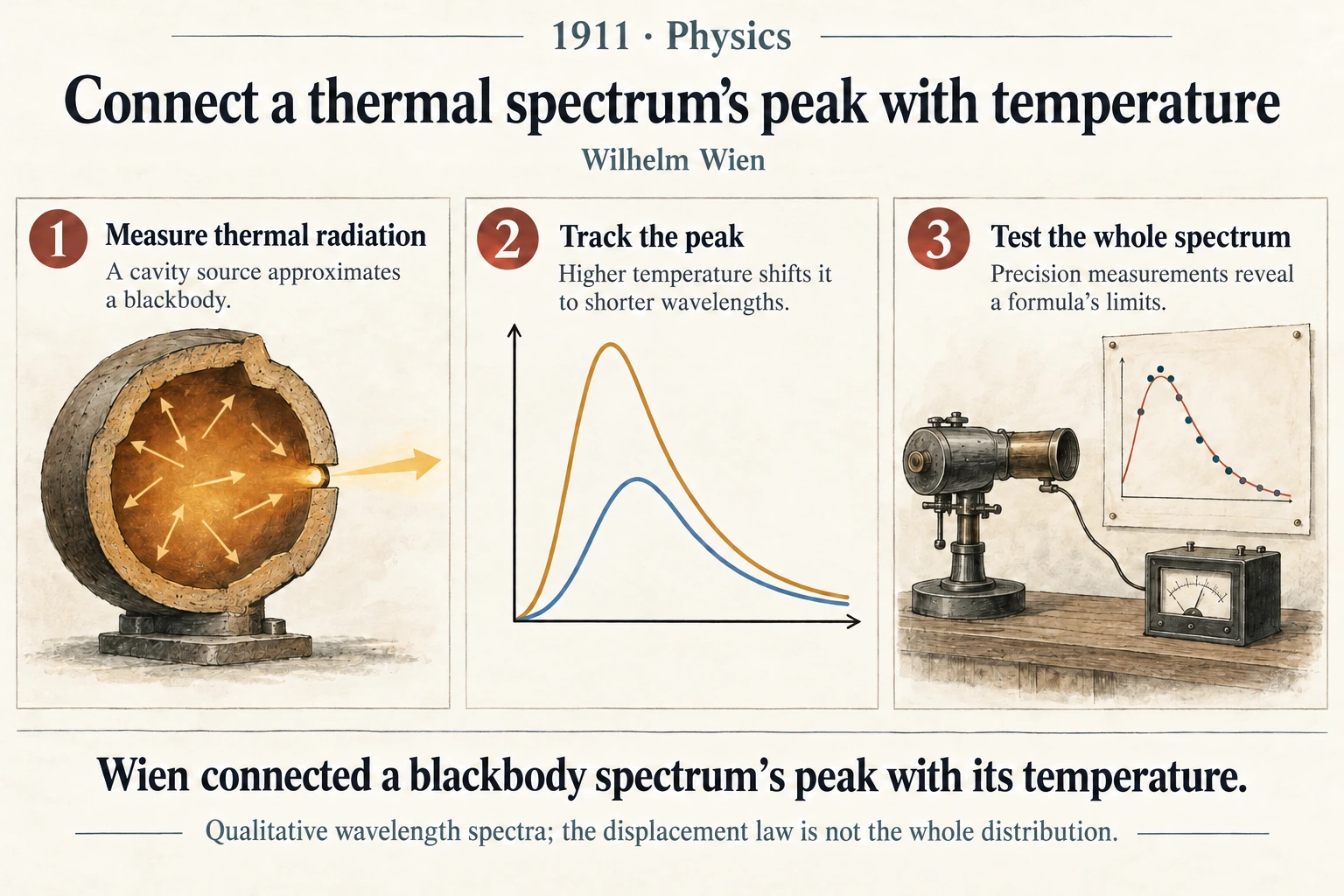
A blackbody is an ideal absorber and emitter used to study thermal radiation. A small opening in a cavity whose walls share a temperature can approximate it. The radiation contains many wavelengths, each with a different intensity. Wien’s displacement law says that, as absolute temperature rises, the peak of the wavelength spectrum moves towards shorter wavelengths. It is a quantitative relation, not simply the observation that some very hot objects glow.
The displacement law does not by itself determine the entire spectrum. Wien also developed a formula for the distribution of radiation over wavelengths, published in 1896. Precise measurements later found deviations at long wavelengths and high temperatures. Planck’s more general law in 1900 accounted for those results. Experiments by Lummer, Pringsheim, Kurlbaum and Rubens were essential to testing the theory; the full 1911 Nobel Prize nevertheless went to Wien alone.
Why it matters
The laws made thermal radiation a tool for estimating temperatures and helped define the problem from which quantum theory emerged. Applying a blackbody relation to real objects requires attention to their emissivity, the wavelength range and the observing method.