01 · The discovery
The idea, in everyday language
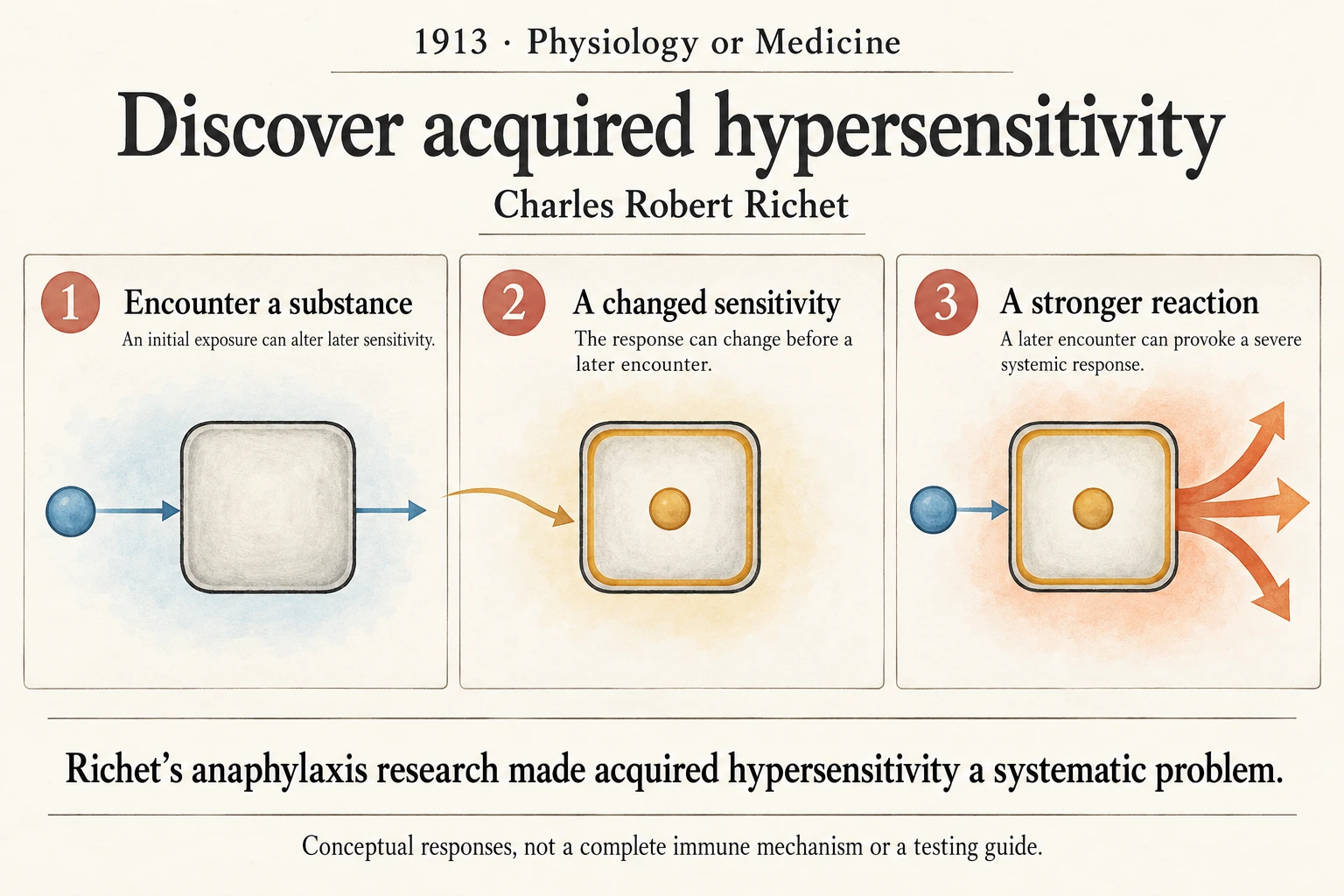
Researchers already knew examples in which prior exposure produced protection. Richet and Paul Portier’s work, published in 1902, demonstrated a different possibility in experiments with dogs: after an initial exposure, a later encounter with the substance could produce a sudden, severe reaction. The effect could not be explained simply by adding together the amounts given.
Richet investigated this changed susceptibility in further experiments, including work on transferring hypersensitivity through serum. The 1913 prize recognised anaphylaxis research. Later immunology supplied more detailed mechanisms: for example, typical IgE-mediated food anaphylaxis involves release of mediators from sensitised mast cells and basophils. That modern account should not be attributed in full to Richet’s 1913 work.
Why it matters
The work helped explain why exposure could lead to hypersensitivity as well as protection. It opened an important path towards understanding severe allergic reactions. Anaphylaxis can be rapid and life-threatening; the historical discovery and later mechanisms form part of a longer development of immunology.