01 · The contribution
The idea, in everyday language
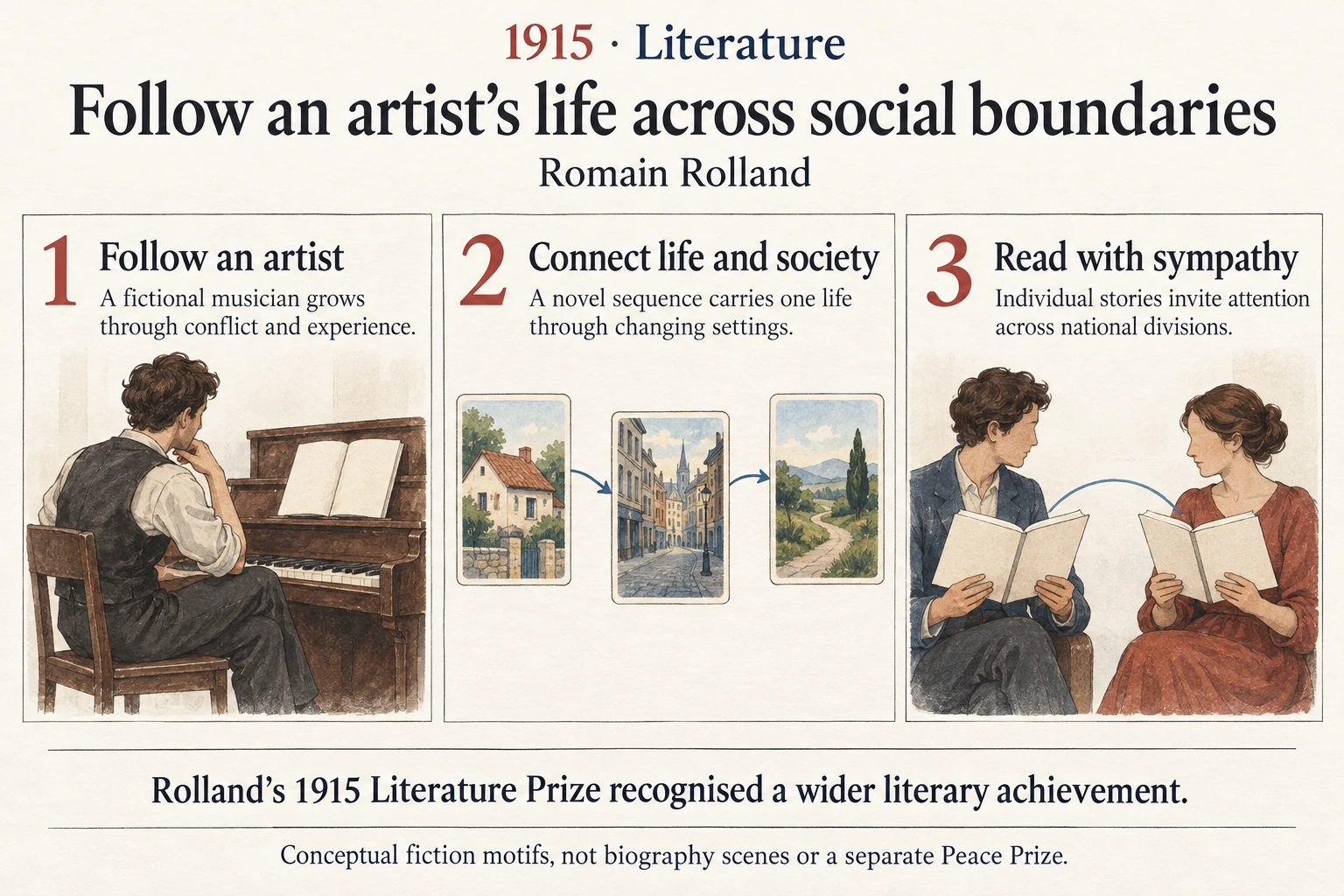
Jean-Christophe follows the development of a fictional German musician, linking artistic ambition with personal relationships and encounters with society. Published from 1904 to 1912, the sequence uses a long individual life to explore tensions between a person’s inner convictions and the world around him. Its musician is a literary character, not a documentary subject or a literal self-portrait of Rolland.
The Nobel recognition concerned Rolland’s literary production and its idealism, sympathy and truth-seeking. His opposition to wartime nationalist hatred provides relevant context, but this was the Literature Prize, not a Peace Prize. The 1915 award was reserved and announced on 9 November 1916. Later fiction and political allegiances belong to a longer history; they must not be projected backwards as the whole reason for the prize.
Why it matters
Rolland used the scale of a novel sequence to connect individual moral and artistic development with a wider social world. The work offered readers a way to consider people across national divisions without treating a literary character as a complete representation of a nation.