01 · The contribution
The idea, in everyday language
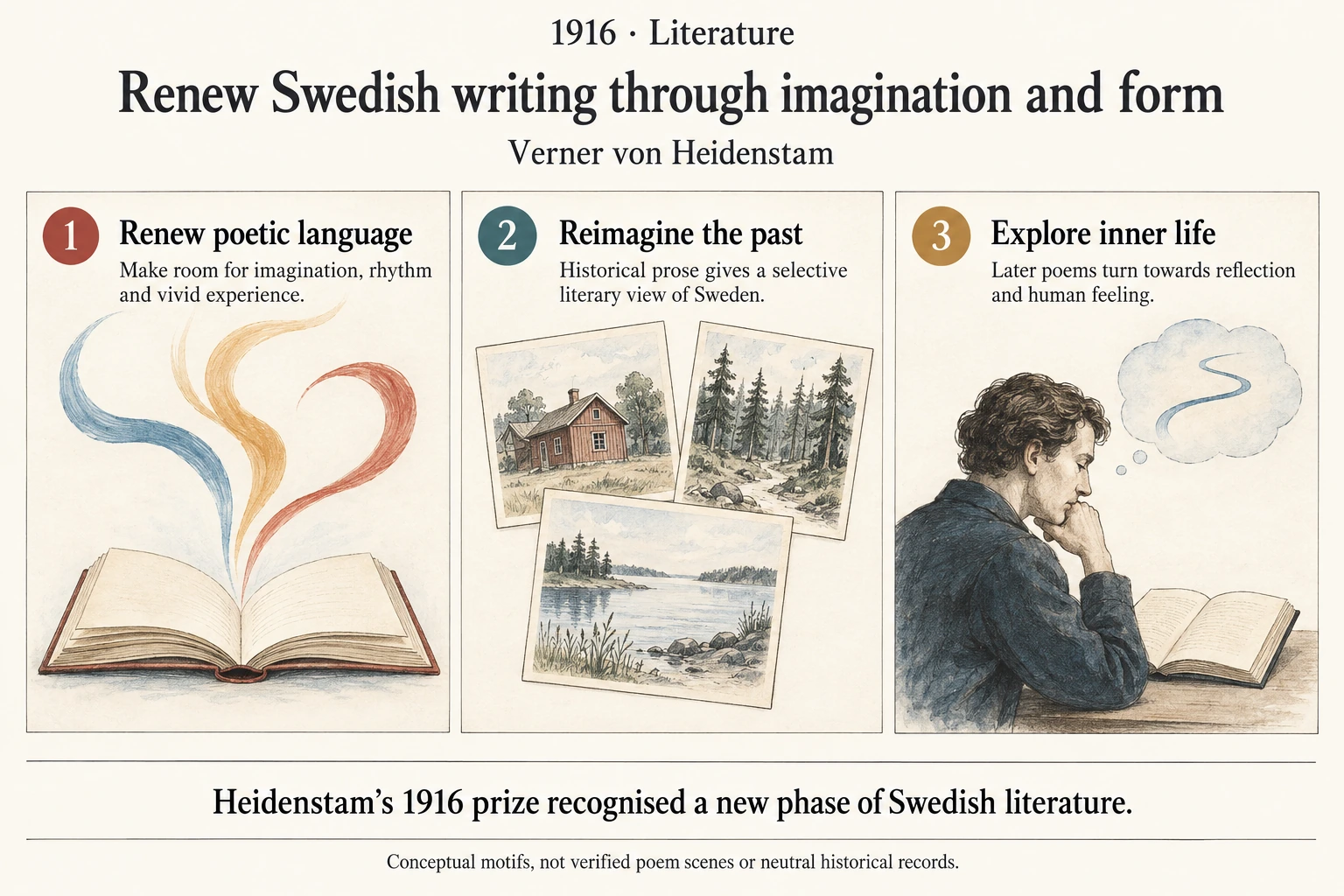
At the end of the nineteenth century, Heidenstam challenged the literary dominance of realism and naturalism. Vallfart och vandringsår, published in 1888, made room for vivid images, sensual experience and imaginative freedom. His polemical Renässans followed in 1889. This was a debate about what literature could do, not proof that realism had become artistically worthless.
His writing subsequently developed several directions. Historical prose such as Karolinerna and Folkungaträdet created narratives around Sweden’s past, while poetry including Dikter and Nya dikter explored inner life, loss and reflection. National feeling and historical imagination are important parts of that work, but a literary picture of a nation is selective. The prize concerned his role in Swedish literary renewal; it did not certify every historical interpretation or political ideal.
Why it matters
The work helped broaden the forms and ambitions of Swedish writing around the generation of the 1890s. Poetry and historical prose could give readers different ways of approaching individual feeling and collective memory. Their force depends on how they are made, not on treating their imagined past as an objective record.