c.curionodeThe Nobel Archive

1922 · Physics

Atomic light reveals discrete energy steps

Bohr connected allowed atomic energies with the sharp lines of the hydrogen spectrum. His 1922 prize recognised investigations of atomic structure and the radiation it emits.

Atomic structureEnergy levelsHydrogen spectrum
1922Physics

Visual guide

The prize, pictured

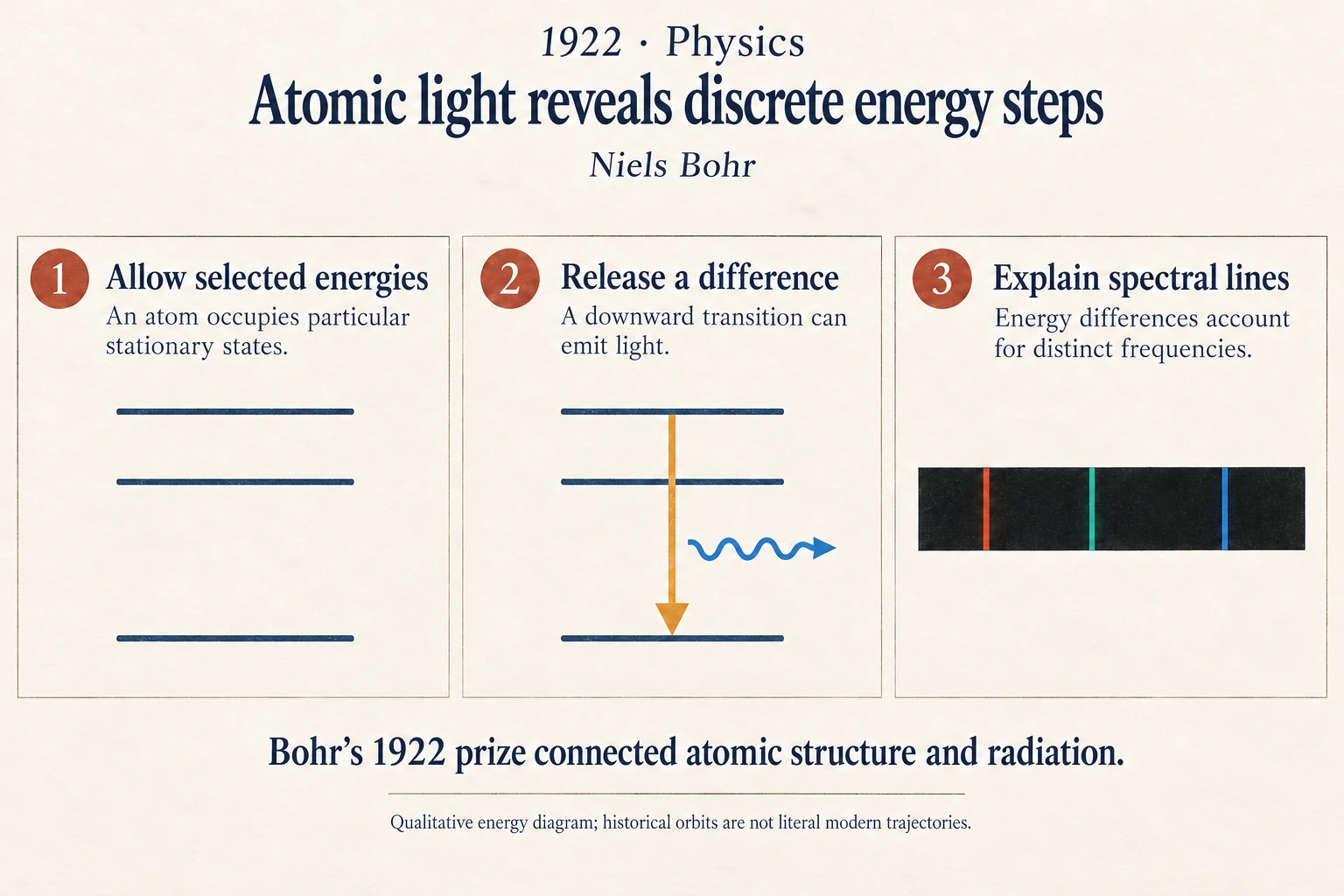
Infographic explaining Atomic light reveals discrete energy steps
Original AI-generated infographic. A conceptual overview; the explanations and sources below provide context.
Read the poster text

Bohr’s 1922 prize connected atomic structure and radiation.

  1. Allow selected energies

    An atom occupies particular stationary states.

  2. Release a difference

    A downward transition can emit light.

  3. Explain spectral lines

    Energy differences account for distinct frequencies.

Qualitative energy diagram; historical orbits are not literal modern trajectories.

01 · The discovery

The idea, in everyday language

Why does a gas emit particular colours instead of every possible colour? A nuclear atom treated by ordinary classical theory did not explain both stability and the observed pattern of light. In 1913 Bohr proposed that an atom could occupy certain stationary states. In the model, an electron did not continually radiate while remaining in one of those allowed states.

Light appeared when the atom changed between allowed energies: a downward change released radiation whose frequency was related to the energy difference. This connected a model of atomic structure to measured spectral lines, with especially important success for hydrogen. It made the spectrum a test of the theory, rather than just a list of colours. The model helped open the route towards quantum mechanics, but its imagined electron orbits were not the final account of atomic behaviour.

Why it matters

The theory connected atomic structure with observable light and helped explain why hydrogen’s spectral pattern was regular. It gave researchers a way to calculate and test atomic ideas, while its difficulties with more complicated atoms showed where new physics was needed.
02 · The people

Who brought the idea to life?

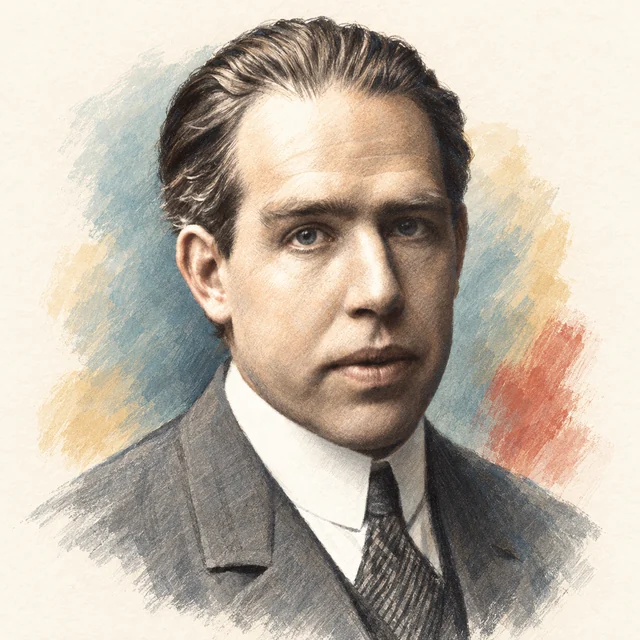
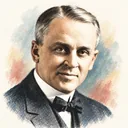
Illustrated portrait of Niels Bohr

Niels Bohr

Prize share · 1

Bohr received the full Physics Prize for investigating atomic structure and atomic radiation. His theory connected allowed atomic energies with the light emitted in transitions, explaining important regularities in hydrogen’s spectrum.

Read the biography ↗

03 · Years in the making

The path here

  1. 1911

    Bohr completes his doctorate at Copenhagen University.

  2. 1913

    He proposes a quantum model connecting hydrogen’s allowed states and spectrum.

  3. 1916

    He becomes professor of theoretical physics at Copenhagen University.

  4. 1921

    The Copenhagen institute is established as a centre for theoretical physics.

  5. 1922

    The Physics Prize recognises his work on atomic structure and radiation.

04 · Read further

From the original sources

Original explanations by Curionode, based on the official records below. Biographical details and affiliations refer to the award year.

  1. Official award summary nobelprize.org
  2. Award ceremony speech nobelprize.org
  3. Niels Bohr Institute: history nbi.ku.dk