c.curionodeThe Nobel Archive

1927 · Literature

Writing the texture of lived time

Bergson made consciousness, memory and change subjects of philosophical prose. The Literature Prize recognized both the force of his ideas and the imaginative precision of their expression.

Philosophical proseDurationMemory1927 prize awarded in 1928
1927Literature

Visual guide

The prize, pictured

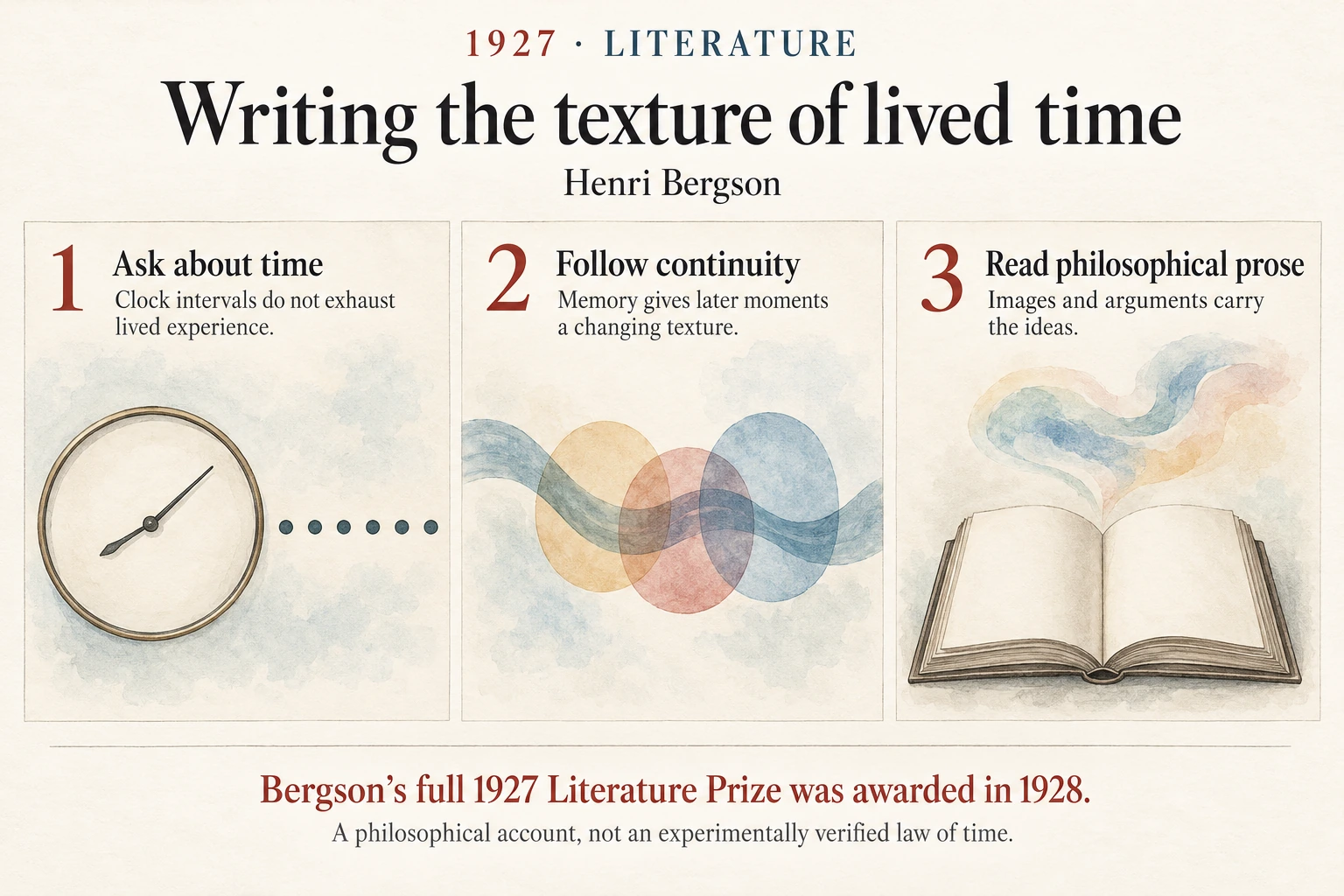
Infographic explaining Writing the texture of lived time
Original AI-generated infographic. A conceptual overview; the explanations and sources below provide context.
Read the poster text

Bergson’s full 1927 Literature Prize was awarded in 1928.

  1. Ask about time

    Clock intervals do not exhaust lived experience.

  2. Follow continuity

    Memory gives later moments a changing texture.

  3. Read philosophical prose

    Images and arguments carry the ideas.

A philosophical account, not an experimentally verified law of time.

01 · The contribution

The idea, in everyday language

A clock divides time into countable intervals. Bergson asked what such a division leaves out of experience: the way moments carry memories, acquire different qualities and form a changing whole. His concept of duration described lived continuity, rather than another unit for a clock to measure.

In books including Time and Free Will, Matter and Memory and Creative Evolution, he used images and analogies to guide readers through difficult arguments. Literary form was part of the work’s influence. The prize acknowledged a philosopher whose way of writing mattered, rather than requiring the winning work to be a novel or a poem.

Why it matters

Bergson’s writing opened philosophical questions to readers through a distinctive combination of argument, metaphor and rhythm. His influence extended across philosophy and literary culture. The award’s emphasis on presentation also shows how a Literature Prize can recognize sustained philosophical prose.
02 · The people

Who brought the idea to life?

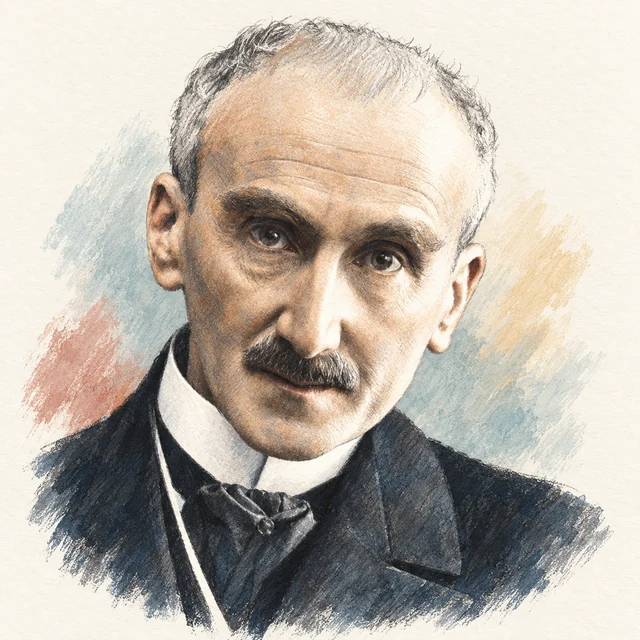
Illustrated portrait of Henri Bergson

Henri Bergson

Prize share · 1

Bergson received the full 1927 Literature Prize, awarded in 1928, for his philosophical ideas and their literary presentation. He made duration, memory and creative change subjects of vivid, influential prose.

Read the biography ↗

03 · Years in the making

The path here

  1. 1889

    Time and Free Will introduces his account of lived duration.

  2. 1896

    Matter and Memory examines consciousness and its relation to the body.

  3. 1907

    Creative Evolution extends his philosophical investigation of life and change.

  4. 1928

    The reserved full Literature Prize for 1927 is announced and presented.

04 · Read further

From the original sources

Original explanations by Curionode, based on the official records below. Biographical details and affiliations refer to the award year.

  1. Official award summary nobelprize.org
  2. Award ceremony speech nobelprize.org

More in Literature

Browse this subject ↗