01 · The discovery
The idea, in everyday language
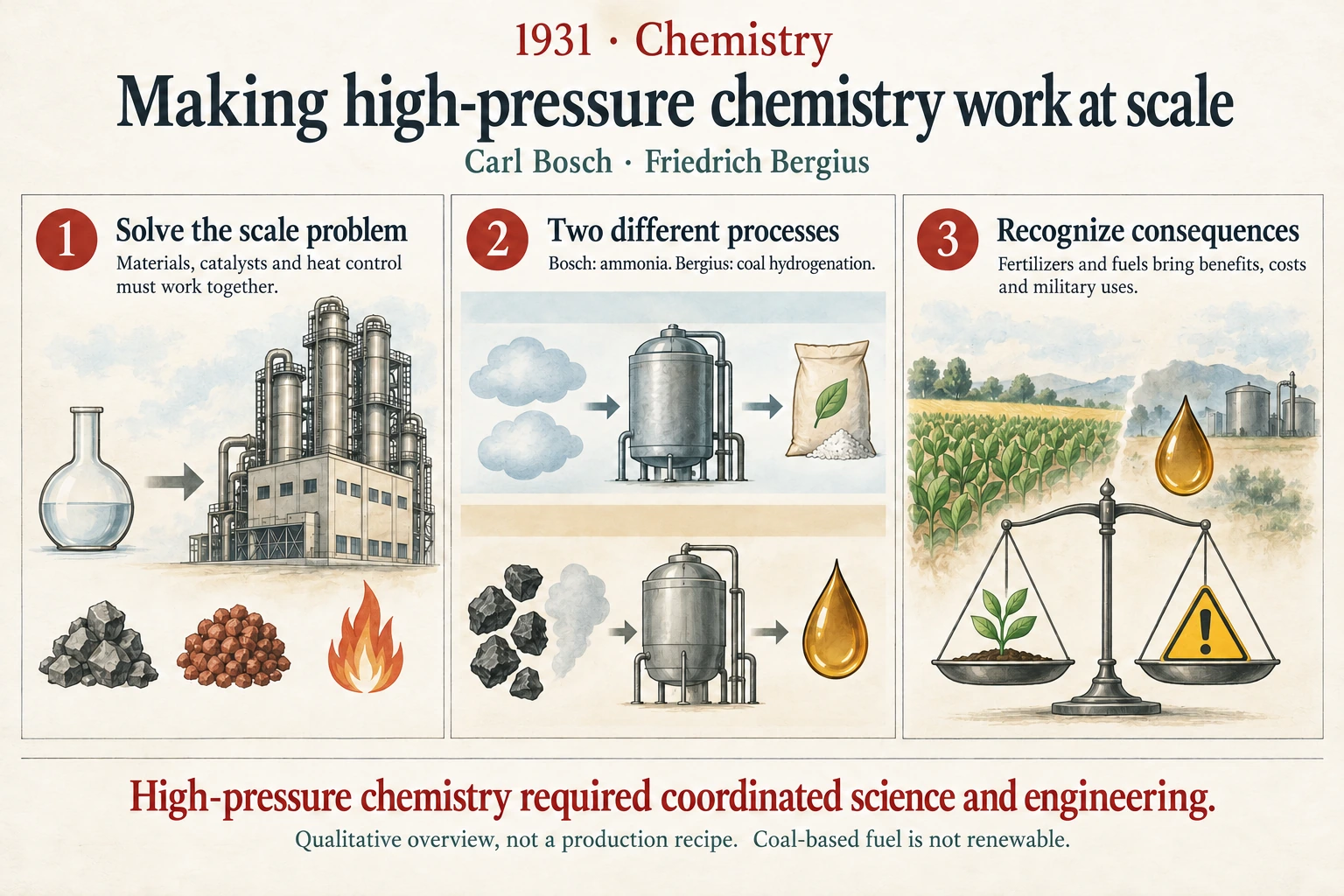
A reaction demonstrated in a laboratory may fail as an industrial process. Hot gases, vessel materials, impurities, catalysts and heat flows must be controlled together. Bosch’s team turned Haber’s ammonia synthesis into reliable production, with Oppau starting in 1913. Nitrogen and hydrogen combine to make ammonia. Pressure favors the ammonia side of this equilibrium, but pressure alone does not supply a complete process or make every reaction go faster.
Bergius investigated a different transformation: hydrogen changes the complex organic material in coal into liquid products. This is chemical conversion, not simply melting coal, and it is distinct from making fuels from carbon monoxide and hydrogen by the Fischer–Tropsch route. Years of engineering and work by industrial teams, including Matthias Pier, stood between early experiments and large-scale production. Both stories show how chemical knowledge depends on materials, measurement and collective industrial development.
Why it matters
Industrial ammonia supplied nitrogen fertilizers and also supported explosives manufacture. Coal hydrogenation expanded ways of producing liquid fuels from coal. These were consequential technologies with civilian and military uses, not automatically beneficial outcomes. Coal-based fuels still depend on fossil carbon and energy inputs.