01 · The contribution
The idea, in everyday language
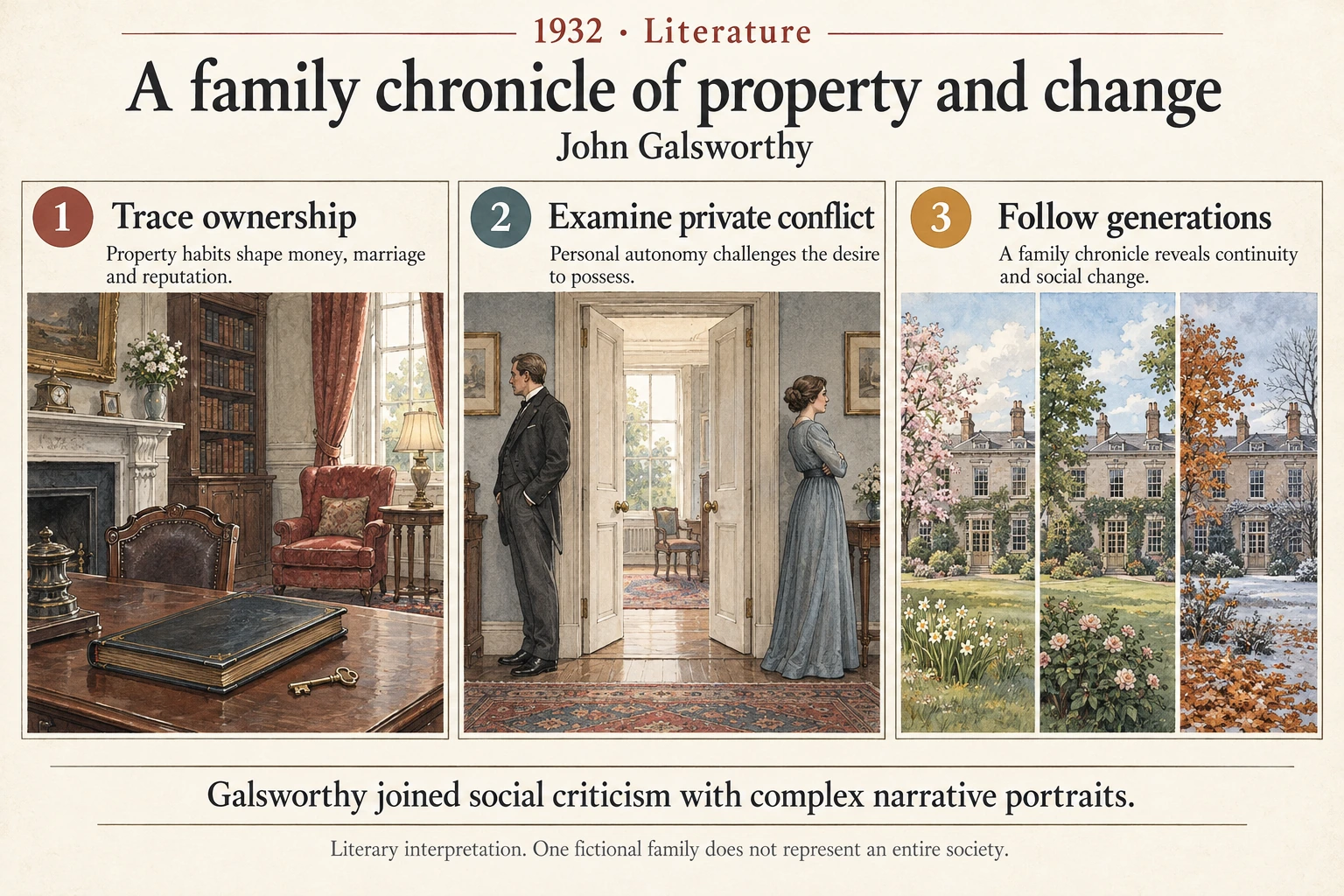
A family can preserve its name and possessions while the meanings attached to them change. Galsworthy turned that tension into a sustained narrative. The Man of Property introduced Soames Forsyte, whose desire to possess extends beyond material wealth into his marriage. Irene’s resistance exposes the limits and harm of treating a person as property. The story asks readers to examine power inside respectable social arrangements rather than assume that legal or financial security makes them just.
In Chancery and To Let continued the family story; with two interludes, the novels were collected as The Forsyte Saga in 1922. Later books followed younger generations and a changing England. Satire gradually makes room for more complex, sometimes sympathetic portraits without erasing coercion or inequality. Galsworthy’s plays also examined justice, employment and class. The 1932 prize singled out his narrative achievement, especially the Forsyte sequence, rather than treating every character as a reliable spokesman for the author.
Why it matters
Galsworthy made the family chronicle a way to examine the relationship between intimate life, ownership and historical change. His narrative combines social criticism with attention to individual motives. The novels and plays invited discussion of established conventions, while their literary value is not reducible to a single reform or political programme.