c.curionodeThe Nobel Archive

1933 · Peace

Questioning the promised profits of conquest

In The Great Illusion, Angell challenged the belief that military conquest reliably makes a nation richer. Public education could expose that assumption, even though economic interdependence did not make war impossible.

The Great IllusionEconomic interdependencePublic educationNorman Angell
1933Peace

Visual guide

The prize, pictured

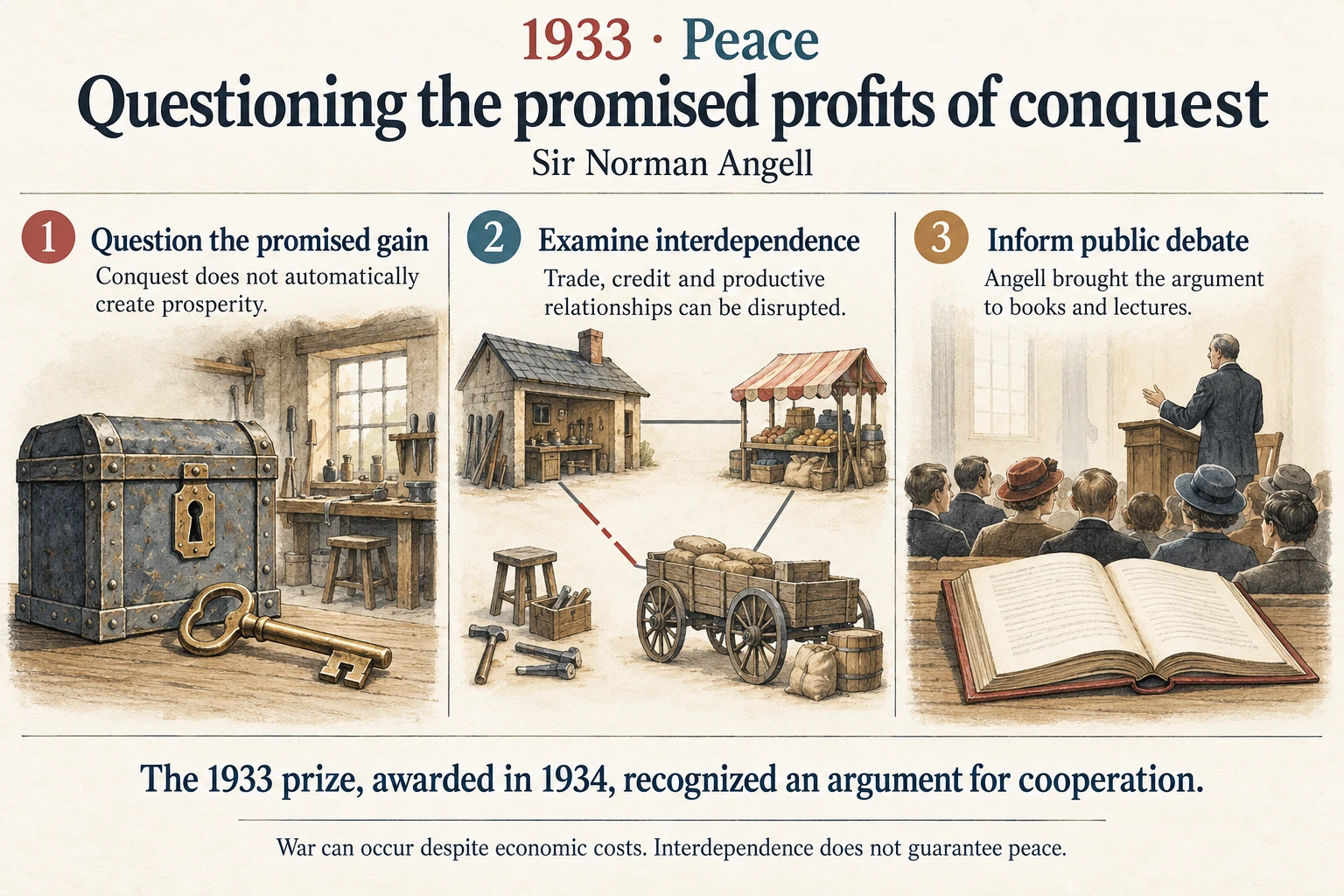
Infographic explaining Questioning the promised profits of conquest
Original AI-generated infographic. A conceptual overview; the explanations and sources below provide context.
Read the poster text

The 1933 prize, awarded in 1934, recognized an argument for cooperation.

  1. Question the promised gain

    Conquest does not automatically create prosperity.

  2. Examine interdependence

    Trade, credit and productive relationships can be disrupted.

  3. Inform public debate

    Angell brought the argument to books and lectures.

War can occur despite economic costs. Interdependence does not guarantee peace.

01 · The contribution

The idea, in everyday language

Governments and publics could treat the seizure of territory as a direct addition to national wealth. Angell asked how that claim worked in societies connected through credit, trade and the labour of living populations. Taking political control did not automatically transfer productive prosperity to the conqueror. Destruction, disrupted exchange and the burdens of domination could undermine the supposed gain. His argument challenged a justification for war, rather than proving that every participant would always act in its economic interest.

The Great Illusion grew from a 1909 work and appeared under its better-known title in 1910. Angell carried the discussion into lectures, journalism and international cooperation campaigns. The First World War showed that war could happen; that alone did not logically refute a claim about its supposed economic benefits. The 1933 Peace Prize was reserved and awarded to Angell in 1934. He was absent from the 1934 ceremony, and delivered his Nobel lecture in June 1935. These later dates belong to a resolved 1933 award, not an upcoming announcement.

Why it matters

Angell made a widely influential argument about the relationship between economic life and international conflict. His work encouraged readers to examine the assumptions behind military power and to consider cooperation and informed public opinion. The prize recognized this intellectual and educational contribution, rather than an achieved abolition of war.
02 · The people

Who brought the idea to life?

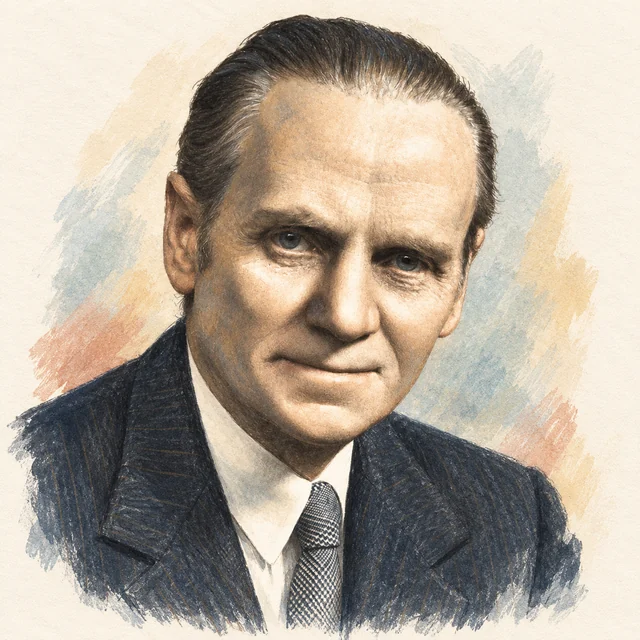
Illustrated portrait of Sir Norman Angell

Sir Norman Angell

Prize share · 1

Angell received the full Peace Prize for examining the economic claims used to justify war and for promoting international cooperation through public education, especially through The Great Illusion.

Read the biography ↗

03 · Years in the making

The path here

  1. 1909

    Europe’s Optical Illusion introduces Angell’s argument.

  2. 1910

    The expanded book appears as The Great Illusion.

  3. 1934

    The reserved 1933 Peace Prize is awarded to Angell.

  4. 1935

    Angell delivers his Nobel lecture on 12 June.

04 · Read further

From the original sources

Original explanations by Curionode, based on the official records below. Biographical details and affiliations refer to the award year.

  1. Official award summary nobelprize.org
  2. Award ceremony speech nobelprize.org
  3. Official recipient biography nobelprize.org
  4. Nobel lecture: Norman Angell, 1935 nobelprize.org