01 · The discovery
The idea, in everyday language
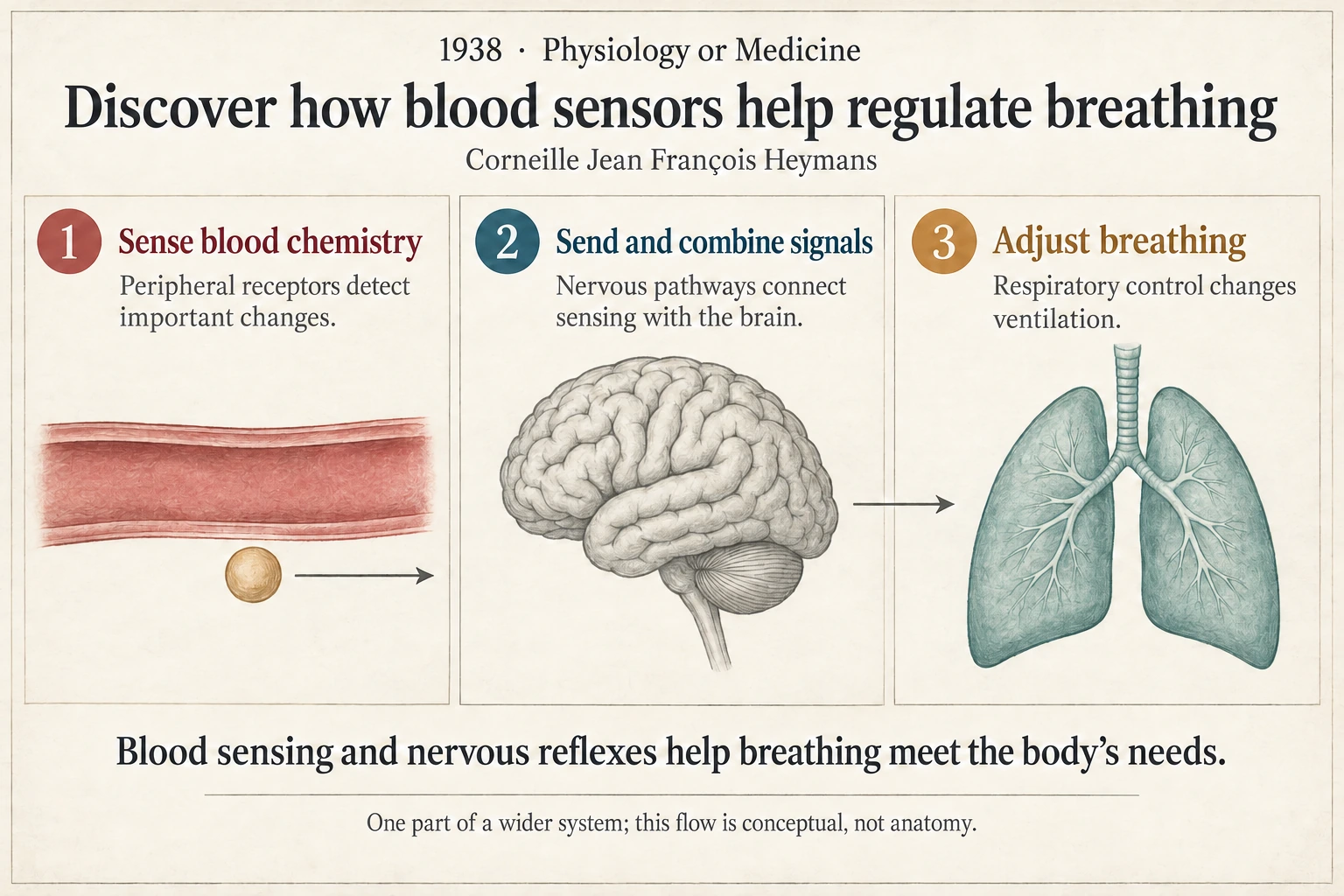
Breathing usually adjusts without a conscious decision. How does the nervous system receive information about what the body needs? Heymans’s research showed that blood chemistry can influence respiration through sensory structures outside the brain, as well as through central mechanisms. Important signals arise around the carotid arteries and the aortic region and reach the brain through nerves.
The carotid sinus and nearby carotid body must be distinguished. Pressure-sensitive mechanisms respond to changes in arterial pressure; chemoreceptors in the carotid body respond to aspects of blood chemistry. Heymans’s group helped separate these effects experimentally. Work with his father, Bouckaert, Dautrebande, Rijlant and other investigators connected peripheral sensing, nerve signals and respiratory responses. De Castro’s earlier anatomical work also belongs to this history.
Why it matters
The work established an important part of physiological feedback: information about the internal environment helps regulate ventilation. It linked circulation, chemical sensing and nervous control. The carotid body is not a lung and does not add oxygen to the blood; sensing a change is different from carrying out the respiratory response.