c.curionodeThe Nobel Archive

1949 · Peace

Reducing hunger through research and cooperation

Boyd Orr joined nutritional research to economic access and international cooperation, arguing that hunger and want help create conditions for conflict.

Hunger and incomeFood accessInternational cooperation
1949Peace

Visual guide

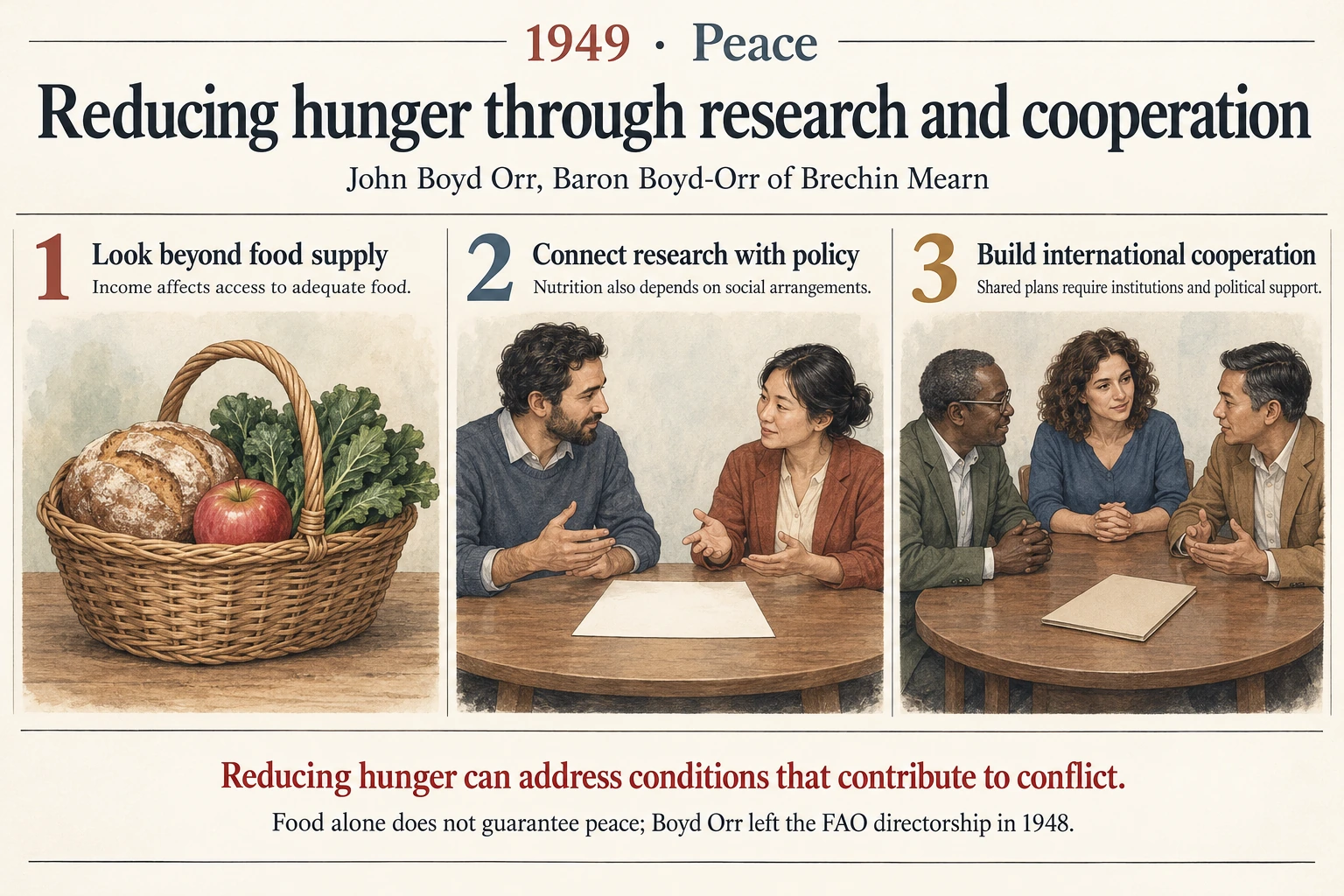
The prize, pictured

Infographic explaining Reducing hunger through research and cooperation
Original AI-generated infographic. A conceptual overview; the explanations and sources below provide context.
Read the poster text

Reducing hunger can address conditions that contribute to conflict.

  1. Look beyond food supply

    Income affects access to adequate food.

  2. Connect research with policy

    Nutrition also depends on social arrangements.

  3. Build international cooperation

    Shared plans require institutions and political support.

Food alone does not guarantee peace; Boyd Orr left the FAO directorship in 1948.

01 · The contribution

The idea, in everyday language

Why can people lack adequate food even where food is available? Boyd Orr’s research drew attention to income and access, alongside the nutritional quality of diets. His 1936 Food, Health and Income connected household circumstances with nutrition and made hunger a question of social and economic arrangements, not production alone.

He carried that concern into international work and served as the first FAO Director-General from 1945 to 1948. He sought arrangements that would connect food needs, agricultural production and international cooperation. His proposed World Food Board was not realised, showing the gap between an international plan and governments’ willingness to support it. By the 1949 prize he had left the directorship, while continuing his wider peace advocacy.

Why it matters

The Peace Prize recognised a lifelong effort against hunger and deprivation and their connection with conditions that can lead to conflict. It highlighted the relationship between scientific knowledge, public policy and international institutions, rather than treating nutrition as a private or purely technical matter.
02 · The people

Who brought the idea to life?

03 · Years in the making

The path here

  1. 1910

    Boyd Orr receives his Glasgow science degree.

  2. 1912

    He qualifies in medicine at Glasgow.

  3. 1936

    Food, Health and Income appears.

  4. 1945

    He becomes the first FAO Director-General.

  5. 1948

    He leaves the FAO directorship on 26 April.

  6. 1949

    He is elevated to the peerage in January and receives the Peace Prize in December.

04 · Read further

From the original sources

Original explanations by Curionode, based on the official records below. Biographical details and affiliations refer to the award year.

  1. Official award summary nobelprize.org
  2. Award ceremony speech nobelprize.org
  3. FAO history: Boyd Orr’s directorship and departure fao.org
  4. Official biography: John Boyd Orr, Baron Boyd-Orr of Brechin Mearn nobelprize.org