01 · The contribution
The idea, in everyday language
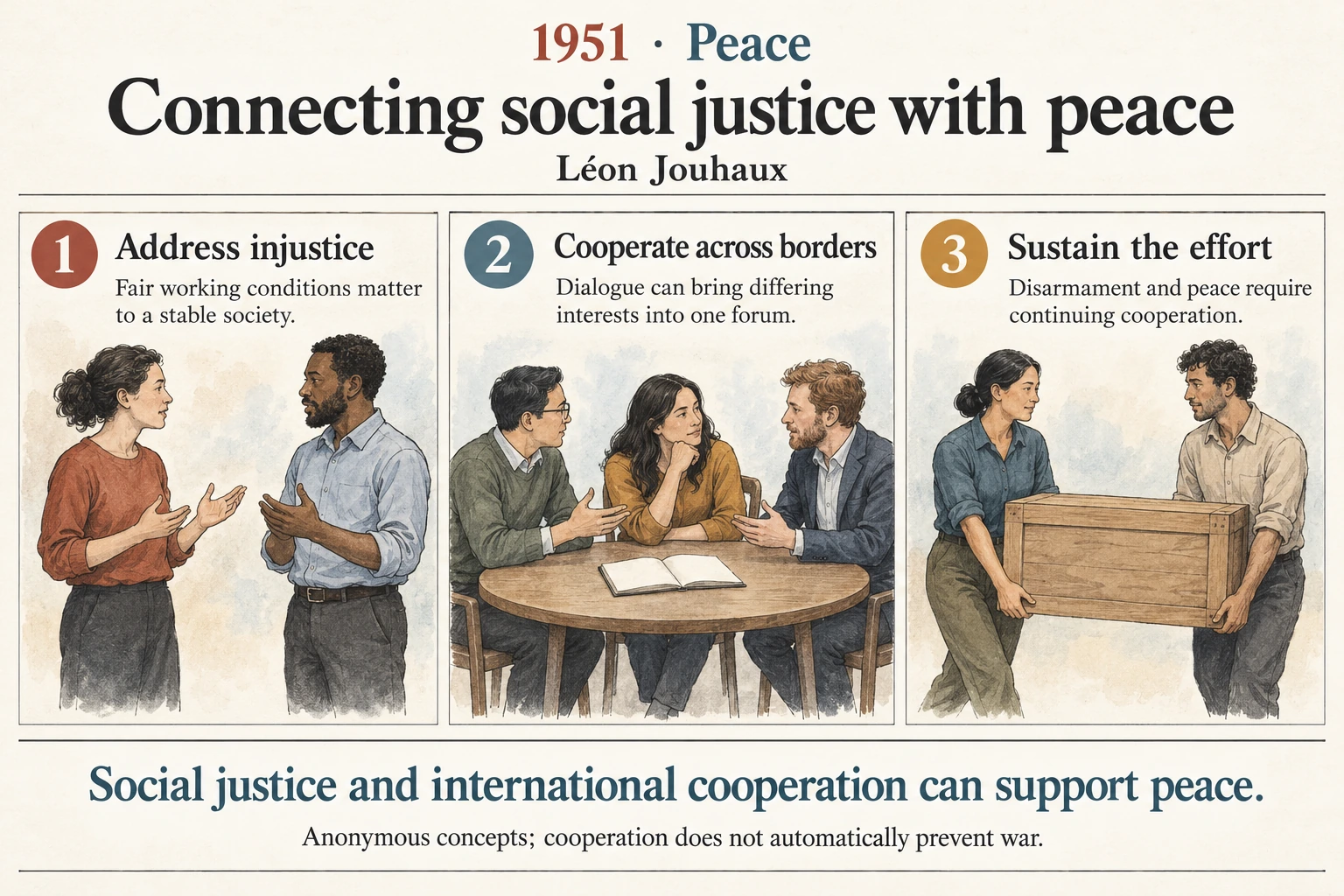
Peace requires more than the absence of immediate fighting. Jouhaux argued that injustice and insecurity in working life undermine stable relations, and that workers could cooperate across national boundaries. His pre-1914 contacts with other countries’ unions sought to resist nationalism, though the outbreak of war showed the limits of that effort.
He helped negotiate the creation of the International Labour Organization in 1919 and served as a workers’ representative on its Governing Body. Its cooperation among governments, employers and workers offered an institutional forum for disagreement and practical standards. His campaigns also included disarmament and Franco-German reconciliation. The 1951 award recognised this sustained international work, rather than treating every trade-union activity as sufficient on its own to prevent war.
Why it matters
Jouhaux’s career connected working conditions with international cooperation and drew attention to social justice as a foundation for peace. He supported the 1936 French reforms and continued international work after Nazi imprisonment. Following the 1947 CGT split and the 1948 founding of Force Ouvrière, the recognition came amid Cold War divisions rather than an already united labour movement.