c.curionodeThe Nobel Archive

1969 · Economic Sciences

Models that follow economic change over time

Frisch and Tinbergen developed and applied dynamic models of economic processes. They shared the first Economic Sciences memorial prize in 1969.

The Sveriges Riksbank Prize in Economic Sciences in Memory of Alfred Nobel.

Dynamic modelsEconometricsEvidence and policy
1969Economic Sciences

Visual guide

The prize, pictured

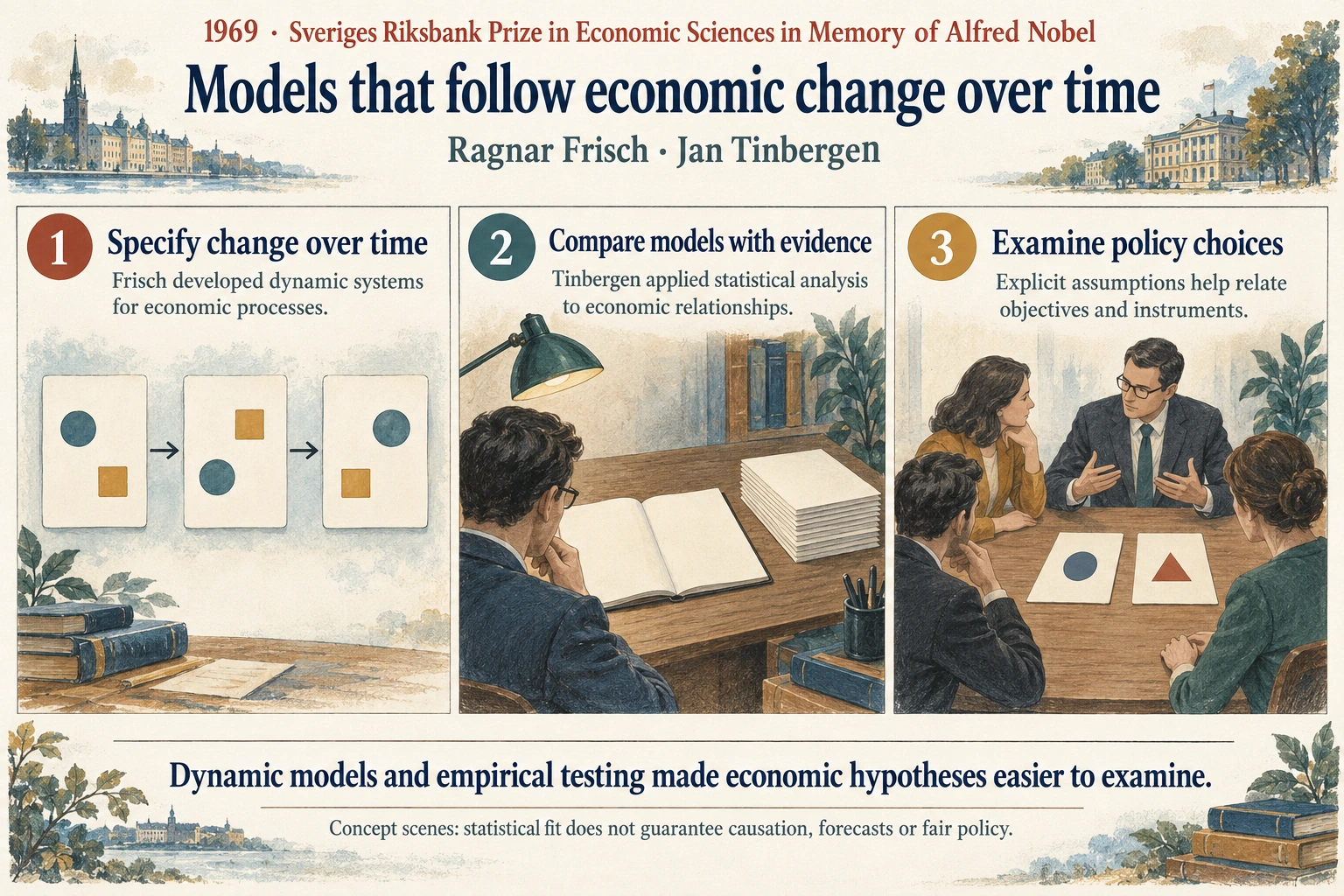
Infographic explaining Models that follow economic change over time
Original AI-generated infographic. A conceptual overview; the explanations and sources below provide context.
Read the poster text

Dynamic models and empirical testing made economic hypotheses easier to examine.

  1. Specify change over time

    Frisch developed dynamic systems for economic processes.

  2. Compare models with evidence

    Tinbergen applied statistical analysis to economic relationships.

  3. Examine policy choices

    Explicit assumptions help relate objectives and instruments.

Concept scenes: statistical fit does not guarantee causation, forecasts or fair policy.

01 · The discovery

The idea, in everyday language

Dynamic models specify how economic variables interact and how effects unfold over time. Frisch used mathematical systems to analyse cyclical movement and disturbances, alongside methods for statistical testing.

Tinbergen confronted models with statistical evidence, including his study of United States business cycles. Both researchers also investigated planning and policy, connecting objectives, available instruments and the assumptions of an economic system. Their related contributions were distinct.

Why it matters

Mathematical specification and empirical testing made economic hypotheses easier to examine and compare. The work helped establish econometrics as a practical research approach and informed the analysis of policy choices.
02 · The people

Who brought the idea to life?

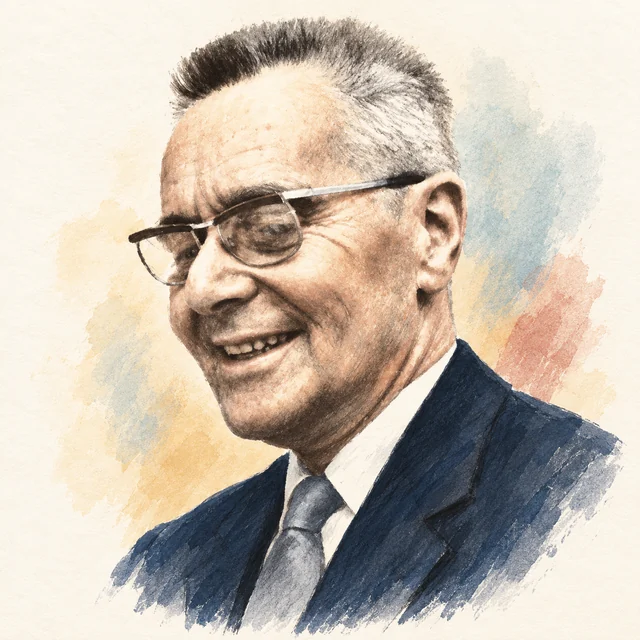
Illustrated portrait of Ragnar Frisch

Ragnar Frisch

Prize share · 1/2

Frisch pioneered dynamic economic models and econometric methods. He received half the first Economic Sciences memorial prize.

Read the biography ↗
Illustrated portrait of Jan Tinbergen

Jan Tinbergen

Prize share · 1/2

Tinbergen applied dynamic economic models to evidence and policy questions. He received half the first Economic Sciences memorial prize.

Read the biography ↗

03 · Years in the making

The path here

  1. 1926

    Frisch completes his mathematical-statistics doctorate.

  2. 1929

    Tinbergen completes his physics doctorate.

  3. 1933

    Frisch presents important dynamic business-cycle work.

  4. 1939

    Tinbergen publishes his United States business-cycle study.

  5. 1945–1955

    Tinbergen directs the Dutch Central Planning Bureau.

  6. 1969

    They share the first Economic Sciences memorial prize.

04 · Read further

From the original sources

Original explanations by Curionode, based on the official records below. Biographical details and affiliations refer to the award year.

  1. Official award summary nobelprize.org
  2. Award ceremony speech nobelprize.org
  3. Riksbank prize history riksbank.se
  4. Official biography: Ragnar Frisch nobelprize.org
  5. Official biography: Jan Tinbergen nobelprize.org

More in Economic Sciences

Browse this subject ↗