c.curionodeThe Nobel Archive

1971 · Economic Sciences

Making economic growth an empirical question

What changes when an economy grows? Kuznets combined national-income measurement, historical evidence and international comparison to interpret growth and structural development.

The Sveriges Riksbank Prize in Economic Sciences in Memory of Alfred Nobel.

Economic growthNational incomeStructural change
1971Economic Sciences

Visual guide

The prize, pictured

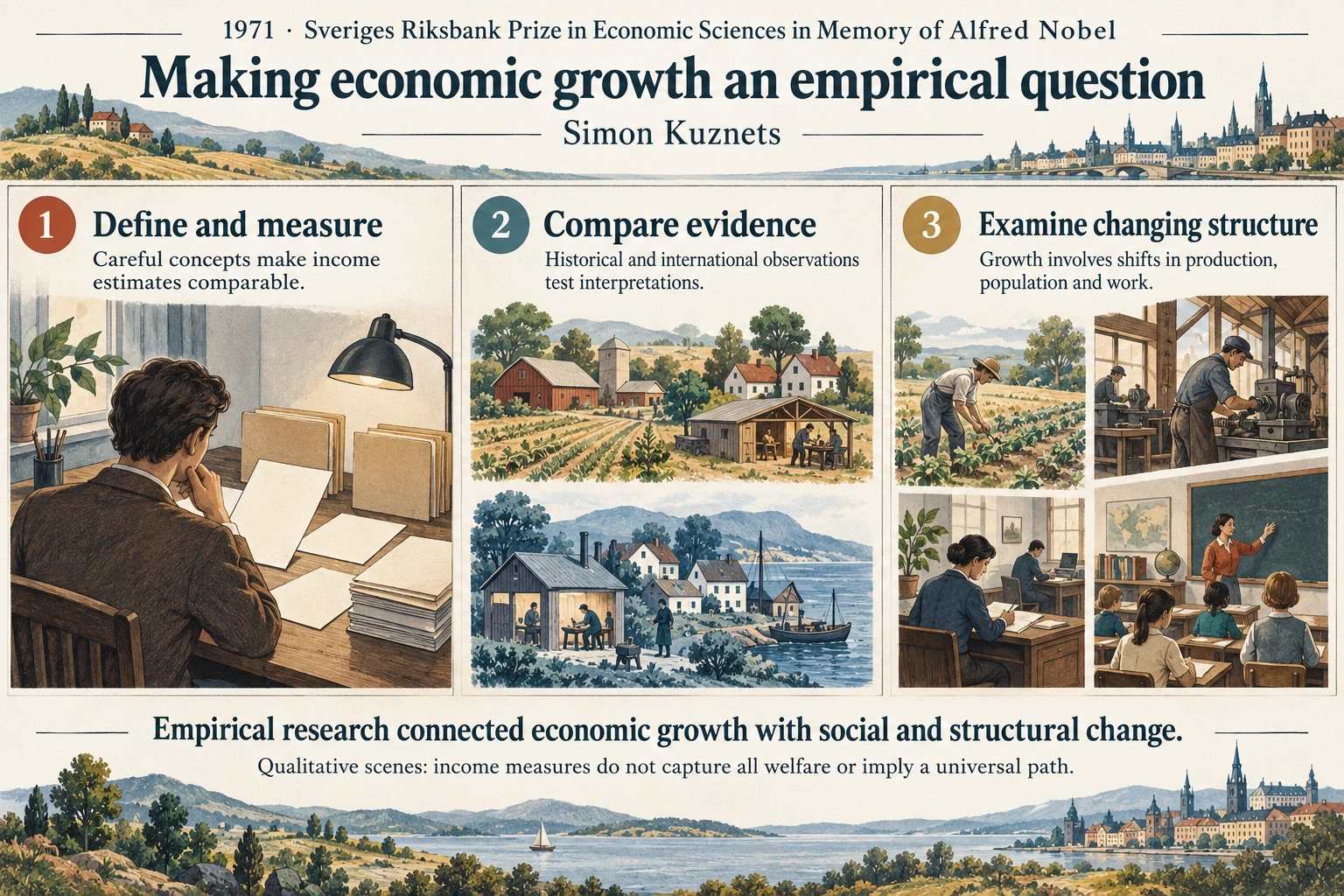
Infographic explaining Making economic growth an empirical question
Original AI-generated infographic. A conceptual overview; the explanations and sources below provide context.
Read the poster text

Empirical research connected economic growth with social and structural change.

  1. Define and measure

    Careful concepts make income estimates comparable.

  2. Compare evidence

    Historical and international observations test interpretations.

  3. Examine changing structure

    Growth involves shifts in production, population and work.

Qualitative scenes: income measures do not capture all welfare or imply a universal path.

01 · The discovery

The idea, in everyday language

Useful comparisons begin with defining what a quantity measures. Kuznets assembled and evaluated evidence on income, production and capital, seeking both precision and an understanding of uncertainty. His work helped standardise national-income and gross-national-product measurement; it was not the invention of every economic statistic.

He connected growth with changes in population, technology, labour and the structure of production. Comparing nations and long periods made development a question of evidence and institutions, rather than an abstract prediction that every country must follow the same path. His 1971 work also examined changes in income distribution.

Why it matters

The research strengthened the empirical study of economic and social development. It encouraged theories that could be tested against historical observations and clarified why rising output, changing production structure and distribution should be examined together.

02 · The people

Who brought the idea to life?

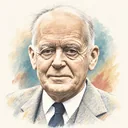
Illustrated portrait of Simon Kuznets

Simon Kuznets

Prize share · 1

Kuznets combined statistical measurement and historical comparison to interpret economic growth and structural change. He received the entire Economic Sciences memorial prize.

Read the biography ↗

03 · Years in the making

The path here

  1. 1922

    Kuznets moves to the United States.

  2. 1926

    He completes his Columbia doctorate.

  3. 1927

    He joins the National Bureau of Economic Research.

  4. 1966

    Modern Economic Growth is published.

  5. 1971

    Economic Growth of Nations appears; he receives the memorial prize.

04 · Read further

From the original sources

Original explanations by Curionode, based on the official records below. Biographical details and affiliations refer to the award year.

  1. Official award summary nobelprize.org
  2. Award ceremony speech nobelprize.org
  3. Official biography: Simon Kuznets nobelprize.org

More in Economic Sciences

Browse this subject ↗