c.curionodeThe Nobel Archive

1970 · Economic Sciences

Sharper analytical tools for economic questions

Samuelson strengthened economics by making assumptions and relationships more explicit. His work connected static choices and equilibria with questions about change and stability.

The Sveriges Riksbank Prize in Economic Sciences in Memory of Alfred Nobel.

Economic analysisRevealed preferenceDynamics and stability
1970Economic Sciences

Visual guide

The prize, pictured

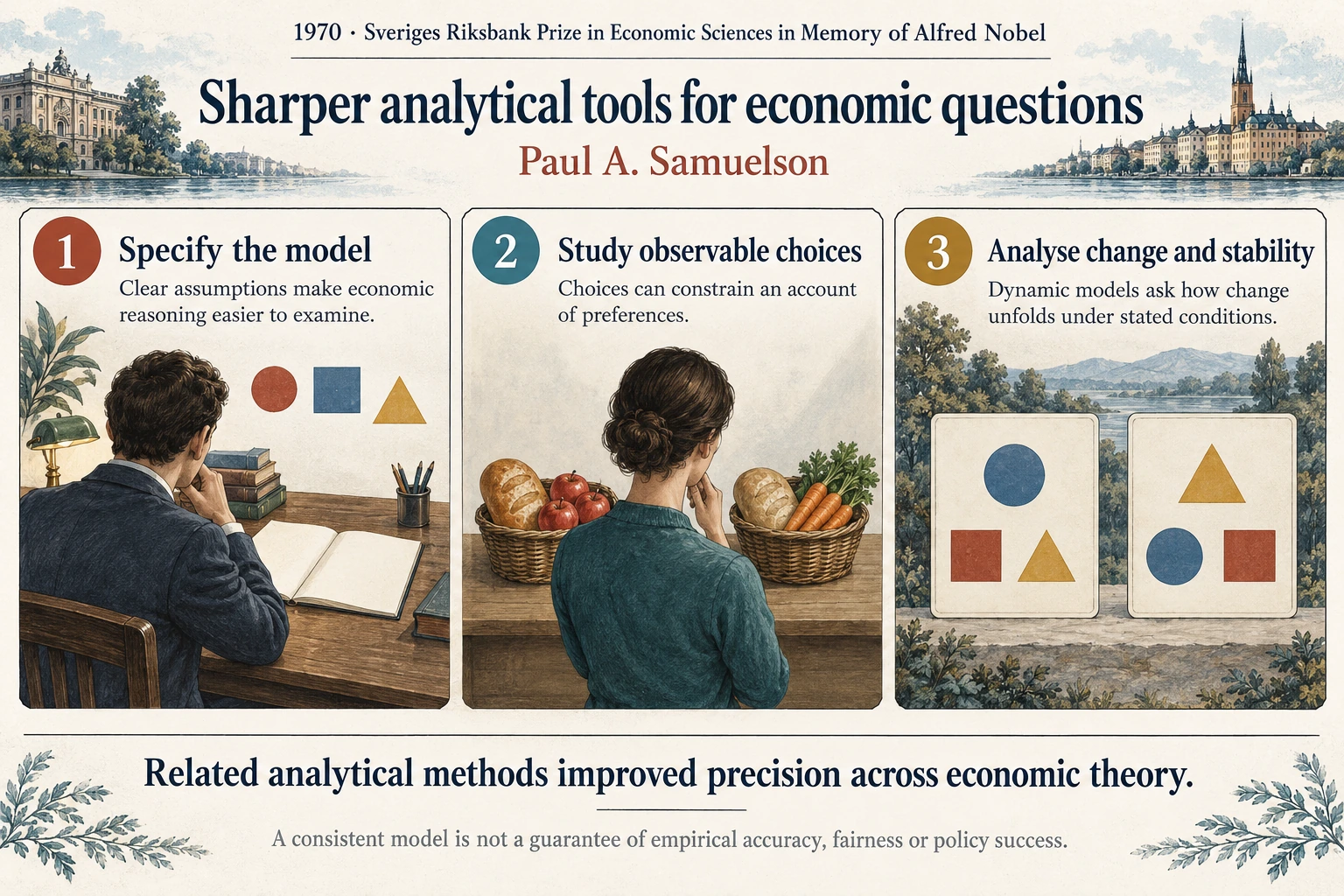
Infographic explaining Sharper analytical tools for economic questions
Original AI-generated infographic. A conceptual overview; the explanations and sources below provide context.
Read the poster text

Related analytical methods improved precision across economic theory.

  1. Specify the model

    Clear assumptions make economic reasoning easier to examine.

  2. Study observable choices

    Choices can constrain an account of preferences.

  3. Analyse change and stability

    Dynamic models ask how change unfolds under stated conditions.

A consistent model is not a guarantee of empirical accuracy, fairness or policy success.

01 · The discovery

The idea, in everyday language

Mathematical formalisation helped separate what was assumed from what followed within a model. Samuelson applied related analytical methods across consumption, welfare, trade and capital. His revealed-preference approach started from observable choices and examined the consistency they could imply under stated conditions.

Dynamic analysis asked how an economic system behaves over time and outside equilibrium. Stability results specified when a model could return toward equilibrium after a disturbance. The correspondence principle connected some dynamic conditions with conclusions from static analysis. These were conditional analytical tools, rather than measurements proving every real economy stable.

Why it matters

The work improved the precision and coherence of economic reasoning and influenced research and teaching across many fields. Analysis of trade, welfare and capital also clarified the difference between aggregate possibilities and effects on different people.

02 · The people

Who brought the idea to life?

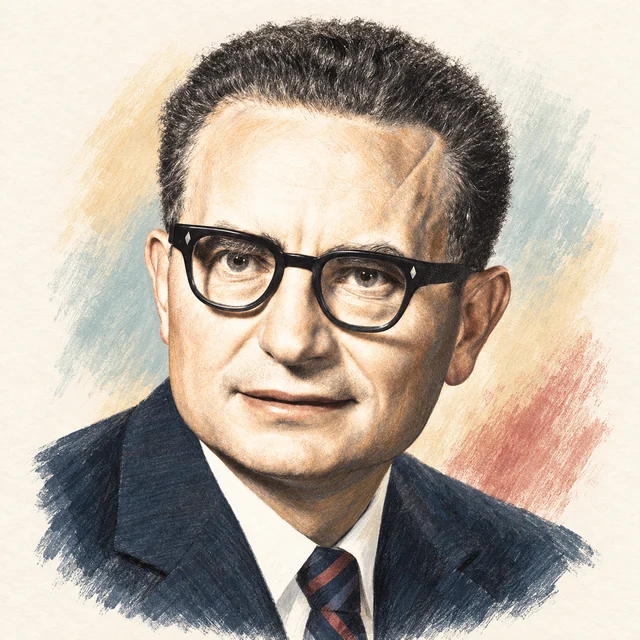
Illustrated portrait of Paul A. Samuelson

Paul A. Samuelson

Prize share · 1

Samuelson developed static and dynamic theory and strengthened analytical methods across economics. He received the entire Economic Sciences memorial prize.

Read the biography ↗

03 · Years in the making

The path here

  1. 1935

    Samuelson graduates from Chicago.

  2. 1940

    He joins MIT.

  3. 1941

    He completes his Harvard doctorate.

  4. 1947

    Foundations of Economic Analysis is published.

  5. 1948

    His introductory Economics textbook appears.

  6. 1970

    He receives the Economic Sciences memorial prize.

04 · Read further

From the original sources

Original explanations by Curionode, based on the official records below. Biographical details and affiliations refer to the award year.

  1. Official award summary nobelprize.org
  2. Award ceremony speech nobelprize.org
  3. Official biography: Paul A. Samuelson nobelprize.org

More in Economic Sciences

Browse this subject ↗