c.curionodeThe Nobel Archive

1972 · Economic Sciences

Connecting markets and examining economic welfare

A change in one market can affect many others. Hicks and Arrow developed general-equilibrium and welfare theory, asking how economic choices fit together and what can be concluded under explicit assumptions.

The Sveriges Riksbank Prize in Economic Sciences in Memory of Alfred Nobel.

General equilibriumWelfare economicsSocial choice
1972Economic Sciences

Visual guide

The prize, pictured

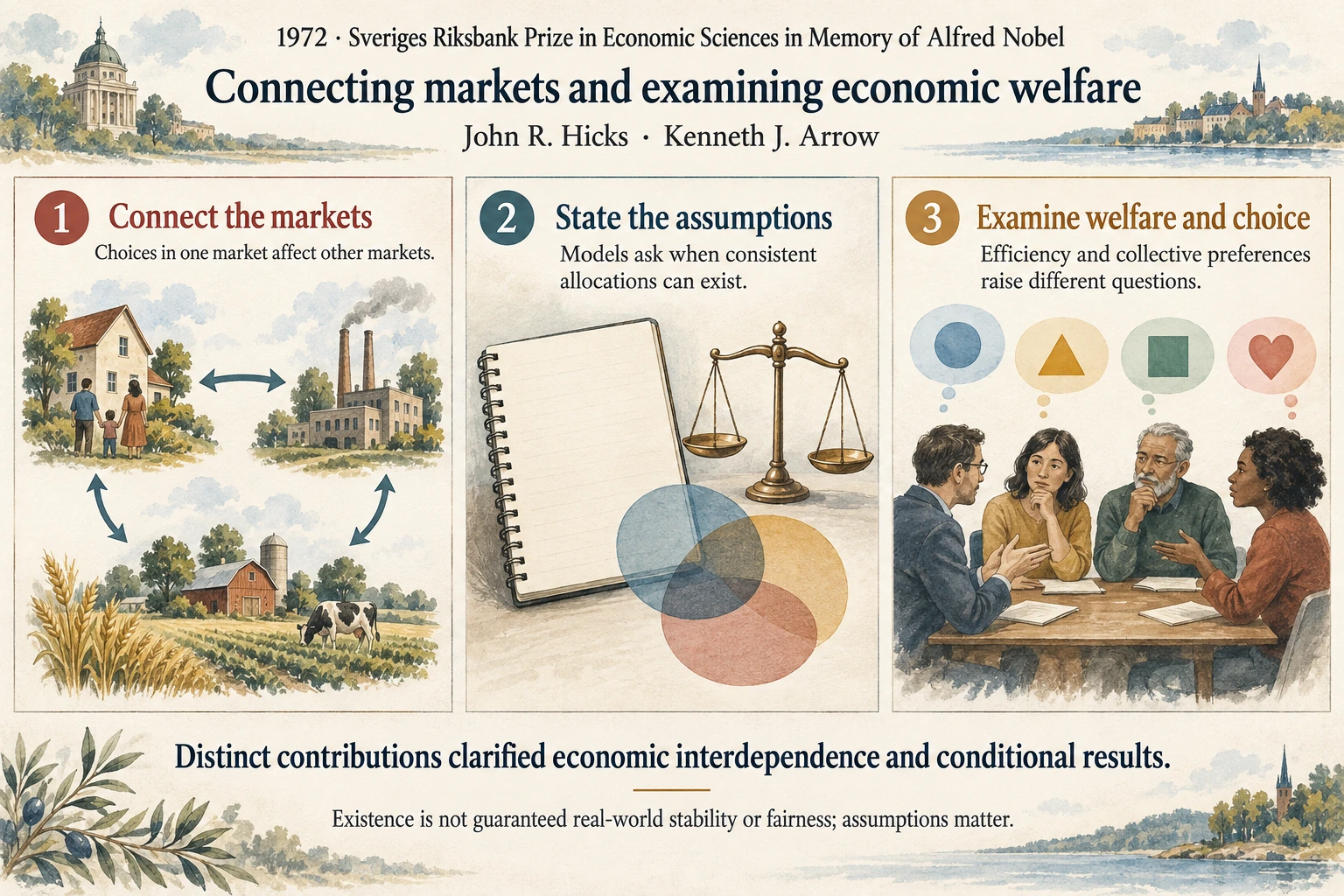
Infographic explaining Connecting markets and examining economic welfare
Original AI-generated infographic. A conceptual overview; the explanations and sources below provide context.
Read the poster text

Distinct contributions clarified economic interdependence and conditional results.

  1. Connect the markets

    Choices in one market affect other markets.

  2. State the assumptions

    Models ask when consistent allocations can exist.

  3. Examine welfare and choice

    Efficiency and collective preferences raise different questions.

Existence is not guaranteed real-world stability or fairness; assumptions matter.

01 · The discovery

The idea, in everyday language

Hicks’s Value and Capital linked consumers, producers, credit, money and capital within a broader model. It helped study how changes across markets interact and how decisions relate across periods. His welfare work also examined criteria for comparing economic situations and the meaning of consumer surplus.

Arrow used new mathematical methods to establish conditions for general equilibrium, including work with Debreu in 1954. He investigated uncertainty and welfare properties, as well as social choice. His impossibility result shows that specified conditions on aggregating individual preferences cannot all be satisfied together. It does not say that every collective decision is impossible.

Why it matters

The work gave economic theory more systematic tools for studying equilibrium and welfare. It also clarified the limits of conclusions: proving that an equilibrium exists under a model’s conditions differs from showing a real economy will reach a unique or fair outcome.

02 · The people

Who brought the idea to life?

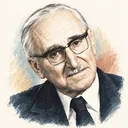
Illustrated portrait of John R. Hicks

John R. Hicks

Prize share · 1/2

Hicks developed general-equilibrium analysis and welfare comparisons, including the framework of Value and Capital. He received half the Economic Sciences memorial prize.

Read the biography ↗
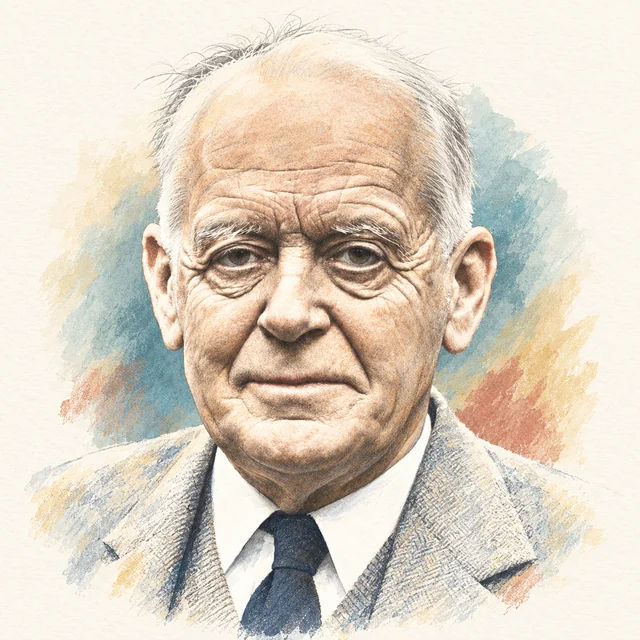
Illustrated portrait of Kenneth J. Arrow

Kenneth J. Arrow

Prize share · 1/2

Arrow strengthened general-equilibrium theory and welfare analysis, including conditional results about equilibrium and social choice. He received half the Economic Sciences memorial prize.

Read the biography ↗

03 · Years in the making

The path here

  1. 1939

    Hicks published Value and Capital.

  2. 1951

    Arrow completed his doctorate and developed social-choice work.

  3. 1954

    Arrow and Debreu published their equilibrium-existence contribution.

  4. 1968

    Arrow moved to Harvard.

  5. 1972

    Hicks and Arrow shared the Economic Sciences memorial prize.

04 · Read further

From the original sources

Original explanations by Curionode, based on the official records below. Biographical details and affiliations refer to the award year.

  1. Official announcement nobelprize.org
  2. Official biography: John R. Hicks nobelprize.org
  3. Official biography: Kenneth J. Arrow nobelprize.org

More in Economic Sciences

Browse this subject ↗