01 · The discovery
The idea, in everyday language
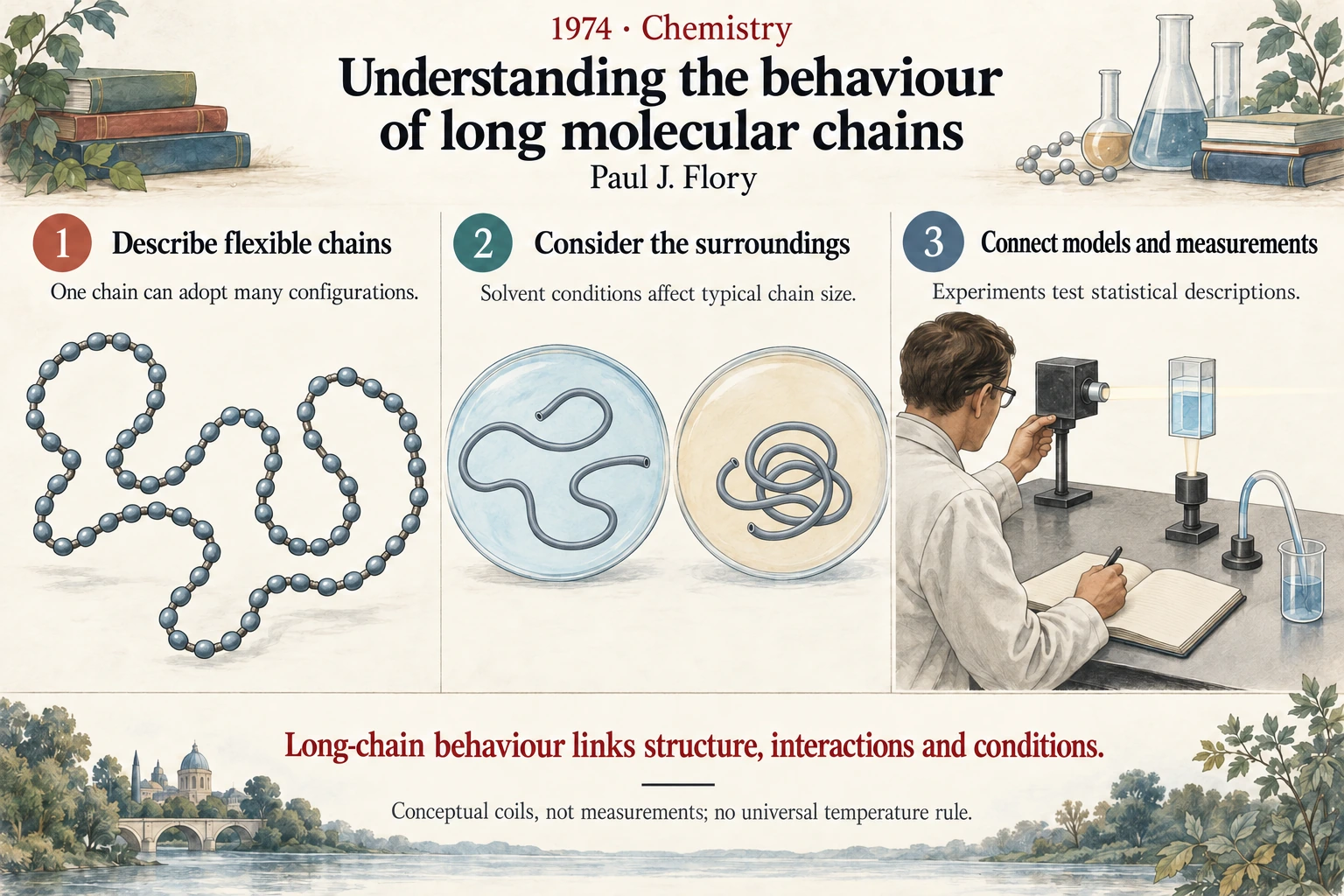
A flexible molecular chain can adopt many configurations. Its typical size depends on chemical structure, chain length and how different segments interact with their surroundings. Segments cannot freely occupy the same physical space; solvent conditions can favour expanded or more compact configurations. Flory developed statistical accounts of these effects and connected them to measurable quantities such as viscosity, diffusion and light scattering.
Theta conditions provide a useful reference for comparing high-molar-mass polymers: an effective excluded-volume contribution is neutralised and some behaviour resembles that of an ideal chain. This is a conditional statistical description, not the disappearance of microscopic interactions or a thermodynamically ideal solution in every respect. Flory also studied how reaction conditions affect the distribution of chain lengths during polymer formation. His work combined mathematical models with experiments rather than prescribing one shape or size for every polymer.
Why it matters
These ideas made macromolecular behaviour more quantitatively understandable, linking molecular structure and preparation to properties useful in studying plastics and biological polymers. The award covered broad theoretical and experimental foundations, rather than one commercial material.