01 · The discovery
The idea, in everyday language
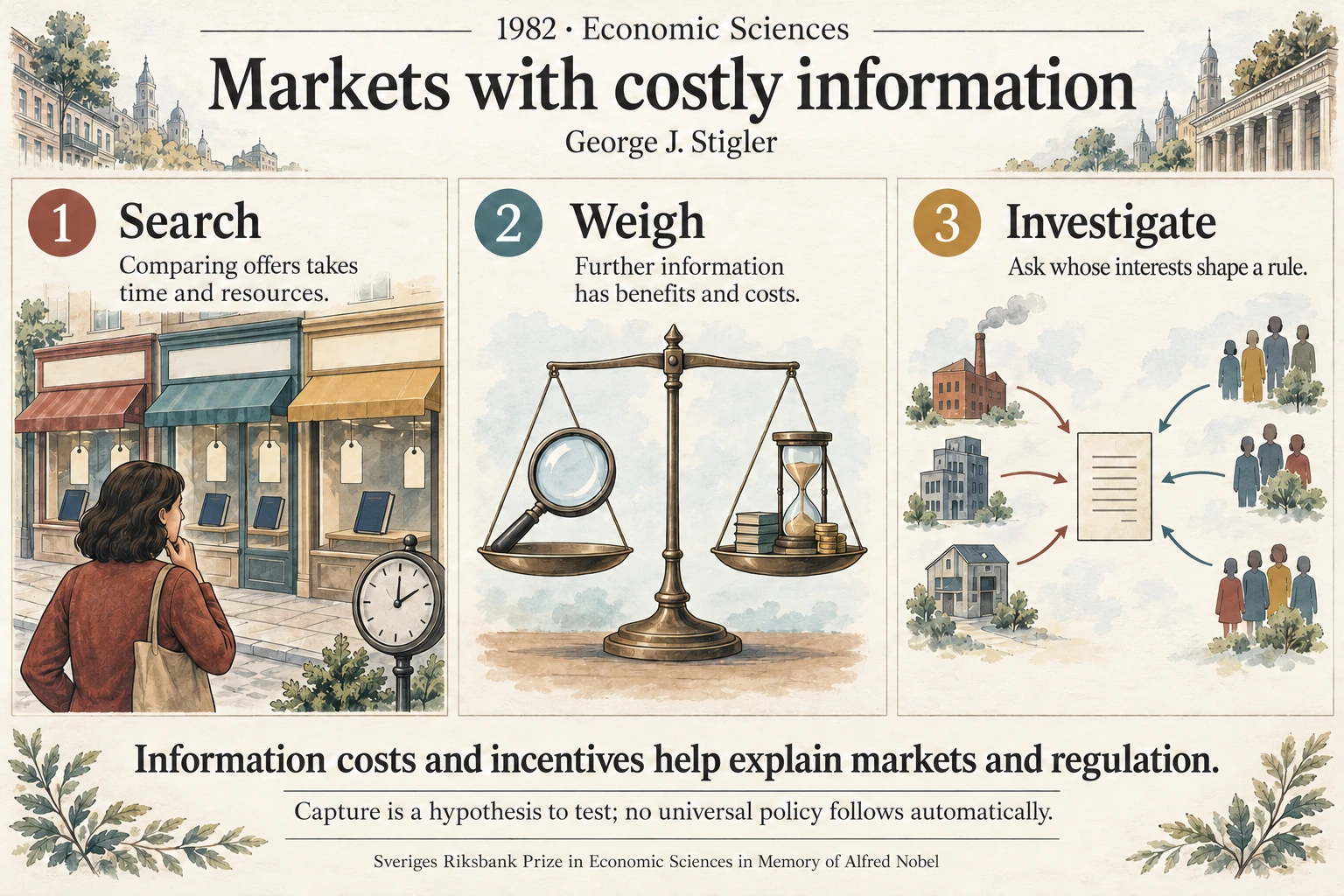
Perfect information is a convenient assumption, but a buyer usually must spend time or resources to compare offers. Stigler treated that search as an economic activity. An additional enquiry may uncover a better price, yet its expected benefit can be smaller than its cost. Price dispersion can therefore persist even when participants respond to incentives.
Industrial organisation asks how firm size, concentration and the ability to monitor competitors affect market behaviour. Regulation introduces another question: who seeks a rule, what can they obtain from it and who bears its costs? Stigler investigated the possibility that organised producer interests influence rules intended to serve the public, making regulation itself part of the economic explanation.
Why it matters
The work made apparently awkward facts—different prices, slow adjustment and unintended regulatory effects—subjects for theoretical and empirical study. His survivor approach examined which firm-size classes persisted rather than assuming production-cost data alone revealed an optimum. The broader legacy is a set of questions about evidence, incentives and institutional design.