c.curionodeThe Nobel Archive

1987 · Physiology or Medicine

Assemble antibody genes from segments

Tonegawa showed that developing immune cells rearrange DNA to create antibody diversity.

antibodiesDNA rearrangementB cellsimmune diversity
1987Physiology or Medicine

Visual guide

The prize, pictured

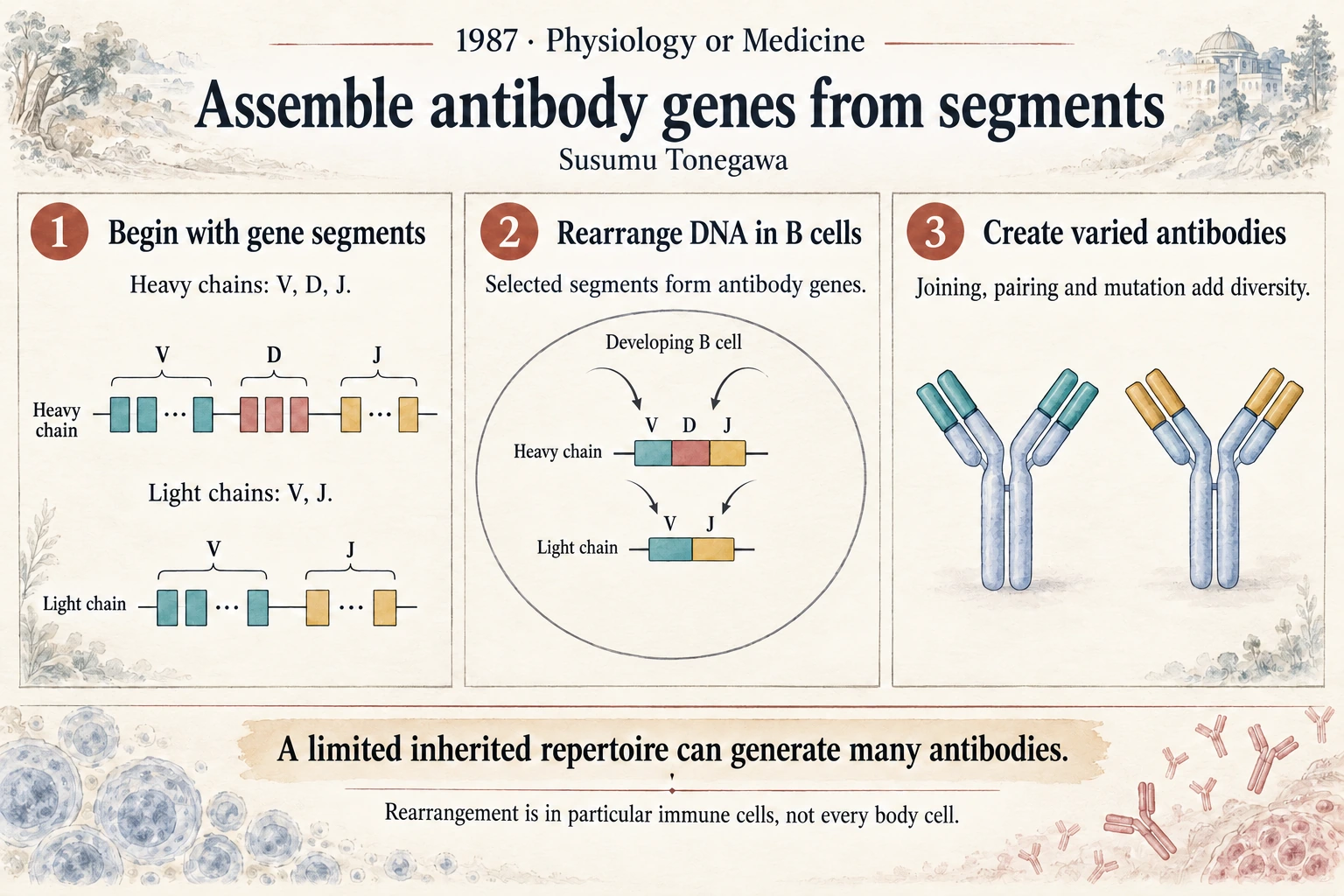
Infographic explaining Assemble antibody genes from segments
Original AI-generated infographic. A conceptual overview; the explanations and sources below provide context.
Read the poster text

A limited inherited repertoire can generate many antibodies.

  1. Begin with gene segments

    Heavy chains: V, D, J. Light chains: V, J.

  2. Rearrange DNA in B cells

    Selected segments form antibody genes.

  3. Create varied antibodies

    Joining, pairing and mutation add diversity.

Rearrangement is in particular immune cells, not every body cell.

01 · The discovery

The idea, in everyday language

An inherited genome need not contain a separate complete gene for every possible antibody. Tonegawa’s work showed that developing B cells rearrange gene segments to assemble antibody genes. Heavy chains use V, D and J segments; light chains use V and J. Joining differences, heavy–light pairing and later somatic mutation add diversity.

In 1976, Hozumi and Tonegawa compared mouse embryonic DNA with DNA from an antibody-producing tumour. Restriction digestion and hybridisation showed different arrangements of light-chain variable and constant sequences. This provided evidence that DNA organisation changes in antibody-producing cells. Subsequent research developed the molecular explanation.

Why it matters

The discovery resolved a central question about how the immune system generates varied recognition molecules. It made DNA rearrangement a concrete biological mechanism rather than an assumption of one inherited gene per antibody. Tonegawa received the full Physiology or Medicine Prize; collaborators and later researchers helped establish the detailed picture.

02 · The people

Who brought the idea to life?

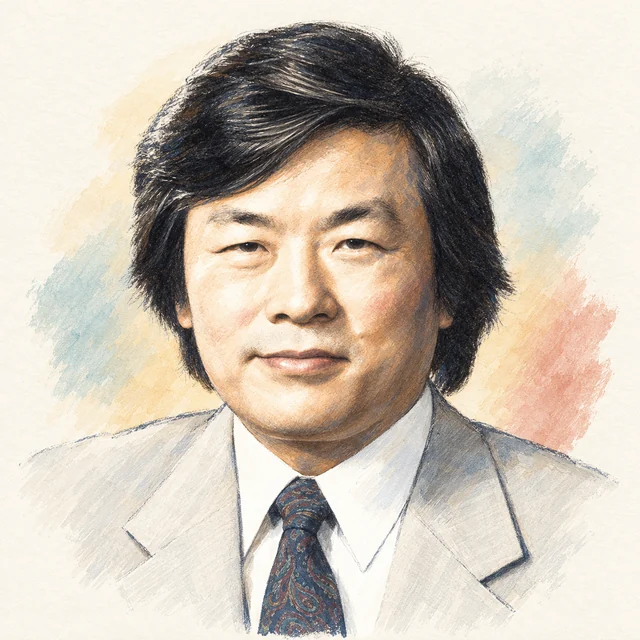
Illustrated portrait of Susumu Tonegawa

Susumu Tonegawa

Prize share · 1

Tonegawa established that antibody diversity depends on somatic rearrangement of DNA segments, resolving a conflict between many possible antibodies and a limited inherited gene repertoire. In a 1976 paper with Hozumi, mouse embryonic DNA and an antibody-producing tumour’s DNA gave different arrangements of light-chain variable and constant gene sequences. Later work clarified mechanisms and additional diversity. He received the full Medicine Prize; this is development of particular immune cells, not rewriting the inherited genome throughout the body.

Read the biography ↗

03 · Years in the making

The path here

  1. 1971

    Tonegawa joins the Basel Institute for Immunology.

  2. 1976

    Hozumi and Tonegawa report evidence of light-chain DNA rearrangement.

  3. 1981

    Tonegawa moves to MIT.

  4. 1987

    He receives the full Medicine Prize for antibody-diversity mechanisms.

04 · Read further

From the original sources

Original explanations by Curionode, based on the official records below. Biographical details and affiliations refer to the award year.

  1. Official announcement nobelprize.org
  2. Hozumi–Tonegawa DNA rearrangement paper (1976) pubmed.ncbi.nlm.nih.gov
  3. Tonegawa review of antibody diversity (1983) pubmed.ncbi.nlm.nih.gov

More in Physiology or Medicine

Browse this subject ↗