c.curionodeThe Nobel Archive

1986 · Physiology or Medicine

Discover signals that regulate cell growth

Levi-Montalcini and Cohen identified growth factors and investigated how cells respond.

growth factorsNGFEGFreceptors
1986Physiology or Medicine

Visual guide

The prize, pictured

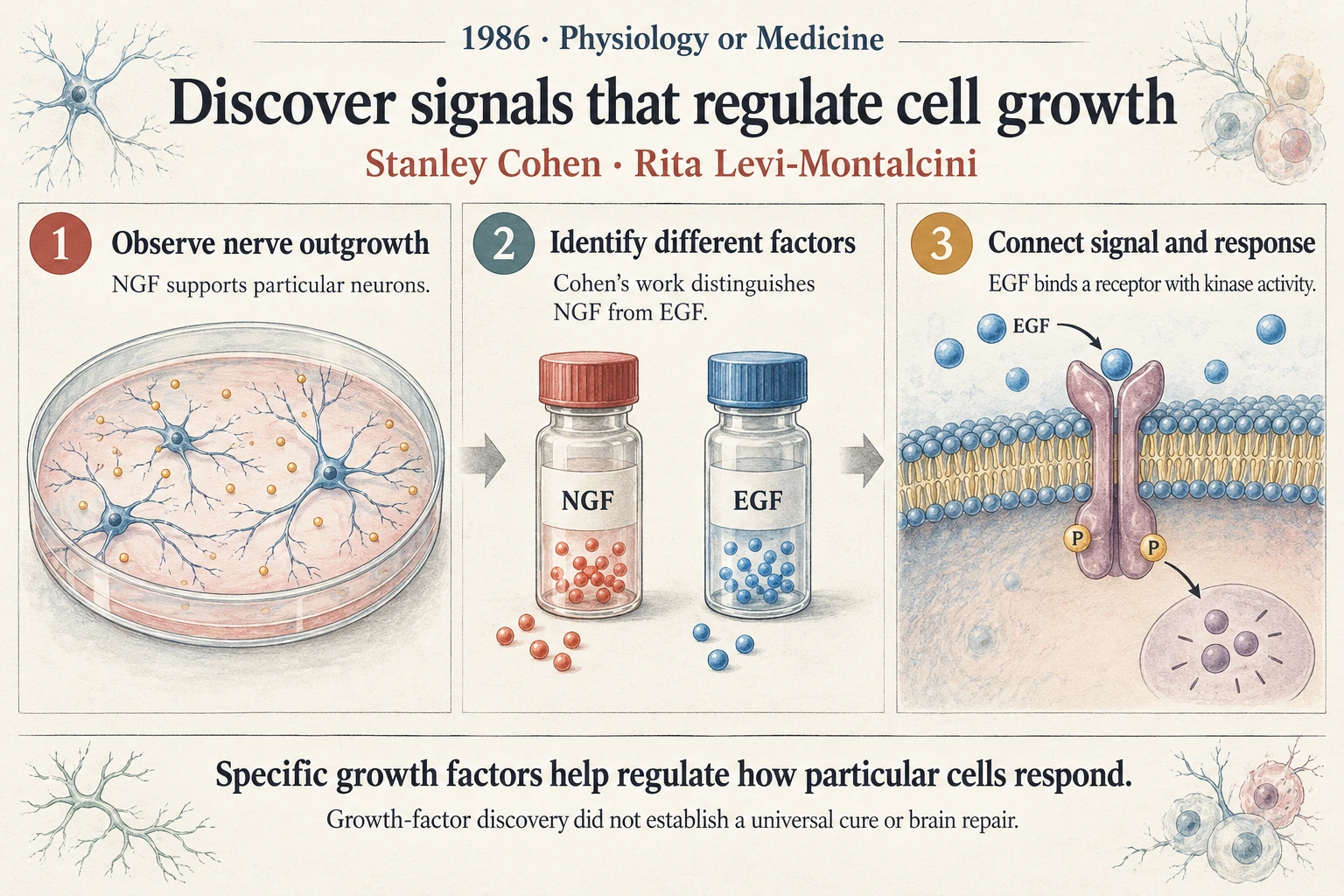
Infographic explaining Discover signals that regulate cell growth
Original AI-generated infographic. A conceptual overview; the explanations and sources below provide context.
Read the poster text

Specific growth factors help regulate how particular cells respond.

  1. Observe nerve outgrowth

    NGF supports particular neurons.

  2. Identify different factors

    Cohen’s work distinguishes NGF from EGF.

  3. Connect signal and response

    EGF binds a receptor with kinase activity.

Growth-factor discovery did not establish a universal cure or brain repair.

01 · The discovery

The idea, in everyday language

Levi-Montalcini’s chick-embryo and tissue-culture experiments showed that certain tumours released a diffusible signal promoting nerve outgrowth. This led to nerve growth factor, important for particular sensory and sympathetic neurons. Cohen joined the work in 1953, using biochemical experiments and rich sources such as snake venom and mouse salivary glands to help characterise NGF.

Unexpected effects of salivary-gland extracts on mouse development led Cohen to epidermal growth factor, isolated in work reported in 1962. Later studies connected EGF binding at the cell membrane with the receptor’s protein-tyrosine kinase activity. These discoveries showed that specific extracellular signals regulate cellular responses; NGF and EGF are different factors with different biological actions.

Why it matters

The discoveries established new ways to study development, cell survival and growth regulation. Work on growth factors and receptors also informed research on abnormal growth and cancer. The award honoured NGF and EGF discoveries and their significance for biology; it did not establish a universal treatment or promise unrestricted tissue repair. Each recipient received one half.
02 · The people

Who brought the idea to life?

Illustrated portrait of Stanley Cohen

Stanley Cohen

Prize share · 1/2

Cohen helped characterise nerve growth factor and discovered epidermal growth factor, whose isolation he reported in 1962. His later work showed that the EGF receptor has protein-tyrosine kinase activity, linking an external signal to cellular biochemistry. He received one half of the Medicine Prize. This is the growth-factor researcher, distinct from the same-named scientist associated with recombinant DNA.

Read the biography ↗
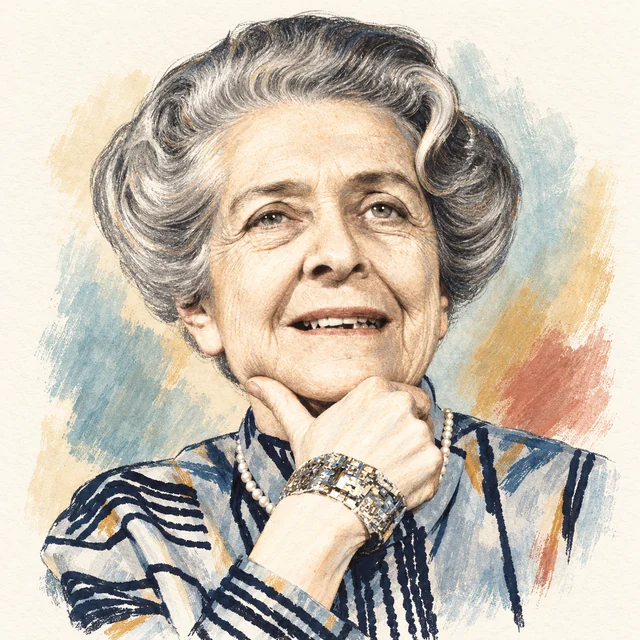
Illustrated portrait of Rita Levi-Montalcini

Rita Levi-Montalcini

Prize share · 1/2

Levi-Montalcini identified the biological action of nerve growth factor through chick-embryo and tissue-culture experiments. A diffusible signal promoted the survival and outgrowth of particular sensory and sympathetic neurons. Cohen’s biochemical work helped characterise the factor. She received one half of the Medicine Prize; NGF does not make all neurons divide or guarantee repair of a damaged brain.

Read the biography ↗

03 · Years in the making

The path here

  1. 1947

    Levi-Montalcini joins Hamburger’s laboratory at Washington University.

  2. 1953

    Cohen begins collaborating on nerve growth factor.

  3. 1962

    Cohen reports isolation of the factor later named EGF.

  4. 1986

    Both receive one half of the Medicine Prize for growth-factor discoveries.

04 · Read further

From the original sources

Original explanations by Curionode, based on the official records below. Biographical details and affiliations refer to the award year.

  1. Official announcement nobelprize.org
  2. Cohen Nobel lecture: EGF and receptor signalling medschool.vanderbilt.edu
  3. Vanderbilt biography of Stanley Cohen news.vanderbilt.edu
  4. EBRI biography of Rita Levi-Montalcini ebri.it

More in Physiology or Medicine

Browse this subject ↗