c.curionodeThe Nobel Archive

1999 · Physics

Making the electroweak theory calculable

A theory unifying electromagnetic and weak interactions needed reliable quantum calculations. ’t Hooft and Veltman showed how to make them work.

electroweak theoryrenormalizationquantum correctionsStandard Model
1999Physics

Visual guide

The prize, pictured

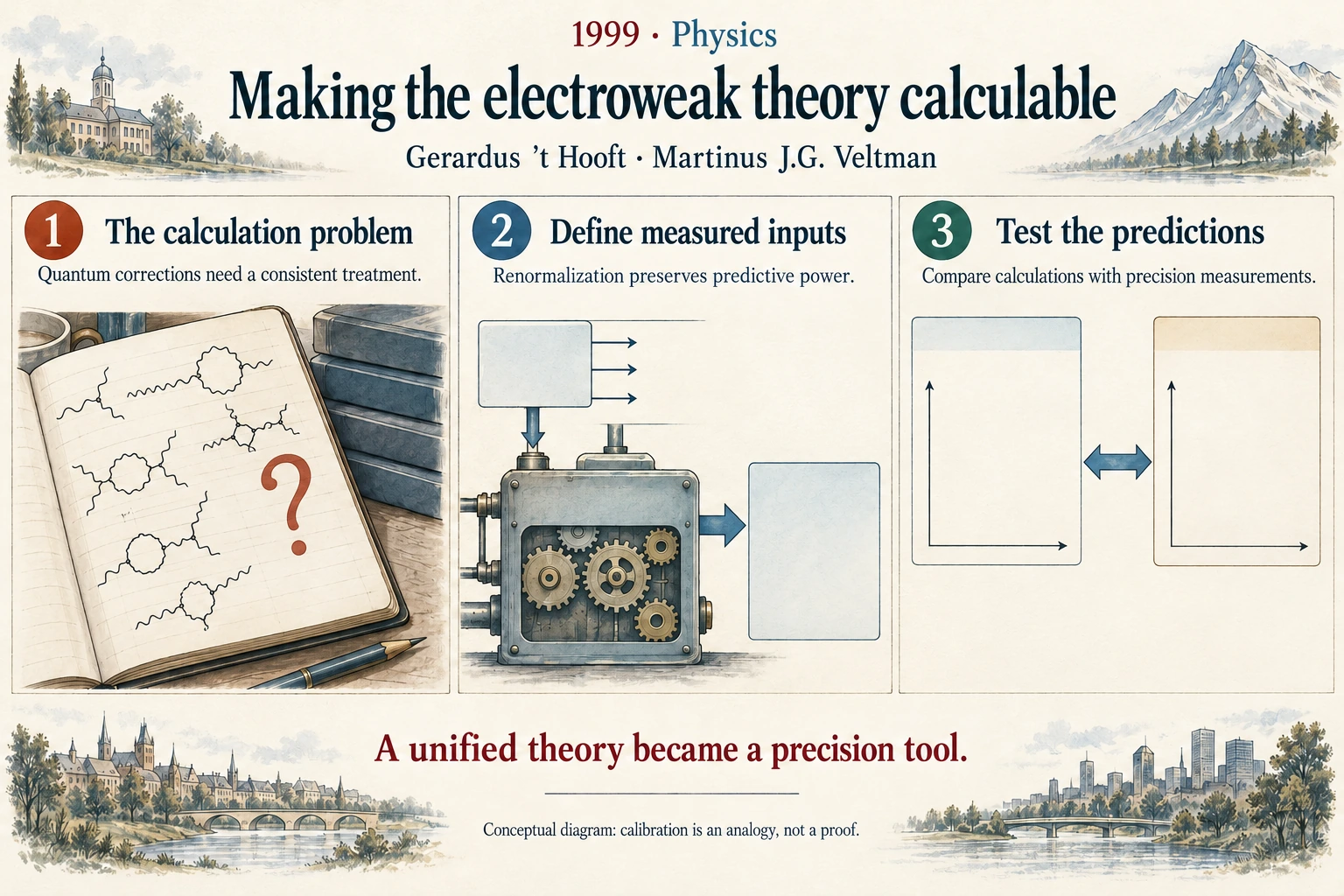
Infographic explaining Making the electroweak theory calculable
Original AI-generated infographic. A conceptual overview; the explanations and sources below provide context.
Read the poster text

A unified theory became a precision tool.

  1. The calculation problem

    Quantum corrections need a consistent treatment.

  2. Define measured inputs

    Renormalization preserves predictive power.

  3. Test the predictions

    Compare calculations with precision measurements.

Conceptual diagram: calibration is an analogy, not a proof.

01 · The discovery

The idea, in everyday language

The electroweak theory described two forces within a common mathematical framework, but calculating quantum corrections could produce divergent expressions. A theory that describes a pattern without yielding usable numbers cannot face a precision test. The challenge was to show that its complicated corrections could be handled consistently while keeping a finite set of measurable inputs.

Veltman pursued this problem and built tools for symbolic calculation. In 1971 his student ’t Hooft established crucial renormalization results, including for theories with spontaneous symmetry breaking. Together they checked the mathematics and developed practical calculation methods. Predictions could then be compared with measurements, and quantum corrections could reveal indirect information about heavier particles.

Why it matters

Their work made the electroweak theory a precision framework within the Standard Model. Comparisons between calculations and collider measurements provided demanding tests and helped constrain the top-quark mass before its direct observation. The prize recognized the quantum structure and calculational foundations, rather than the original unification proposal alone.

02 · The people

Who brought the idea to life?

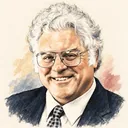
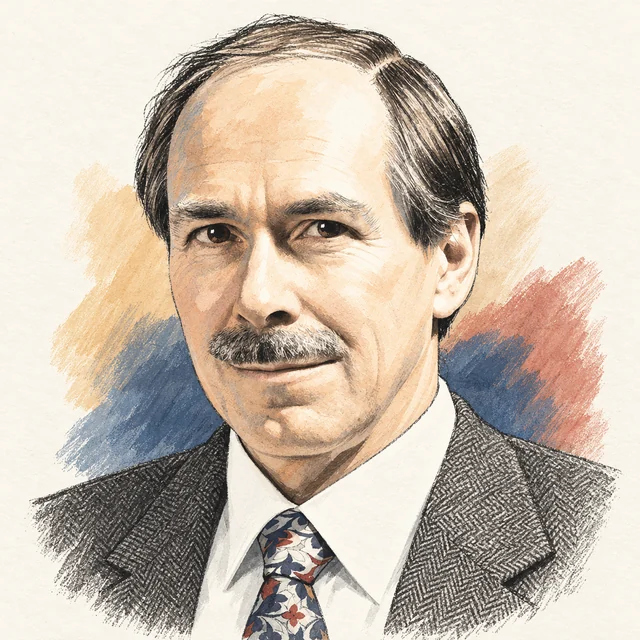
Illustrated portrait of Gerardus 't Hooft

Gerardus 't Hooft

Prize share · 1/2

In 1971, ’t Hooft showed how non-Abelian gauge theories, including the spontaneously broken electroweak theory, could be renormalized. This made it possible to absorb problematic divergent terms into a finite set of measured parameters while retaining predictive power. Working with Veltman, he developed the calculation methods and checks that turned the theory into a practical tool for precision particle physics.

Read the biography ↗
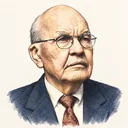
Illustrated portrait of Martinus J.G. Veltman

Martinus J.G. Veltman

Prize share · 1/2

Veltman pursued the renormalization of non-Abelian gauge theories and provided the research setting and symbolic-computation tools for his student ’t Hooft’s breakthrough. Together they tested the results and developed detailed methods for calculating quantum corrections in the electroweak theory. These corrections allowed precision measurements to test the theory and constrain properties of particles not yet directly observed.

Read the biography ↗

03 · Years in the making

The path here

  1. 1971

    ’t Hooft published breakthrough results on renormalizing non-Abelian gauge theories.

  2. 1983

    The W and Z particles were observed at CERN.

  3. 1995

    The top quark was directly observed at Fermilab.

  4. 1999

    The prize recognized the quantum structure of electroweak interactions.

04 · Read further

From the original sources

Original explanations by Curionode, based on the official records below. Biographical details and affiliations refer to the award year.

  1. Official announcement nobelprize.org