01 · The discovery
The idea, in everyday language
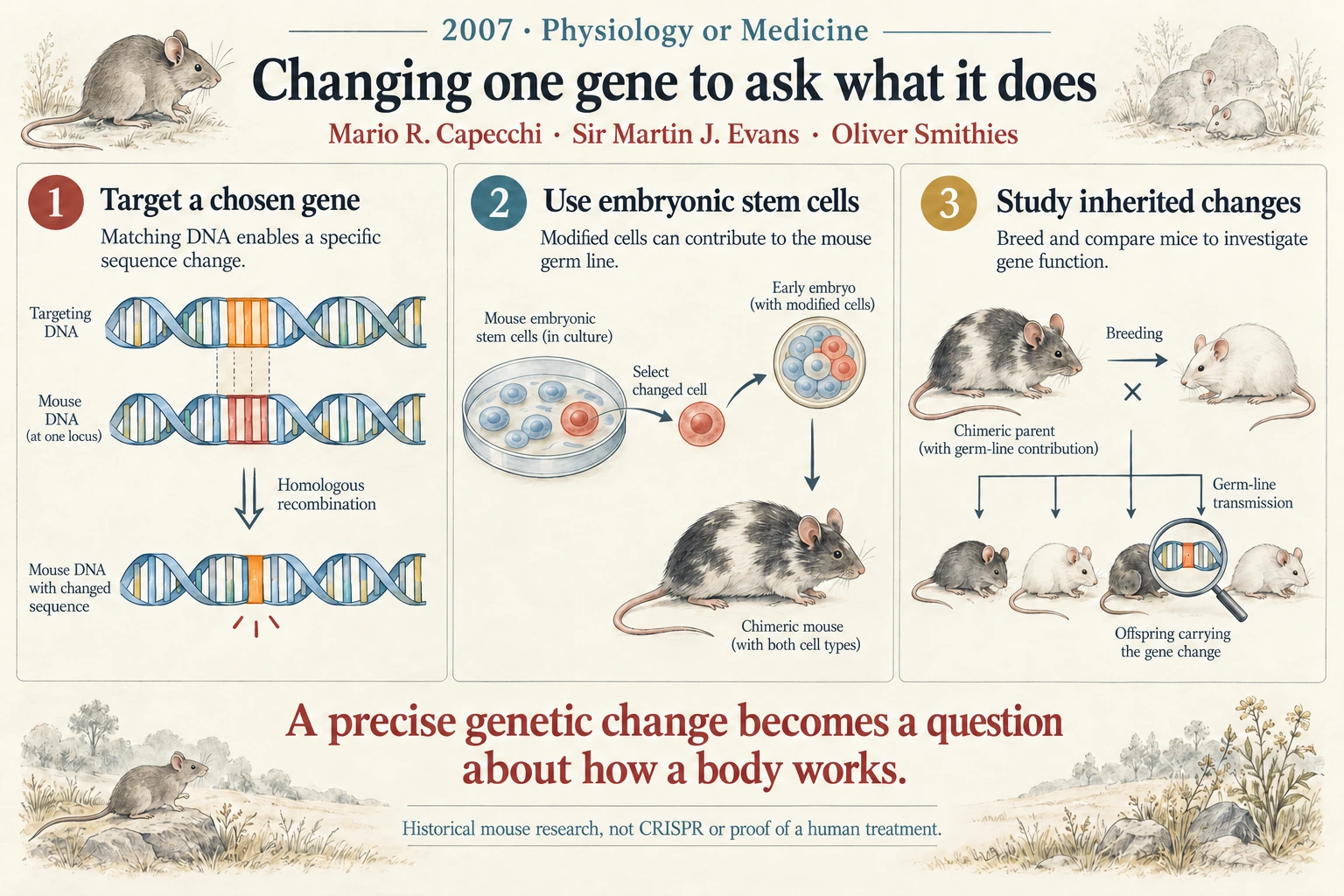
A gene’s sequence does not by itself tell us everything about its job. Researchers can learn more by changing a chosen gene and comparing the result with an appropriate control. Capecchi and Smithies developed ways to use homologous recombination: introduced DNA with matching regions can exchange sequence with a chosen location in a mammalian chromosome. This is targeted modification rather than adding DNA at an arbitrary position.
Evans provided a crucial vehicle: mouse embryonic stem cells that could be grown in culture and contribute to an animal’s tissues, including its germ line. Researchers could modify and select cells, introduce them into an early embryo, obtain mice made from a mixture of cell lineages, and breed offspring carrying the change. Reports of gene-targeted mice appeared in 1989. Inactivating a gene, called a knockout, became one especially useful application.
Why it matters
The technology gave researchers a way to connect particular genes with development, physiology and disease. Mouse models helped investigate inherited disorders and test biological explanations. More elaborate methods later made changes conditional on a tissue or stage of life, allowing questions that a whole-body knockout could not answer.