c.curionodeThe Nobel Archive

2006 · Physiology or Medicine

Silencing a message with RNA

Double-stranded RNA can direct a cell to suppress a matching genetic message.

RNA interferencegene silencingdouble-stranded RNAC. elegans
2006Physiology or Medicine

Visual guide

The prize, pictured

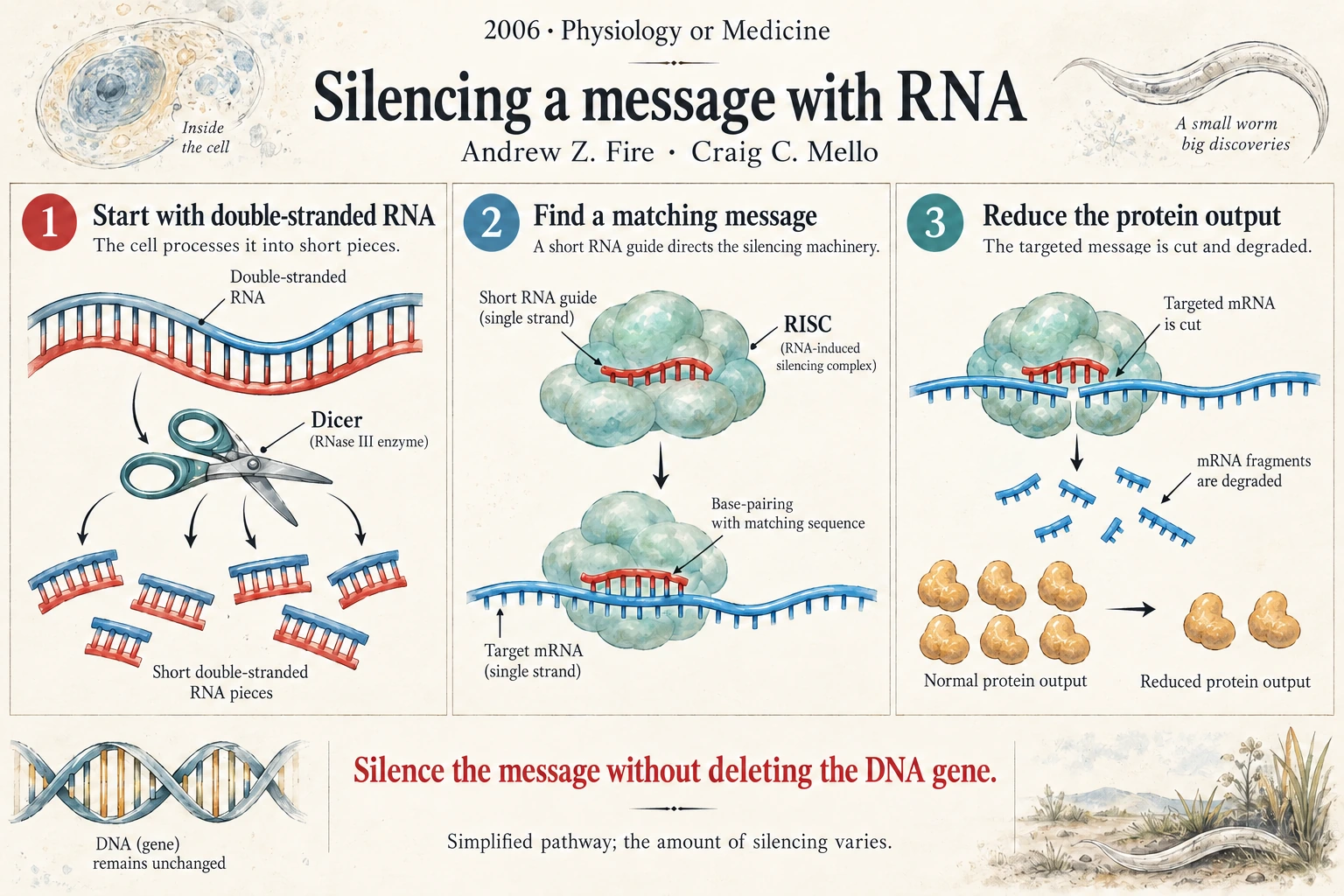
Infographic explaining Silencing a message with RNA
Original AI-generated infographic. A conceptual overview; the explanations and sources below provide context.
Read the poster text

Silence the message without deleting the DNA gene.

  1. Start with double-stranded RNA

    The cell processes it into short pieces.

  2. Find a matching message

    A short RNA guide directs the silencing machinery.

  3. Reduce the protein output

    The targeted message is cut and degraded.

Simplified pathway; the amount of silencing varies.

01 · The discovery

The idea, in everyday language

DNA stores genes, but many genes act through messenger RNA that can be read to make protein. In experiments on C. elegans, Fire, Mello and colleagues found that introducing double-stranded RNA could strongly reduce expression of a gene with a matching sequence. Either single strand alone had much less effect. They reported the discovery in 1998.

Subsequent research explained a molecular pathway: enzymes cut double-stranded RNA into short pieces; one strand guides a silencing complex to matching messenger RNA. The message can then be cut and degraded, reducing the corresponding protein. The original gene need not be removed from DNA. RNA interference thus uses sequence matching to control which messages remain available.

Why it matters

Researchers gained a powerful way to reduce the activity of a chosen gene and observe the consequences. RNA interference also revealed important natural mechanisms of regulation and defence in many organisms. It opened therapeutic research based on targeting RNA, although successful treatment requires solving problems such as delivery and unwanted effects.


02 · The people

Who brought the idea to life?

Illustrated portrait of Andrew Z. Fire

Andrew Z. Fire

Prize share · 1/2

Working with Craig Mello and colleagues, Fire tested different forms of RNA introduced into worms. Double-stranded RNA produced powerful, sequence-specific suppression of a matching gene’s expression, far beyond the effects of either single strand alone. Their 1998 paper established a way for RNA to direct the destruction of matching messages, rather than simply serve as a message itself.

Read the biography ↗
Illustrated portrait of Craig C. Mello

Craig C. Mello

Prize share · 1/2

Mello and Fire jointly led the experiments that identified double-stranded RNA as a potent trigger of RNA interference. The effect followed the sequence of the introduced RNA, could spread within the animal and could persist into offspring. These observations pointed to an active biological mechanism rather than simple physical blocking by an injected strand. Later work by many groups established the molecular machinery.

Read the biography ↗

03 · Years in the making

The path here

  1. 1998

    Fire, Mello and colleagues reported potent, sequence-specific interference by double-stranded RNA.

  2. 2000s

    Researchers identified short RNA guides and protein machinery that recognise matching messages.

  3. 2006

    The prize recognised RNA interference: gene silencing triggered by double-stranded RNA.

04 · Read further

From the original sources

Original explanations by Curionode, based on the official records below. Biographical details and affiliations refer to the award year.

  1. Official announcement nobelprize.org

More in Physiology or Medicine

Browse this subject ↗