01 · The discovery
The idea, in everyday language
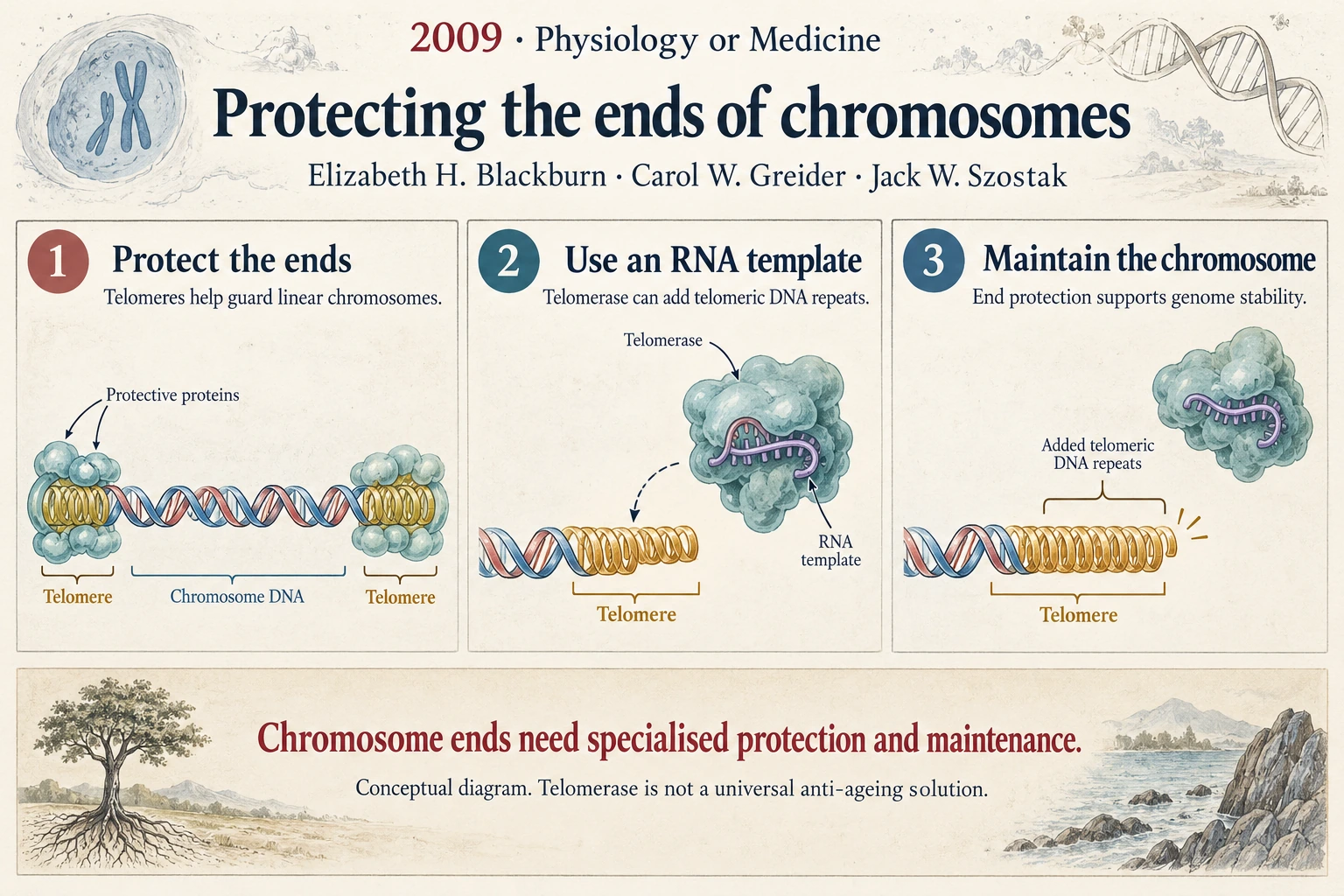
The end of a chromosome presents two problems. It must be protected from degradation or mistaken repair, and ordinary DNA copying has difficulty reproducing the very end of a linear molecule. Blackburn studied repeated DNA at the ends of Tetrahymena chromosomes. With Szostak, she showed that these sequences could protect linear DNA introduced into yeast, revealing a function that crossed distant species.
Greider and Blackburn then found telomerase, an enzyme that adds telomeric DNA repeats. Its RNA component supplies a template for this extension. Together with proteins that organise and protect chromosome ends, these mechanisms help preserve genome stability. Telomeres are specialised DNA–protein structures, not plastic caps, and telomerase is not the enzyme that copies the whole genome.
Why it matters
The discoveries connected chromosome-end maintenance with cell proliferation, some inherited diseases and cancer biology. They also provided a way to investigate one contributor to cellular senescence. Researchers could ask how changing telomere protection or maintenance alters the long-term behaviour of cells.