01 · The contribution
The idea, in everyday language
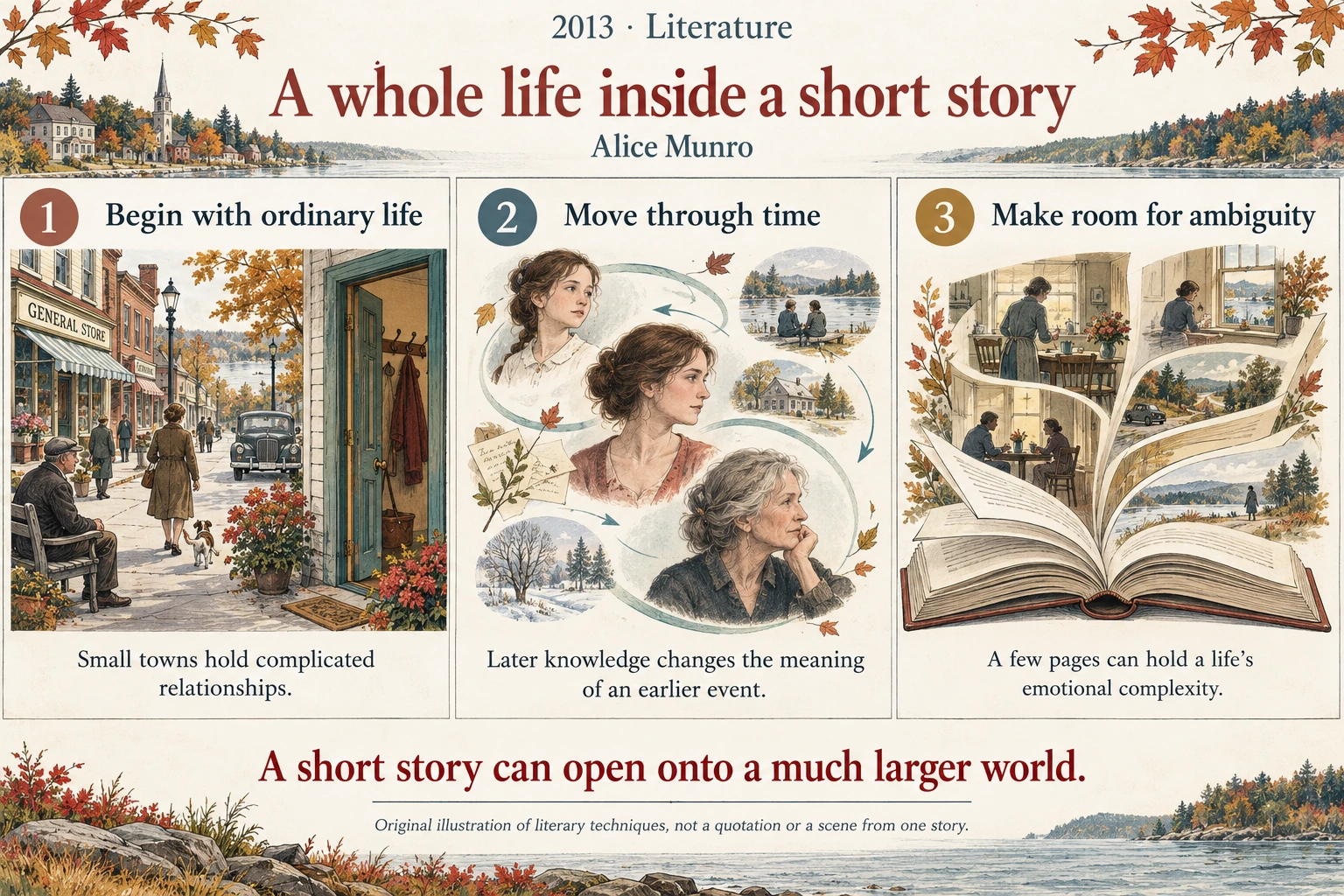
A short story need not describe only a small event or a short stretch of time. Munro’s fiction can move across decades, returning to an incident after a character has changed. A conversation, a departure or a remembered detail may look different from a later vantage point. The reader gradually discovers connections and omissions instead of receiving a life in a simple chronological sequence.
Her settings often include small towns and rural communities in Ontario. Their apparent familiarity makes room for difficult questions about desire, family, class and the pressure of social expectations. Characters are not reduced to examples of a moral lesson. Precise details and shifts in narrative perspective allow a short work to hold competing feelings and interpretations. The Nobel award recognised the literary achievement of this body of work, rather than one book or a scientific explanation of human behaviour.
Why it matters
Munro demonstrated how much narrative scope and psychological depth the short story can carry. Works such as Dance of the Happy Shades, Runaway and Dear Life invite readers to stay with uncertainty and reconsider an initial judgement. Her achievement offers a way to understand literary form: length alone does not determine the scale of a story’s emotional or temporal world.