c.curionodeThe Nobel Archive

2014 · Literature

Following the traces of missing lives

Modiano used uncertain memories and the streets of Paris to explore identity and historical absence.

memoryidentityParis and the occupation
2014Literature

Visual guide

The prize, pictured

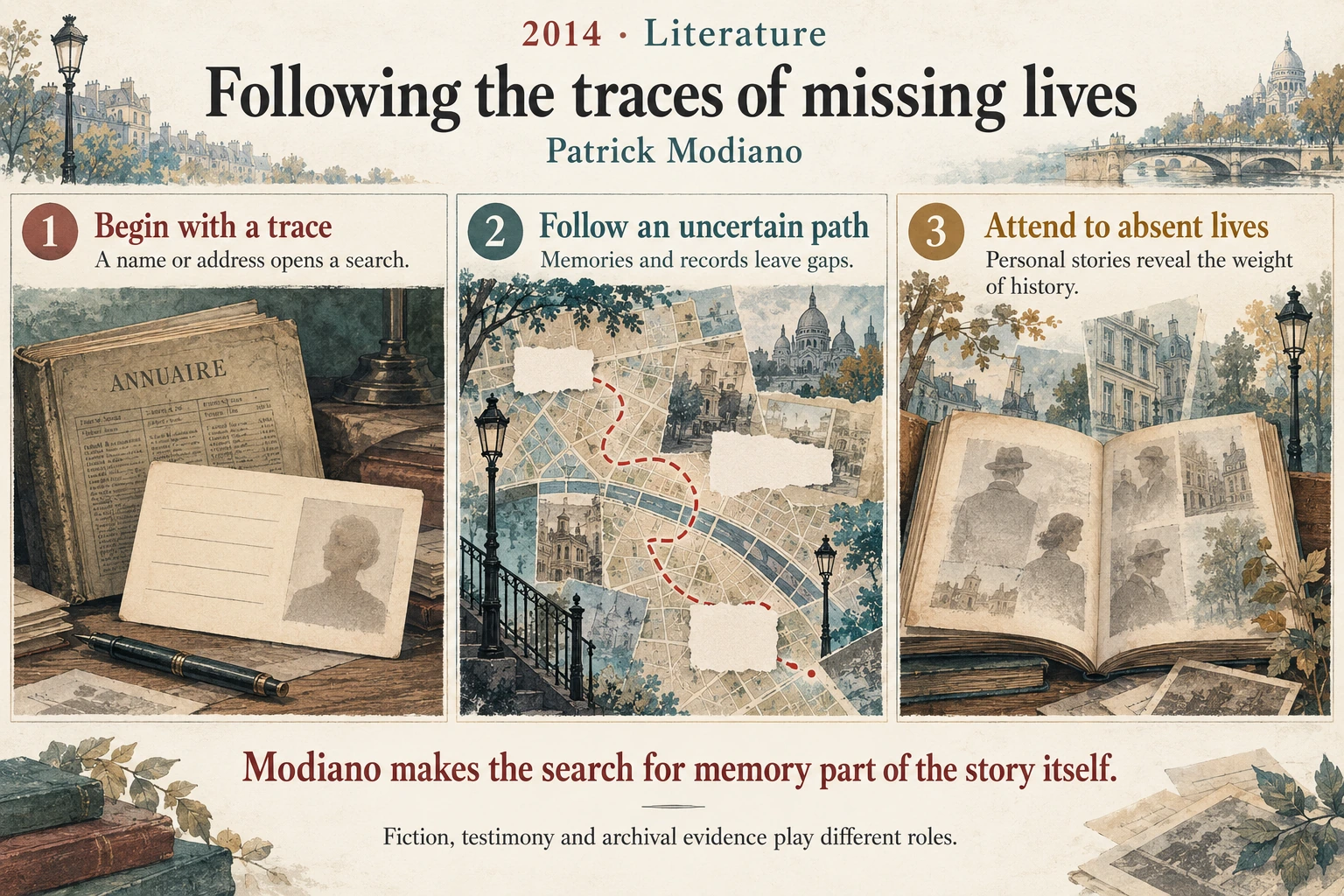
Infographic explaining Following the traces of missing lives
Original AI-generated infographic. A conceptual overview; the explanations and sources below provide context.
Read the poster text

Modiano makes the search for memory part of the story itself.

  1. Begin with a trace

    A name or address opens a search.

  2. Follow an uncertain path

    Memories and records leave gaps.

  3. Attend to absent lives

    Personal stories reveal the weight of history.

Fiction, testimony and archival evidence play different roles.

01 · The contribution

The idea, in everyday language

A name in an old directory, an unfamiliar address or a half-remembered meeting can begin a search in Modiano’s writing. His narrators follow traces that seem to promise a clearer account of a life, yet the evidence often remains incomplete. The reader moves through changing streets and overlapping times, encountering people who have vanished or whose identities are difficult to establish.

The German occupation of France is a recurring historical presence, even when a story unfolds later. Memory, guilt and survival enter through personal questions rather than a complete panoramic account. Paris helps connect the works: places recur, acquire different meanings and hold the possibility of forgotten encounters. In the documentary work Dora Bruder, Modiano investigates the life of a Jewish teenager who became a Holocaust victim. Other books use fictional searches to explore what can and cannot be recovered.

Why it matters

The work makes absence and uncertainty active elements of literary form. It encourages attention to lives that official records preserve only in fragments and to the way later generations encounter a past they did not directly experience. The prize recognised a sustained art of memory across a body of writing.


02 · The people

Who brought the idea to life?

Illustrated portrait of Patrick Modiano

Patrick Modiano

Prize share · 1/1

He developed an art of following incomplete traces: names, memories, old records and places whose meanings have changed. His narratives explore identity, absence and the occupation’s legacy. Dora Bruder turns to the documented life of a Jewish girl who became a Holocaust victim; other works use fiction to examine the uncertainties of remembering.

Read the biography ↗

03 · Years in the making

The path here

  1. 1968

    Modiano publishes his first novel, La place de l’étoile.

  2. 1997

    Dora Bruder follows documentary traces of a Jewish girl in occupied Paris.

  3. 2014

    The Literature Prize recognises his art of memory.

04 · Read further

From the original sources

Original explanations by Curionode, based on the official records below. Biographical details and affiliations refer to the award year.

  1. Official award announcement nobelprize.org
  2. Official biobibliography nobelprize.org

More in Literature

Browse this subject ↗