c.curionodeThe Nobel Archive

2014 · Economic Sciences

Rules for markets with powerful firms

Tirole showed why effective regulation depends on incentives, information and the industry itself.

The Sveriges Riksbank Prize in Economic Sciences in Memory of Alfred Nobel.

market powerregulationinformation and incentives
2014Economic Sciences

Visual guide

The prize, pictured

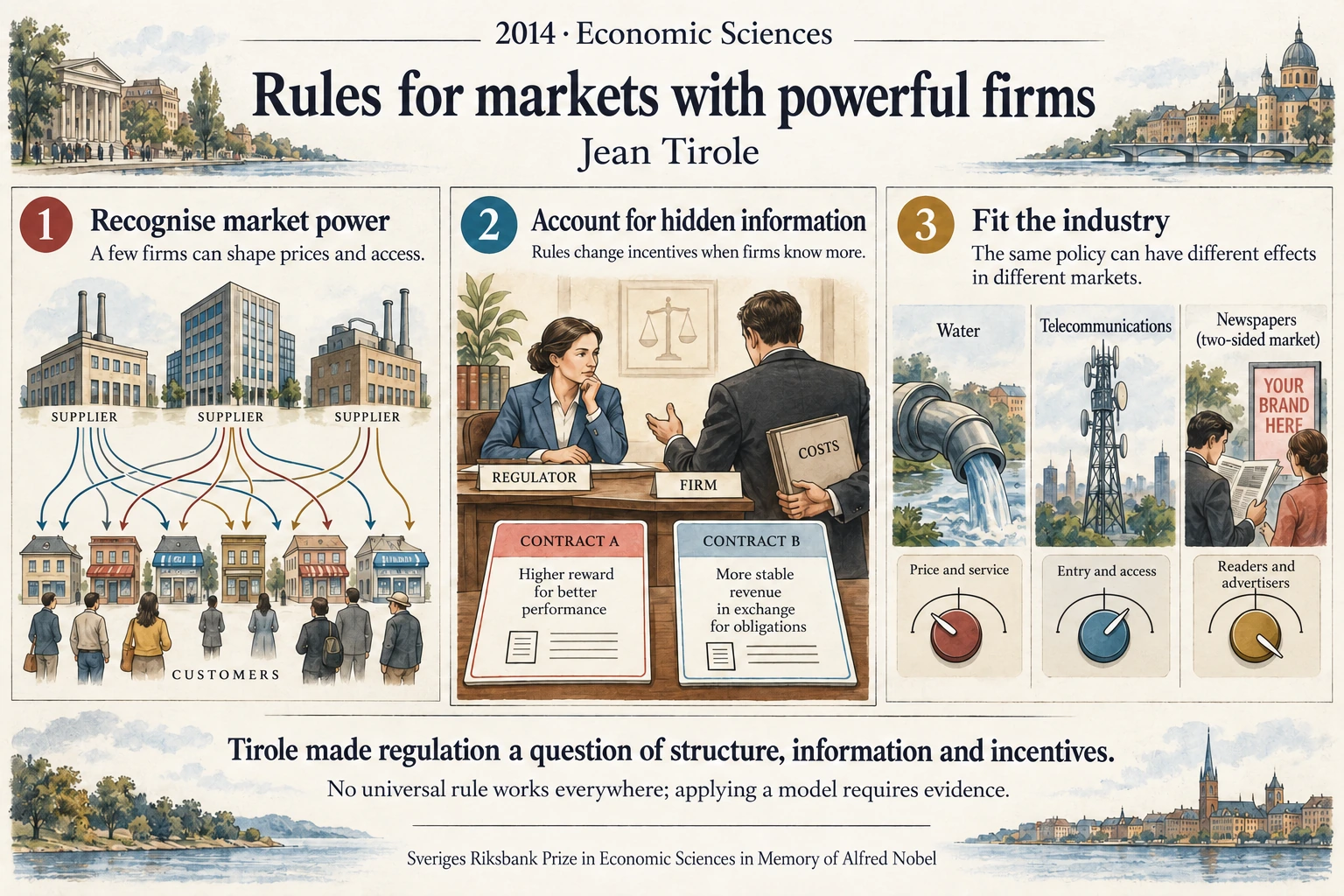
Infographic explaining Rules for markets with powerful firms
Original AI-generated infographic. A conceptual overview; the explanations and sources below provide context.
Read the poster text

Tirole made regulation a question of structure, information and incentives.

  1. Recognise market power

    A few firms can shape prices and access.

  2. Account for hidden information

    Rules change incentives when firms know more.

  3. Fit the industry

    The same policy can have different effects in different markets.

No universal rule works everywhere; applying a model requires evidence.

01 · The discovery

The idea, in everyday language

Some markets have only a few major firms, or one supplier that is very difficult to replace. Those firms can influence prices, quality and the opportunities available to rivals. A regulator may want affordable services and productive investment, but usually knows less than the firm about its real costs and choices. Simply ordering a low price can create different problems from reimbursing every reported expense.

Tirole used game theory and contract theory to analyse these interactions. With Jean-Jacques Laffont, he studied how a menu of contracts can account for a firm’s private information while encouraging useful effort. Other work examined mergers, strategic investments and access to important parts of a supply chain. Research with Jean-Charles Rochet clarified platform markets, where the value to one group depends on participation by another—for example, readers and advertisers. A practice that looks similar on the surface can therefore have different effects in different industries.

Why it matters

The research gave policymakers a framework for analysing market power rather than relying on one slogan about large firms. It connected competition, investment and regulation with the specific structure of an industry. The contribution was theoretical and practical: it improved the questions asked when assessing how rules might affect consumers, firms and entry.


02 · The people

Who brought the idea to life?

Illustrated portrait of Jean Tirole

Jean Tirole

Prize share · 1/1

He analysed regulation when firms know more about their costs than the regulator does, including influential work with Jean-Jacques Laffont. He also studied mergers, strategic investment and platform markets with collaborators. His work explains why a policy’s effects depend on incentives, information and market structure, rather than on one rule suitable for every industry.

Read the biography ↗

03 · Years in the making

The path here

  1. 1986

    Laffont and Tirole analyse regulation when a firm has private information about costs.

  2. 1993

    Their book develops an incentive-based theory of procurement and regulation.

  3. 2014

    The prize recognises Tirole’s analysis of market power and regulation.

04 · Read further

From the original sources

Original explanations by Curionode, based on the official records below. Biographical details and affiliations refer to the award year.

  1. Official award announcement nobelprize.org
  2. Nobel Committee’s accessible background nobelprize.org

More in Economic Sciences

Browse this subject ↗