c.curionodeThe Nobel Archive

2016 · Economic Sciences

Designing cooperation when a contract is incomplete

Contract theory explains how incentives, risk and decision rights shape cooperation.

The Sveriges Riksbank Prize in Economic Sciences in Memory of Alfred Nobel.

contract theoryincentivescontrol rights
2016Economic Sciences

Visual guide

The prize, pictured

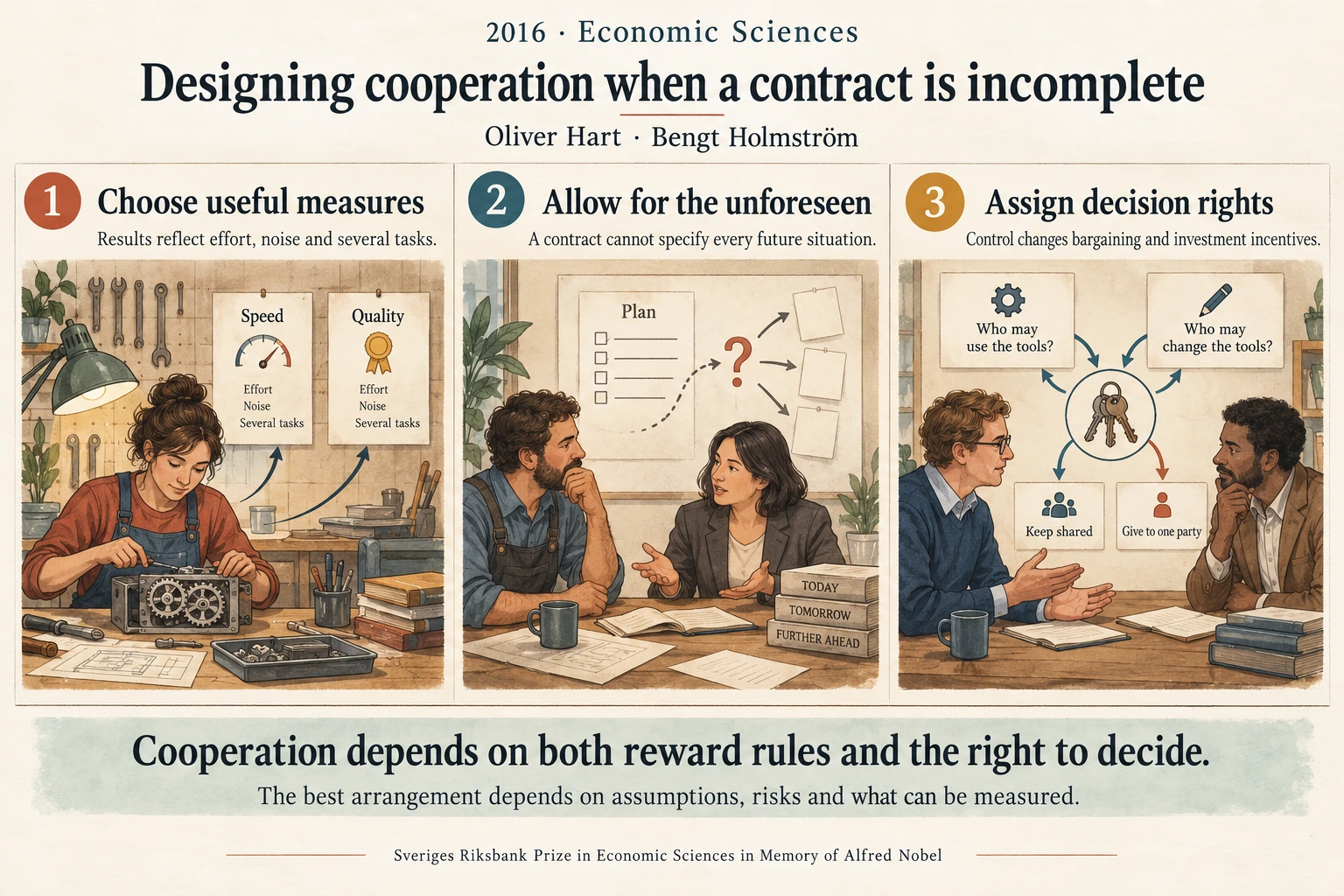
Infographic explaining Designing cooperation when a contract is incomplete
Original AI-generated infographic. A conceptual overview; the explanations and sources below provide context.
Read the poster text

Cooperation depends on both reward rules and the right to decide.

  1. Choose useful measures

    Results reflect effort, noise and several tasks.

  2. Allow for the unforeseen

    A contract cannot specify every future situation.

  3. Assign decision rights

    Control changes bargaining and investment incentives.

The best arrangement depends on assumptions, risks and what can be measured.

01 · The discovery

The idea, in everyday language

Suppose a workshop pays a repairer only for the number of jobs completed. Speed may rise, but careful diagnosis and lasting quality may suffer. Holmström studied such problems when one party cannot observe another’s actions directly. Performance measures contain information, but also luck. Good contract design must consider which measures reveal effort, how much risk a worker bears, and whether rewarding one task draws attention away from others.

Hart examined another gap: no contract can spell out every future situation in an enforceable way. When something unforeseen happens, who gets to decide? Ownership and control rights affect bargaining power. They therefore change each party’s willingness to make investments before the uncertainty is resolved. With collaborators, Hart showed why the boundaries of a firm and the allocation of assets are part of the cooperation problem, not just administrative details.

Why it matters

The theories offer tools for analysing employment, insurance, business ownership, finance and public services. They show why stronger performance pay is not always better and why transferring ownership changes incentives. Their value lies in making assumptions and trade-offs explicit, so different arrangements can be compared.


02 · The people

Who brought the idea to life?

Illustrated portrait of Oliver Hart

Oliver Hart

Prize share · 1/2

With collaborators including Sanford Grossman and John Moore, he developed the theory of incomplete contracts. Their models explain how assigning control over assets changes bargaining power and incentives to invest, helping economists analyse firm boundaries, financing and public versus private provision.

Read the biography ↗
Illustrated portrait of Bengt Holmström

Bengt Holmström

Prize share · 1/2

He analysed how contracts can use informative performance measures while balancing incentives against risk. Later work addressed teams, career concerns and jobs with several tasks. It explained why rewarding a narrow target too strongly can draw attention away from equally valuable but less measurable work.

Read the biography ↗

03 · Years in the making

The path here

  1. 1979

    Holmström analyses informative performance measures and incentive contracts.

  2. 1980s

    Hart and collaborators develop the economics of incomplete contracts and ownership.

  3. 2016

    The memorial prize recognises contributions to contract theory.

04 · Read further

From the original sources

Original explanations by Curionode, based on the official records below. Biographical details and affiliations refer to the award year.

  1. Official award announcement nobelprize.org
  2. Nobel Committee’s accessible background nobelprize.org

More in Economic Sciences

Browse this subject ↗