c.curionodeThe Nobel Archive

2017 · Economic Sciences

Economics with real people in the model

Richard Thaler showed how limited attention, fairness and self-control shape economic decisions.

The Sveriges Riksbank Prize in Economic Sciences in Memory of Alfred Nobel.

Mental accountingFairnessChoice and self-control
2017Economic Sciences

Visual guide

The prize, pictured

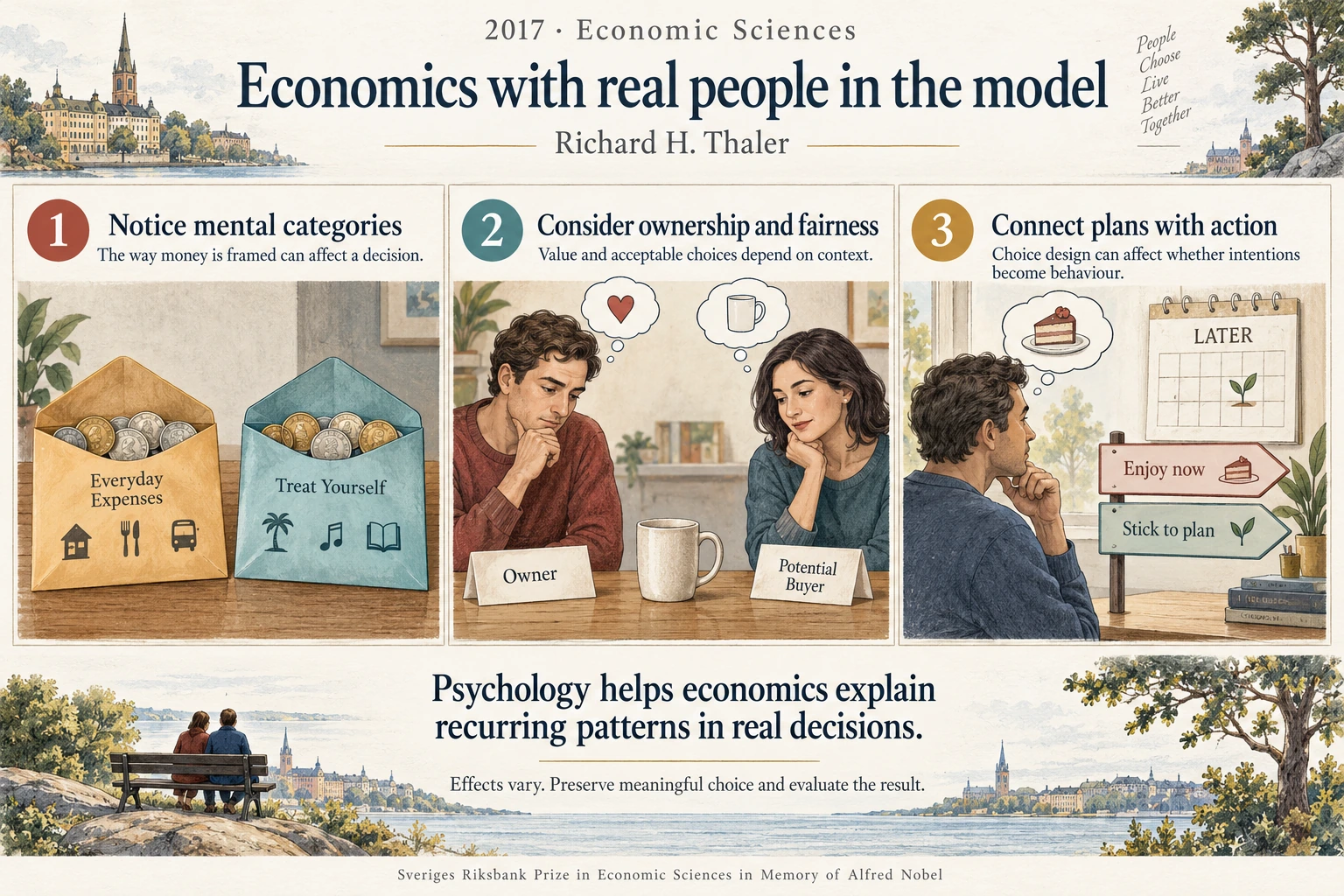
Infographic explaining Economics with real people in the model
Original AI-generated infographic. A conceptual overview; the explanations and sources below provide context.
Read the poster text

Psychology helps economics explain recurring patterns in real decisions.

  1. Notice mental categories

    The way money is framed can affect a decision.

  2. Consider ownership and fairness

    Value and acceptable choices depend on context.

  3. Connect plans with action

    Choice design can affect whether intentions become behaviour.

Effects vary. Preserve meaningful choice and evaluate the result.

01 · The discovery

The idea, in everyday language

A useful economic model simplifies people, but some simplifications miss systematic patterns. Thaler studied decisions that do not fit a picture of perfectly calculating individuals concerned only with their own material gain. Mental accounting describes how people separate money into imagined categories, such as spending and saving, even when the money is interchangeable. Ownership can also change valuation: giving up an object may feel different from acquiring the same object. These patterns help explain why the context of a choice matters.

He also investigated social preferences and the conflict between plans and immediate desires. People may reject a profitable exchange if it seems unfair, or agree with a long-term saving goal but postpone acting when the moment arrives. With collaborators, Thaler developed theories and experiments to bring these behaviours into economic analysis. Work on choice architecture asked whether changing the way options are presented, including the default, could help people follow their intentions while retaining the ability to choose otherwise.

Why it matters

Behavioural economics widened the questions researchers could ask about consumers, organisations and markets. It encouraged empirical tests of how actual choices respond to framing, ownership, perceived fairness and timing. Applications such as voluntary saving programmes show how an insight can inform institutional design, but an application still needs evidence that it helps its intended users.
02 · The people

Who brought the idea to life?

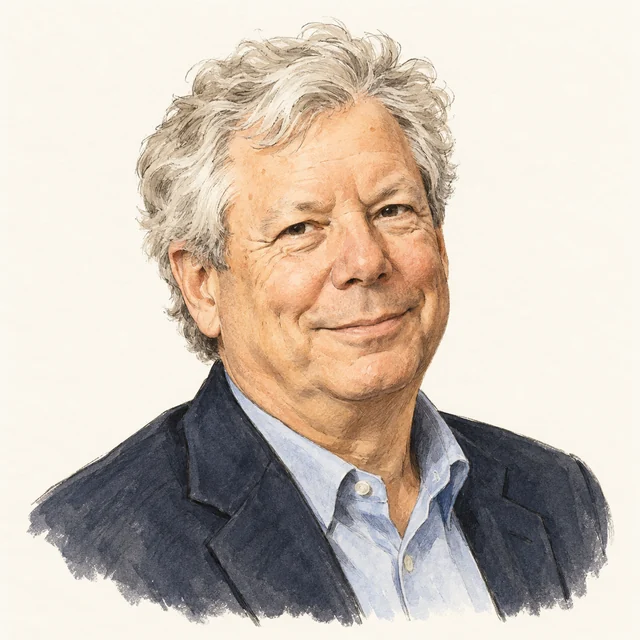
Illustrated portrait of Richard H. Thaler

Richard H. Thaler

Prize share · 1/1

His contributions include mental accounting, research on fairness and ownership, and models of conflict between long-term plans and immediate desires. Together these ideas helped establish behavioural economics and informed work on how the design of choices can influence decisions.

Read the biography ↗

03 · Years in the making

The path here

  1. 1980s

    Thaler develops influential work on mental accounting, fairness and self-control.

  2. 1990

    Experiments with mugs examine how ownership affects valuation.

  3. 2017

    The Economics prize recognises his contributions to behavioural economics.

04 · Read further

From the original sources

Original explanations by Curionode, based on the official records below. Biographical details and affiliations refer to the award year.

  1. Official award announcement nobelprize.org
  2. Nobel Committee’s accessible background nobelprize.org

More in Economic Sciences

Browse this subject ↗