01 · The discovery
The idea, in everyday language
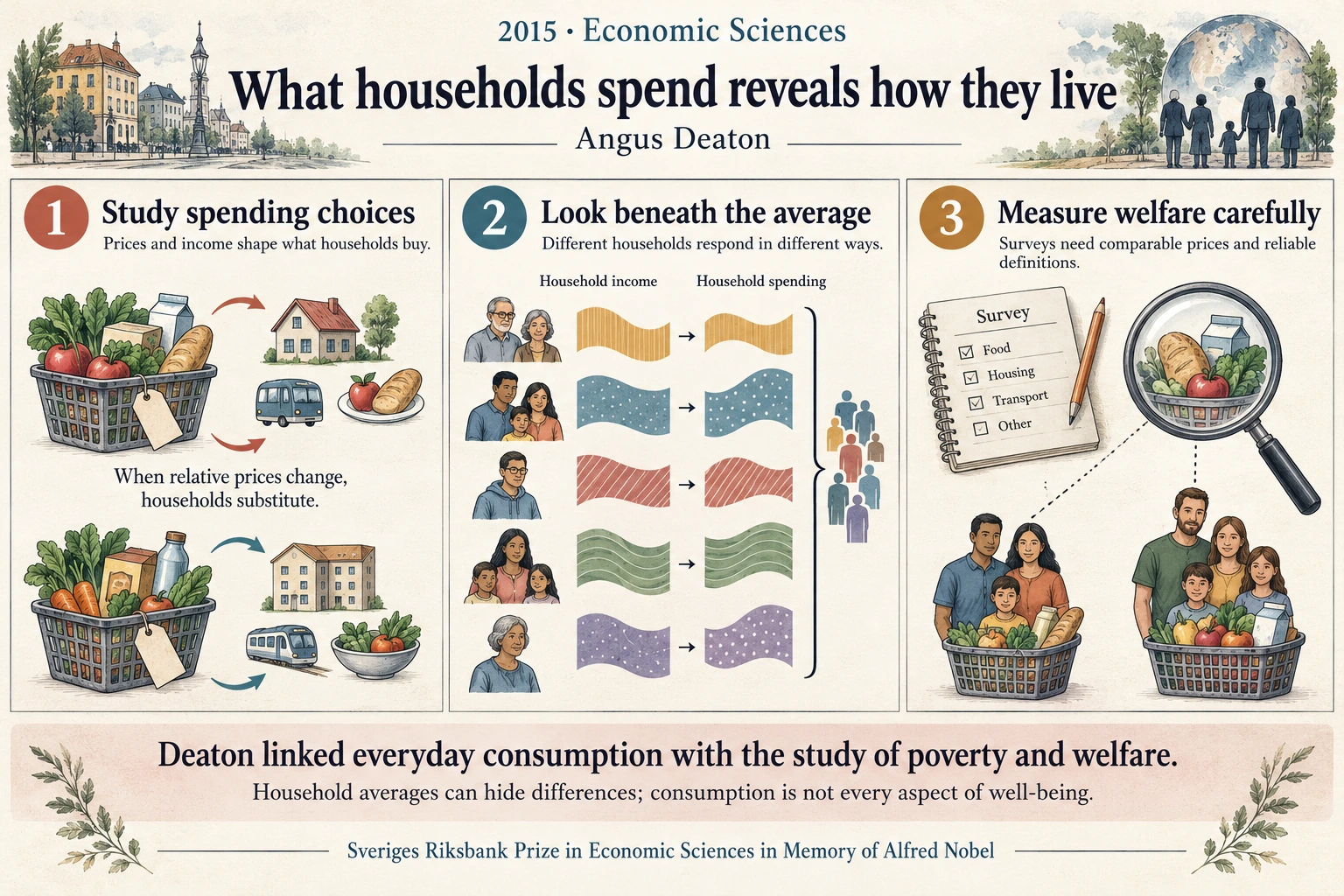
A national average can hide very different lives. To understand living standards, economists need to know what households buy, what those goods cost, and how spending changes when income rises or falls. With John Muellbauer, Deaton developed the Almost Ideal Demand System in 1980. It provides a practical way to estimate how demand for several goods responds to prices and spending, allowing researchers to study the different effects of policies such as consumption taxes.
He also investigated consumption over time. A temporary income shock, uncertainty about the future and difficulty borrowing can affect households differently. Adding up these individual responses need not produce the behaviour of one imaginary average consumer. In development economics, Deaton used detailed household surveys to examine poverty and welfare while showing how easily comparisons can go wrong when prices, product quality, survey methods or household composition differ.
Why it matters
The research helped economists connect theory with data about everyday choices. It improved tools for analysing taxes, income changes and living standards, and made household evidence central to the study of economic development. The contribution is a way of asking and measuring better questions, rather than a single policy that always reduces poverty.