01 · The contribution
The idea, in everyday language
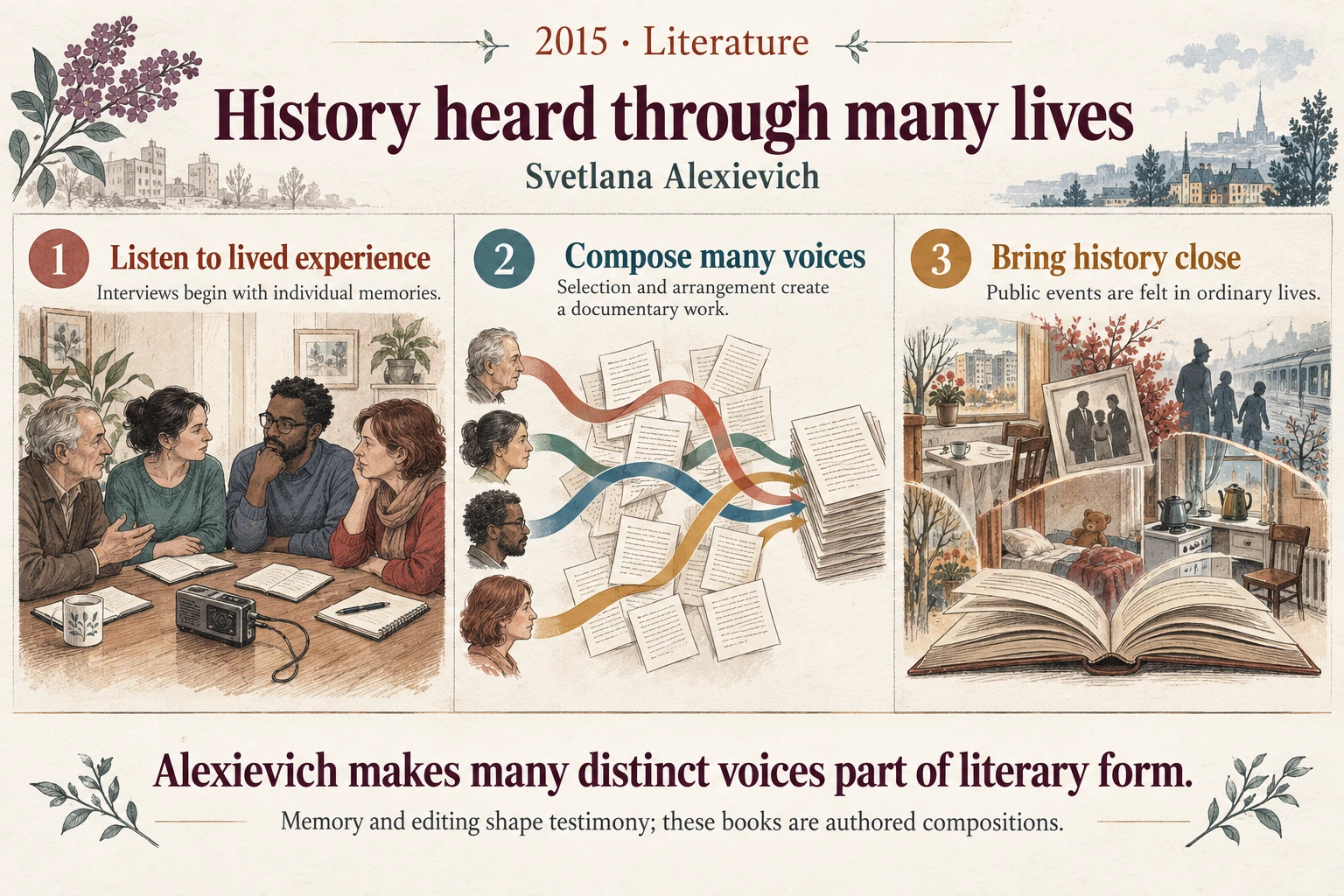
Large events often reach us as a sequence of leaders, battles and dates. Alexievich approached them through people describing what it felt like to live through them. Her books draw on extensive interviews with women who served in the Second World War, people affected by the Soviet war in Afghanistan, survivors of Chernobyl and people negotiating the end of Soviet life. The scale changes from the public event to a voice remembering a room, a relationship or a loss.
Her literary method is often called polyphonic: many voices remain distinct within one work. She selects and arranges testimony so that experiences can echo, interrupt or challenge one another. A confident belief may sit beside disappointment; private grief may complicate a public story of heroism. The result is neither a conventional single-narrator novel nor a raw archive of recordings. The author’s composition shapes how the reader hears these voices together.
Why it matters
The work expands the possibilities of documentary literature and makes lived experience central to the understanding of history. It asks readers to notice people whose inner lives can disappear from official accounts, while showing how collective events continue within families, memories and everyday language.