A life in context
The person behind the prize
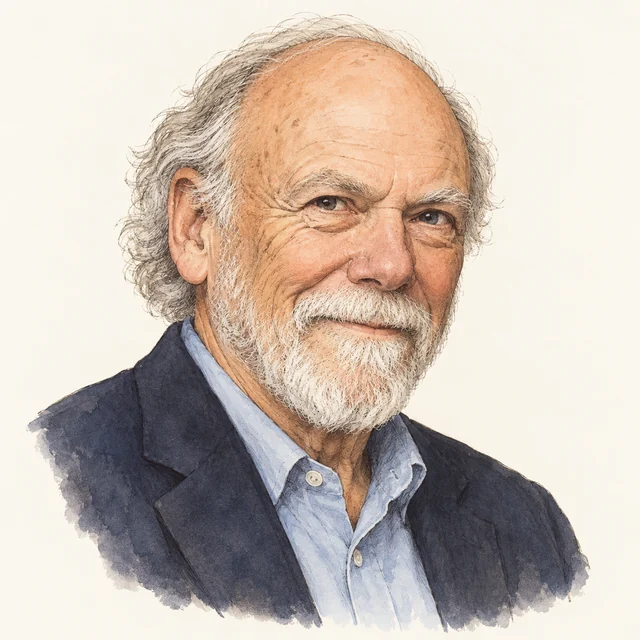
Barish grew up in California and earned his doctorate at Berkeley in 1962. He moved to Caltech the following year. His career in experimental physics prepared him for projects in which scientific ideas depend on complex instruments and coordinated teams. Taking a leading role in LIGO in 1994, he helped turn a demanding detector proposal into a working observatory and an enduring research collaboration.
The contribution
He provided crucial scientific and organisational leadership as LIGO developed towards operation. Building the detectors, organising the collaboration and planning their improvement were essential parts of reaching the sensitivity needed for the first direct observation of gravitational waves.
The idea in plain language
General relativity predicts that changing distributions of mass can send gravitational waves through spacetime. As a wave passes, it changes the relative distances between freely moving objects by an extremely small amount. LIGO uses two long perpendicular arms and laser light to measure this effect. Light travels along both arms and is brought back together. A tiny difference in the paths changes the interference signal, turning a distortion of spacetime into something an instrument can record.
Read the full award story ↗