A life in context
The person behind the prize
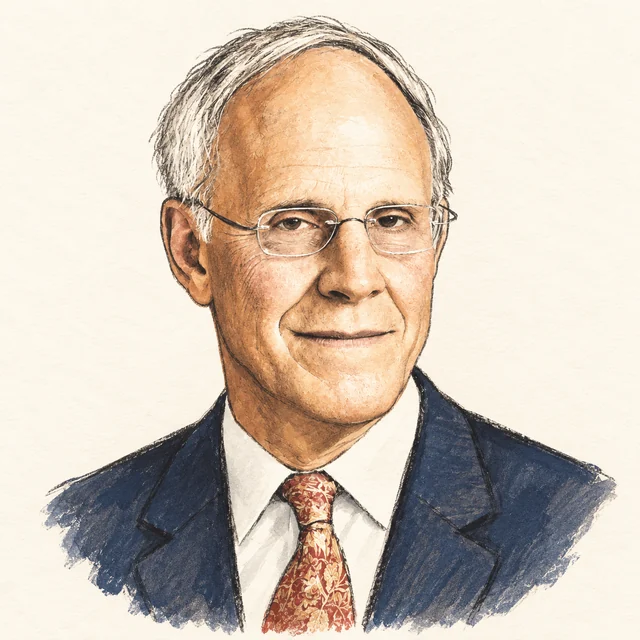
Gross earned his physics doctorate at the University of California, Berkeley in 1966. His research asked how a consistent quantum theory could describe the force binding quarks inside protons and neutrons. Scattering experiments suggested that these constituents could behave almost independently when examined at very short distances, even though individual quarks were never seen emerging on their own.
The contribution
Working with his graduate student Frank Wilczek, Gross calculated in 1973 how the strength of a non-Abelian gauge interaction changes with the scale at which it is probed. Their result, obtained independently by Politzer, showed that the effective coupling can become weaker at higher energies. Asymptotic freedom helped establish quantum chromodynamics as the theory of the strong interaction and made precise short-distance calculations possible.
The idea in plain language
Protons and neutrons contain quarks interacting through gluons. The force is strong enough that isolated quarks are not observed in ordinary experiments. Yet high-energy scattering revealed behaviour resembling collisions with nearly free constituents. A useful theory had to account for both the binding of matter and the simpler behaviour seen when physicists examined very small distances.
Read the full award story ↗