A life in context
The person behind the prize
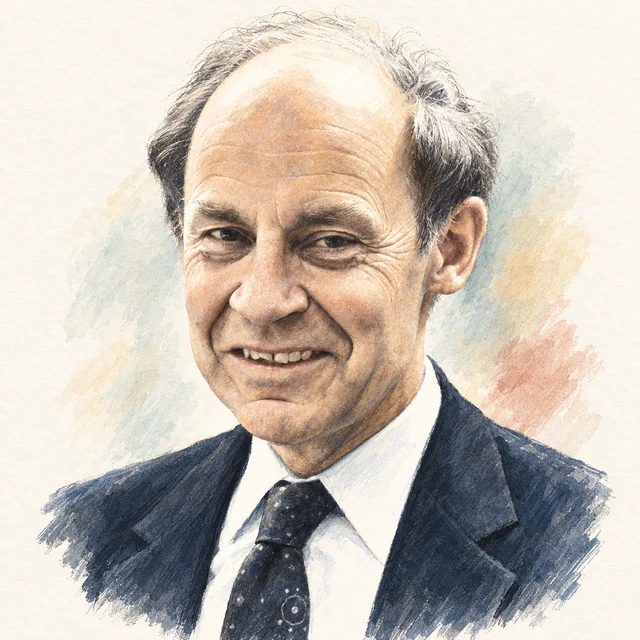
Herschbach grew up in California and studied mathematics and chemistry at Stanford, then physics and chemical physics at Harvard. He completed his doctorate with E. Bright Wilson in 1958. Beginning at Berkeley in 1959, he developed crossed molecular-beam experiments to investigate individual collisions. He moved to Harvard in 1963, where Lee joined him in 1967. Research drew on many colleagues and advances in beam sources and detection. Teaching remained central to his career, alongside experiments that connected molecular motion with chemical change.
The contribution
Herschbach pioneered crossed-beam studies of chemical reactions. Beams with known directions and controlled conditions meet at low density, allowing researchers to measure how reaction products scatter. These distributions reveal aspects of collision dynamics that bulk mixtures obscure. He received one third of the Chemistry Prize, alongside Lee and Polanyi.
The idea in plain language
A bulk reaction combines enormous numbers of collisions, concealing their individual dynamics. Herschbach developed experiments in which directed molecular beams meet at low density. Lee’s versatile instruments extended detection to many reactions, measuring product scattering and energy under controlled conditions. Neutral products can be ionised after collision for mass analysis.
Read the full award story ↗